


Interacting virus abundance and transmission intensity underlie tomato spotted wilt virus incidence: an example weather-based model for cultivated tobacco
- PMID: 23977384
- PMCID: PMC3747132
- DOI: 10.1371/journal.pone.0073321
Interacting virus abundance and transmission intensity underlie tomato spotted wilt virus incidence: an example weather-based model for cultivated tobacco
Erratum in
-
Correction: Interacting Virus Abundance and Transmission Intensity Underlie Tomato Spotted Wilt Virus Incidence: An Example Weather-Based Model for Cultivated Tobacco.PLoS One. 2018 May 14;13(5):e0197565. doi: 10.1371/journal.pone.0197565. eCollection 2018. PLoS One. 2018. PMID: 29758062 Free PMC article.
Abstract
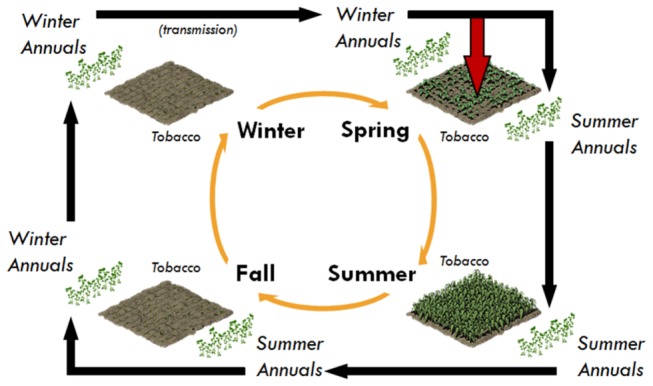
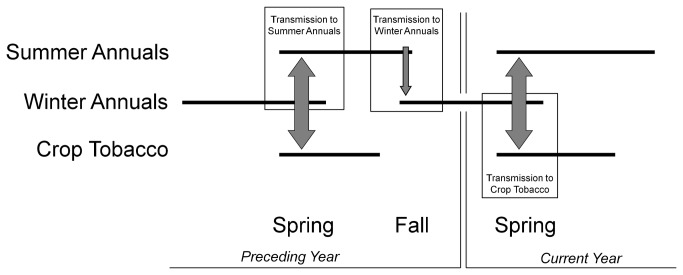
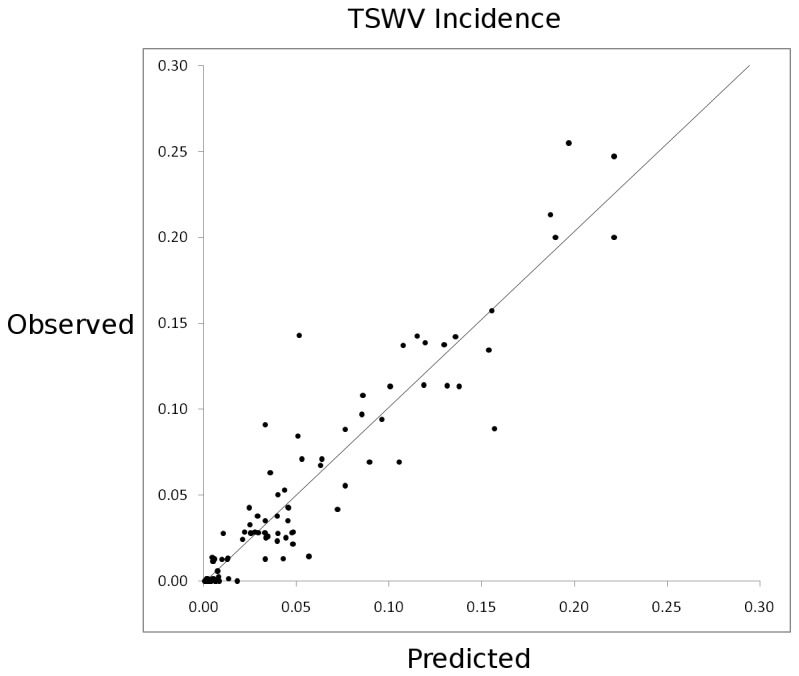
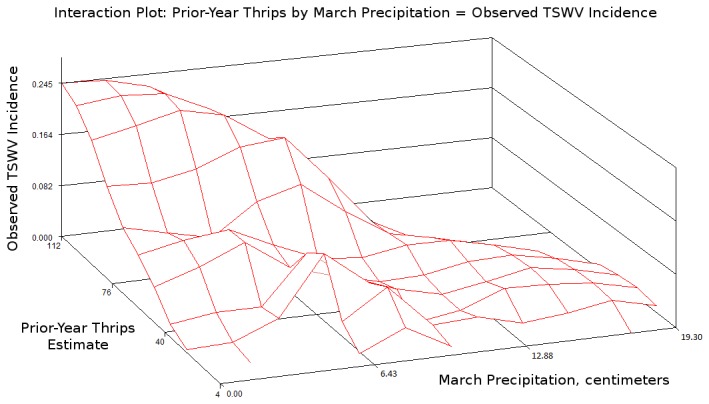
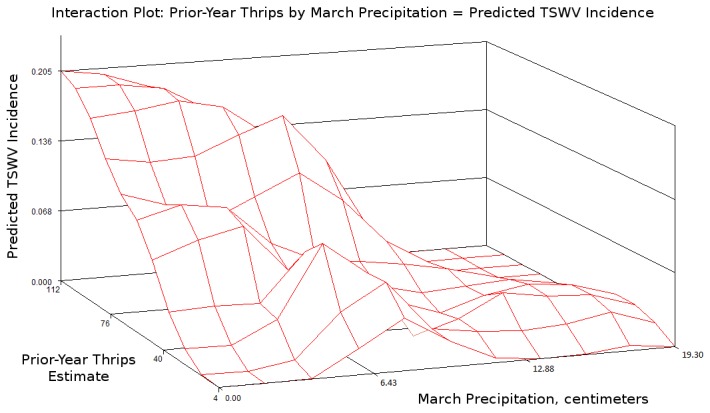
Through a modeling approach, we investigated weather factors that affect the summer incidence of Tomato spotted wilt virus (TSWV), a virus vectored exclusively by thrips, in cultivated tobacco. Aspects of thrips and plant biology that affect disease spread were treated as functions of weather, leading to a model of disease incidence informed by thrips and plant biology, and dependent on weather input variables. We found that disease incidence during the summer was influenced by weather affecting thrips activity during the preceding year, especially during a time when thrips transmit TSWV to and from the plant hosts that constitute the virus' natural reservoir. We identified an interaction between spring precipitation and earlier weather affecting thrips, relating this to virus abundance and transmission intensity as interacting factors affecting disease incidence. Throughout, weather is the basic driver of epidemiology in the system, and our findings allowed us to detect associations between atypically high- or low-incidence years and the local climatic deviations from normal weather patterns, brought about by El Niño Southern Oscillation transitions.
Conflict of interest statement
Figures
References
-
- Nault LR (1997) Arthropod Transmission of Plant Viruses: A New Synthesis. Ann Entomol Soc Am 90: 521-541.
-
- Spence NJ (2001) Virus-vector interactions in plant virus disease transmission and epidemiology. In: Jeger MJ, Spence NJ. Biotic Interactions in Plant-Pathogen Interactions. Wallingford, UK: CAB International; pp. 15–26.
-
- Madden LV, Raccah B, Pirone TP (1990) Modeling plant disease increase as a function of vector numbers: non persistent viruses. Researches Popul Ecol 32: 47–65. doi:10.1007/BF02512589. - DOI
-
- Madden LV, Knoke JK, Louie R (1983) The statistical relationship between aphid trap catches and maize dwarf mosaic virus inoculation pressure. In: Plumb RT, Thresh JM. Oxford: Plant Virus Epidemiology: Blackwell. pp. 159–168
-
- Morsello SC, Kennedy GG (2009) Spring temperature and precipitation affect tobacco thrips, Frankliniella fusca (Thysanoptera: Thripidae) population growth and Tomato spotted wilt virus within patches of the winter weed Stellaria media . Entomol Exp Applicata 130: 138-148. doi:10.1111/j.1570-7458.2008.00801.x. - DOI
Publication types
MeSH terms
LinkOut - more resources
Full Text Sources
Other Literature Sources
