Clinical Trial
. 2013 Sep;28(3):729-43.
doi: 10.1037/a0033236. Epub 2013 Aug 26.

Age-related decline of precision and binding in visual working memory

Affiliations
Clinical Trial

Age-related decline of precision and binding in visual working memory

Muy-Cheng Peich et al. Psychol Aging. 2013 Sep.

Abstract

Working memory declines with normal aging, but the nature of this impairment is debated. Studies based on detecting changes to arrays of visual objects have identified two possible components to age-related decline: a reduction in the number of items that can be stored, or a deficit in maintaining the associations (bindings) between individual object features. However, some investigations have reported intact binding with aging, and specific deficits arising only in Alzheimer's disease. Here, using a recently developed continuous measure of recall fidelity, we tested the precision with which adults of different ages could reproduce from memory the orientation and color of a probed array item. The results reveal a further component of cognitive decline: an age-related decrease in the resolution with which visual information can be maintained in working memory. This increase in recall variability with age was strongest under conditions of greater memory load. Moreover, analysis of the distribution of errors revealed that older participants were more likely to incorrectly report one of the unprobed items in memory, consistent with an age-related increase in misbinding. These results indicate a systematic decline with age in working memory resources that can be recruited to store visual information. The paradigm presented here provides a sensitive index of both memory resolution and feature binding, with the potential for assessing their modulation by interventions. The findings have implications for understanding the mechanisms underpinning working memory deficits in both health and disease.


Figures
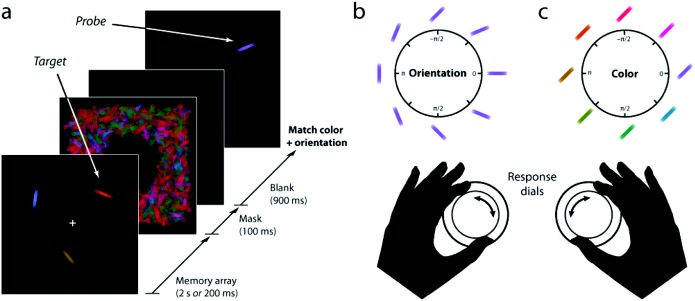
Figure 1
Figure 1
The dual-feature working memory task. (a) Participants were presented with an array of colored, oriented bars, followed by a pattern mask. After a blank retention interval, a probe appeared and subjects used two response dials to adjust its color and orientation to match the item at the corresponding location in the memory array (the target). (b & c) Turning each dial cycled the probe through a circular parameter space of possible colors or orientations. Some examples of orientations (b) and colors (c) are shown corresponding to different points in each response space.
Figure 2
Figure 2
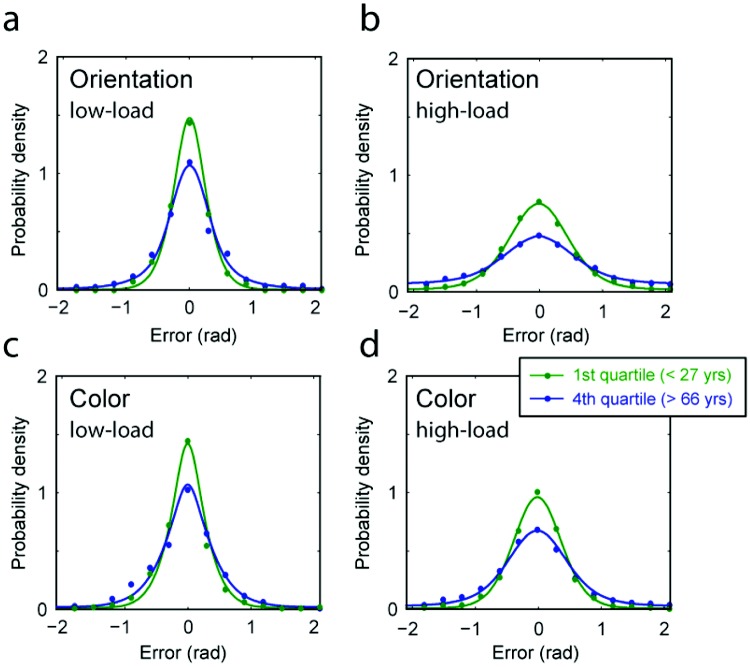
Distribution of errors for young and old participants. (a–b) Frequency of response as a function of the deviation between reported and target orientations, for participants in the youngest (green symbols) and oldest (blue symbols) age quartiles. Results are shown for [low-load, one memory item, (a); high-load, three memory items, (b)] conditions. Colored lines indicate the response probabilities predicted by a fitted probabilistic model of response generation. Note the increase in response variability (width of the distribution) for older participants. (c–d) Corresponding results for recall of color.
Figure 3
Figure 3
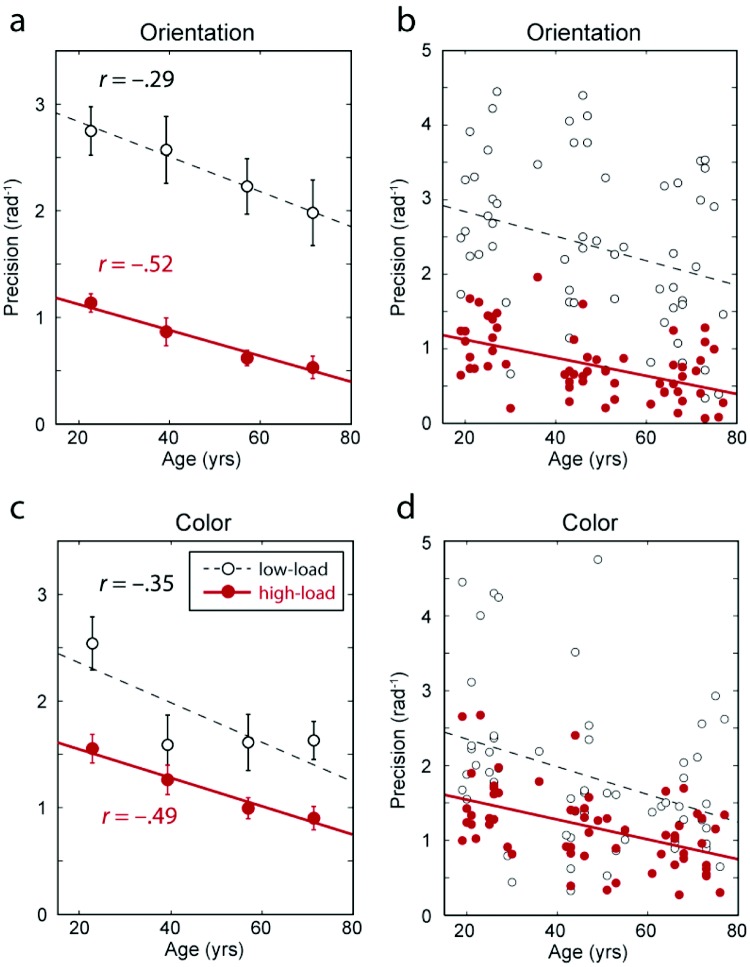
Age effects on recall precision. (a–b) Precision of orientation recall as a function of age, for low-load (black) and high-load (red) conditions. Symbols and errorbars in (a) indicate mean ± 1 SE for each age quartile. Individual subject results are plotted in (b). Precision is here defined as the reciprocal of the standard deviation of error in participants’ responses; zero indicates chance performance. Fitted regression lines are shown for the relationship between precision and age. (c–d) Corresponding results for color recall.
Figure 4
Figure 4
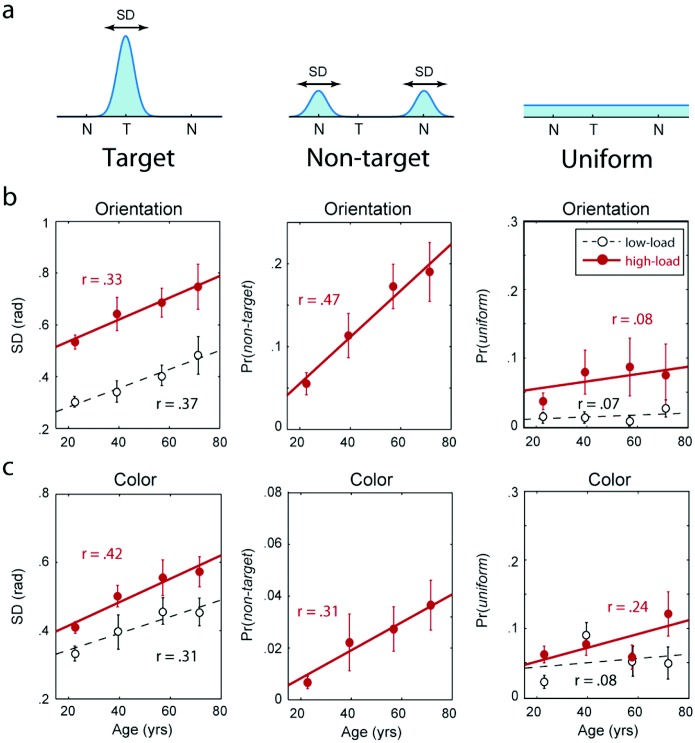
Components of error in the working memory task. (a) The distribution of responses in each feature dimension was decomposed into a mixture of three separate components: responses distributed with Gaussian variability around the correct target (T) feature value (left), responses distributed around the feature values of other, nontarget (NT) items in the memory array (center), and responses uniformly distributed throughout the response space (right). (b–c) Maximum likelihood estimates of parameters of the mixture model illustrated above, for orientation responses (b) and color responses (c). Fitted regression lines illustrate relationships between each model parameter and age. Gaussian variability in target responses (left) increases with age, as does the frequency of nontarget responses in multiitem arrays (center). The frequency of random responses (right) is not correlated with age. Error bars indicate ± 1 SE.
Figure 5
Figure 5
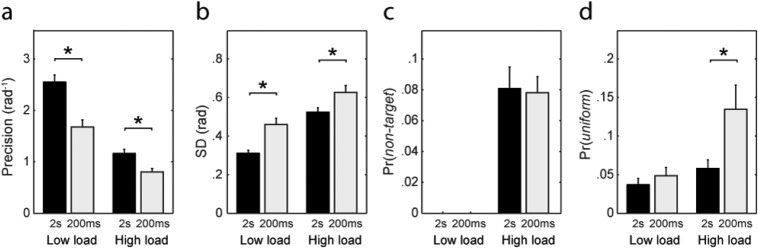
Effects of exposure duration on recall precision and error components. (a) Precision of recall for static (2 s; black bars) and briefly flashed (200 ms; light bars) memory arrays, in low- and high-load conditions. Asterisks indicate significant (p < .05) effects of exposure duration. Results shown are means over feature dimensions. (b–d) Effects of exposure duration on components of error as specified by the mixture model: (b) Gaussian variability (SD), (c) frequency of misbinding (nontarget) errors, (d) uniformly distributed errors.
Figure 6
Figure 6
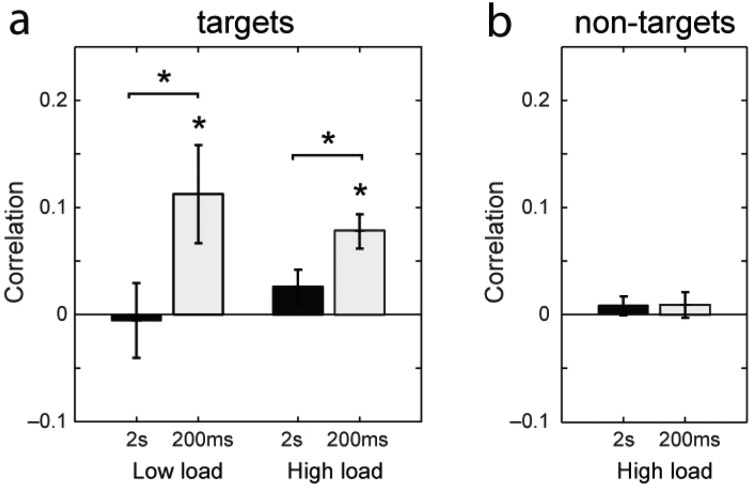
Correlation of errors in orientation and color judgments. (a) Correlation between magnitude of error in color and orientation judgments for static (2 s; black bars) and briefly flashed (200 ms; light bars) memory arrays, in low- and high-load conditions. Asterisks indicate significant (p < .05) correlations and effects of exposure duration. (b) Correlation between magnitude of deviation of responses from nontarget colors and orientations in the high-load condition, for static and briefly flashed memory arrays. No significant correlations were observed, indicating that misreporting of nontarget features occurred independently in each feature dimension.

References

    1. Alvarez G. A., & Cavanagh P. (2004). The capacity of visual short-term memory is set both by visual information load and by number of objects. Psychological Science, 15, 106–111 doi: 10.1111/j.0963-7214.2004.01502006.x - DOI - PubMed
    1. Anderson D. E., Vogel E. K., & Awh E. (2011). Precision in visual working memory reaches a stable plateau when individual item limits are exceeded. The Journal of Neuroscience, 31, 1128–1138 doi: 10.1523/JNEUROSCI.4125-10.2011 - DOI - PMC - PubMed
    1. Bays P. M., Catalao R. F. G., & Husain M. (2009). The precision of visual working memory is set by allocation of a shared resource. Journal of Vision, 9, 7 doi: 10.1167/9.10.7 - DOI - PMC - PubMed
    1. Bays P. M., Gorgoraptis N., Wee N., Marshall L., & Husain M. (2011). Temporal dynamics of encoding, storage, and reallocation of visual working memory. Journal of Vision, 11 doi: 10.1167/11.10.6 - DOI - PMC - PubMed
    1. Bays P. M., & Husain M. (2008). Dynamic shifts of limited working memory resources in human vision. Science, 321, 851–854 doi: 10.1126/science.1158023 - DOI - PMC - PubMed

Publication types