


Association between autozygosity and major depression: stratification due to religious assortment
- PMID: 23978897
- PMCID: PMC3827717
- DOI: 10.1007/s10519-013-9610-1
Association between autozygosity and major depression: stratification due to religious assortment
Abstract
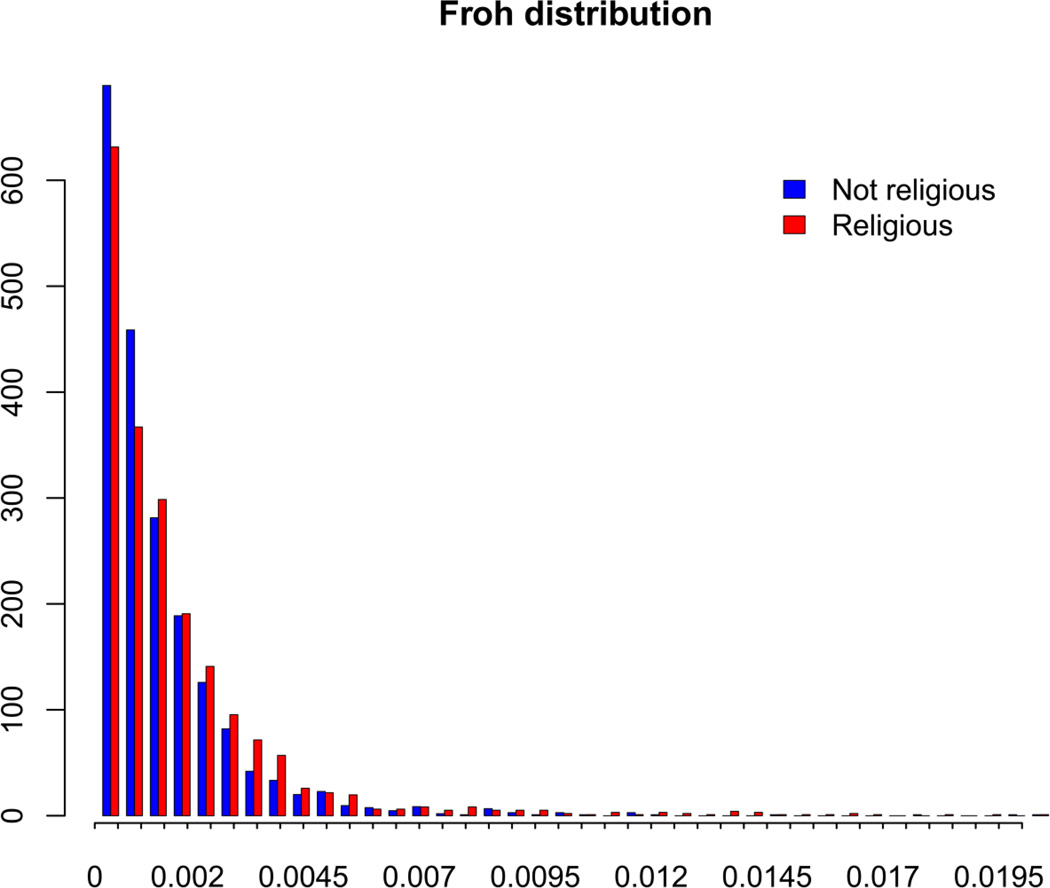
The effects of inbreeding on the health of offspring can be studied by measuring genome-wide autozygosity as the proportion of the genome in runs of homozygosity (F roh) and relate F roh to outcomes such as psychiatric phenotypes. To successfully conduct these studies, the main patterns of variation for genome-wide autozygosity between and within populations should be well understood and accounted for. Within population variation was investigated in the Dutch population by comparing autozygosity between religious and non-religious groups. The Netherlands have a history of societal segregation and assortment based on religious affiliation, which may have increased parental relatedness within religious groups. Religion has been associated with several psychiatric phenotypes, such as major depressive disorder (MDD). We investigated whether there is an association between autozygosity and MDD, and the extent to which this association can be explained by religious affiliation. All F roh analyses included adjustment for ancestry-informative principal components (PCs) and geographic factors. Religious affiliation was significantly associated with autozygosity, showing that F roh has the ability to capture within population differences that are not captured by ancestry-informative PCs or geographic factors. The non-religious group had significantly lower F roh values and significantly more MDD cases, leading to a nominally significant negative association between autozygosity and depression. After accounting for religious affiliation, MDD was not associated with F roh, indicating that the relation between MDD and inbreeding was due to stratification. This study shows how past religious assortment and recent secularization can have genetic consequences in a relatively small country. This warrants accounting for the historical social context and its effects on genetic variation in association studies on psychiatric and other related traits.
Figures
References
-
- Abdellaoui A, Hottenga JJ, de Knijff P, Nivard MG, Xiao X, Scheet P, Brooks A, Ehli EA, Hu Y, Davies GE, Hudziak JJ, Sullivan PF, van Beijsterveldt CEM, Willemsen G, de Geus EJ, Penninx BWJH, Boomsma DI. Population Structure, Migration, and Diversifying Selection in the Netherlands. Eur J Hum Genet Advance online publication. 2013 - PMC - PubMed
-
- Alford JR, Hatemi PK, Hibbing JR, Martin NG, Eaves LJ. The politics of mate choice. J Pol. 2011;73(2):362–379.
-
- Beekink E, Liefbroer AC, van Poppel F. Changes in choice of spouse as an indicator of a society in a state of transition: Woerden, 1830–1930. Historical Social Research/Historische Sozialforschung. 1998:231–253.
-
- Boomsma DI, de Geus EJC, van Baal GCM, Koopmans JR. A religious upbringing reduces the influence of genetic factors on disinhibition: Evidence for interaction between genotype and environment on personality. Twin Res Hum Genet. 1999;2(02):115–125. - PubMed
Publication types
MeSH terms
Grants and funding
LinkOut - more resources
Full Text Sources
Other Literature Sources
Miscellaneous
