


Interventions to modify health care provider adherence to asthma guidelines: a systematic review
- PMID: 23979092
- PMCID: PMC4079294
- DOI: 10.1542/peds.2013-0779
Interventions to modify health care provider adherence to asthma guidelines: a systematic review
Abstract
Background and objective: Health care provider adherence to asthma guidelines is poor. The objective of this study was to assess the effect of interventions to improve health care providers' adherence to asthma guidelines on health care process and clinical outcomes.
Methods: Data sources included Medline, Embase, Cochrane CENTRAL Register of Controlled Trials, Cumulative Index to Nursing and Allied Health Literature, Educational Resources Information Center, PsycINFO, and Research and Development Resource Base in Continuing Medical Education up to July 2012. Paired investigators independently assessed study eligibility. Investigators abstracted data sequentially and independently graded the evidence.
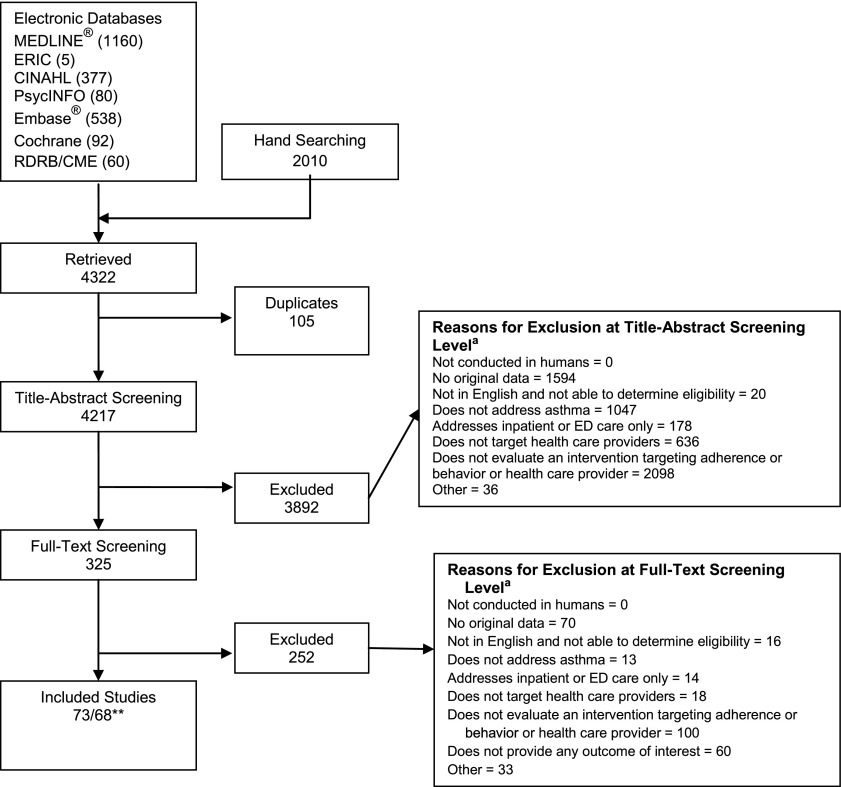
Results: Sixty-eight eligible studies were classified by intervention: decision support, organizational change, feedback and audit, clinical pharmacy support, education only, quality improvement/pay-for-performance, multicomponent, and information only. Half were randomized trials (n = 35). There was moderate evidence for increased prescriptions of controller medications for decision support, feedback and audit, and clinical pharmacy support and low-grade evidence for organizational change and multicomponent interventions. Moderate evidence supports the use of decision support and clinical pharmacy interventions to increase provision of patient self-education/asthma action plans. Moderate evidence supports use of decision support tools to reduce emergency department visits, and low-grade evidence suggests there is no benefit for this outcome with organizational change, education only, and quality improvement/pay-for-performance.
Conclusions: Decision support tools, feedback and audit, and clinical pharmacy support were most likely to improve provider adherence to asthma guidelines, as measured through health care process outcomes. There is a need to evaluate health care provider-targeted interventions with standardized outcomes.
Keywords: asthma; guidelines; systematic review.
Figures
References
-
- Centers for Disease Control and Prevention . Vital signs: asthma prevalence, disease characteristics, and self-management education: United States, 2001—2009. MMWR Morb Mortal Wkly Rep. 2011;60(17):547–552 - PubMed
-
- Akinbami L, Centers for Disease Control and Prevention National Center for Health Statistics . The state of childhood asthma, United States, 1980–2005. Adv Data. 2006;(381):1–24 - PubMed
-
- National Asthma Education and Prevention Program . Expert Panel Report 3 (EPR-3): Guidelines for the diagnosis and management of asthma—summary report 2007. J Allergy Clin Immunol. 2007;120(suppl 5):S94–S138 - PubMed
-
- Evans R, III, Gergen PJ, Mitchell H, et al. . A randomized clinical trial to reduce asthma morbidity among inner-city children: results of the National Cooperative Inner-City Asthma Study. J Pediatr. 1999;135(3):332–338 - PubMed
-
- Kattan M, Crain EF, Steinbach S, et al. . A randomized clinical trial of clinician feedback to improve quality of care for inner-city children with asthma. Pediatrics. 2006;117(6). Available at: www.pediatrics.org/cgi/content/full/117/6/e1095 - PubMed
Publication types
MeSH terms
Substances
Grants and funding
LinkOut - more resources
Full Text Sources
Other Literature Sources
Medical
Molecular Biology Databases
