


Comment
doi: 10.1128/MCB.01033-13.
Epub 2013 Aug 26.
Histone methylation keeps the brakes on autophagy
Affiliations
- PMID: 23979595
- PMCID: PMC3811685
- DOI: 10.1128/MCB.01033-13
Item in Clipboard
Comment
Histone methylation keeps the brakes on autophagy
Mol Cell Biol.
2013 Oct.
No abstract available
Figures
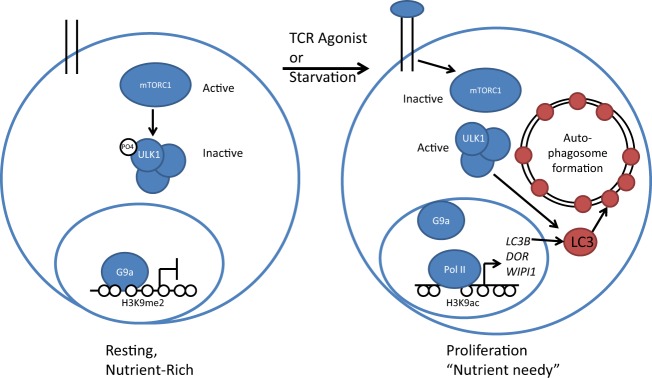
Repression of autophagosome formation by G9a. Under resting, nutrient-rich conditions (left), G9a represses autophagosome genes LC3B, DOR, and WIPI1 by modifying the chromatin around gene promoters with the repressive H3K9me2 mark. In the cytoplasm, mTORC1 kinase phosphorylates and inactivates complexes containing ULK1 that drive autophagosome formation. Upon starvation or during T cell proliferation (right), G9a and H3K9me2 are removed from relevant promoters, leading to expression of LCB3, DOR, and WIPI1, which are essential components of autophagosomes. This transcription-dependent process synergizes with inactivation of mTORC1, which releases restrictions on ULK1 complexes and guides autophagic flux to its completion.
Comment on
-
Epigenetic regulation of autophagy by the methyltransferase G9a.Mol Cell Biol. 2013 Oct;33(20):3983-93. doi: 10.1128/MCB.00813-13. Epub 2013 Aug 5. Mol Cell Biol. 2013. PMID: 23918802 Free PMC article.
References
-
- Kondo Y, Shen L, Suzuki S, Kurokawa T, Masuko K, Tanaka Y, Kato H, Mizuno Y, Yokoe M, Sugauchi F, Hirashima N, Orito E, Osada H, Ueda R, Guo Y, Chen X, Issa J-PJ, Sekido Y. 2007. Alterations of DNA methylation and histone modifications contribute to gene silencing in hepatocellular carcinomas. Hepatol. Res. 37:974–983 - PubMed
Publication types
MeSH terms
Substances
Grants and funding
LinkOut - more resources
Full Text Sources
Other Literature Sources
