Review
. 2013 Dec;15(4):720-36.
doi: 10.1007/s12017-013-8257-7. Epub 2013 Aug 25.

SUMO and Alzheimer's disease

Affiliations
Review

SUMO and Alzheimer's disease

Linda Lee et al. Neuromolecular Med. 2013 Dec.

Abstract

Alzheimer's disease (AD) is a neurodegenerative disorder characterized by progressive cognitive decline and is the most common cause of dementia in the elderly. Histopathologically, AD features insoluble aggregates of two proteins in the brain, amyloid-β (Aβ) and the microtubule-associated protein tau, both of which have been linked to the small ubiquitin-like modifier (SUMO). A large body of research has elucidated many of the molecular and cellular pathways that underlie AD, including those involving the abnormal Aβ and tau aggregates. However, a full understanding of the etiology and pathogenesis of the disease has remained elusive. Consequently, there are currently no effective therapeutic options that can modify the disease progression and slow or stop the decline of cognitive functioning. As part of the effort to address this lacking, there needs a better understanding of the signaling pathways that become impaired under AD pathology, including the regulatory mechanisms that normally control those networks. One such mechanism involves SUMOylation, which is a post-translational modification (PTM) that is involved in regulating many aspects of cell biology and has also been found to have several critical neuron-specific roles. Early studies have indicated that the SUMO system is likely altered with AD-type pathology, which may impact Aβ levels and tau aggregation. Although still a relatively unexplored topic, SUMOylation will likely emerge as a significant factor in AD pathogenesis in ways which may be somewhat analogous to other regulatory PTMs such as phosphorylation. Thus, in addition to the upstream effects on tau and Aβ processing, there may also be downstream effects mediated by Aβ aggregates or other AD-related factors on SUMO-regulated signaling pathways. Multiple proteins that have functions relevant to AD pathology have been identified as SUMO substrates, including those involved in synaptic physiology, mitochondrial dynamics, and inflammatory signaling. Ongoing studies will determine how these SUMO-regulated functions in neurons and glial cells may be impacted by Aβ and AD pathology. Here, we present a review of the current literature on the involvement of SUMO in AD, as well as an overview of the SUMOylated proteins and pathways that are potentially dysregulated with AD pathogenesis.


Figures
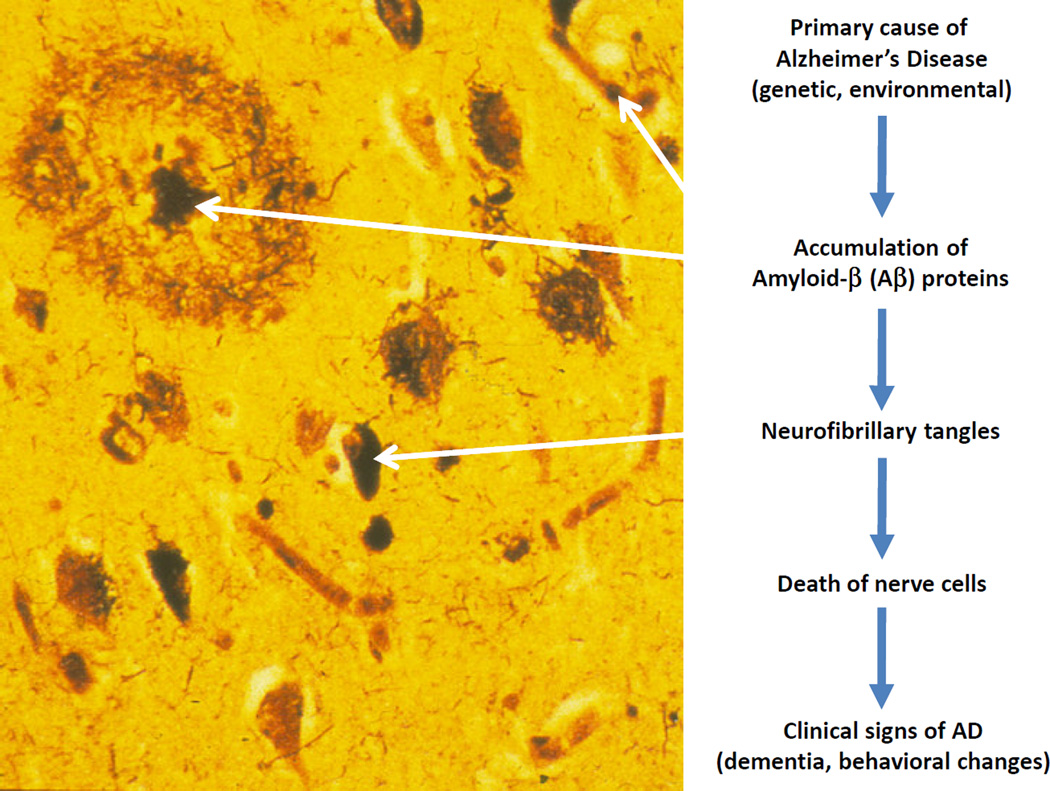
Figure 1
Figure 1. Alzheimer’s disease pathology
Initiating factors, likely comprising multiple genetic and environmental components, result in a build-up of amyloid-β aggregates. These Aβ aggregates include soluble neurotoxic oligomers and insoluble amyloid plaques. With neuronal damage, microtubule associated protein tau becomes hyperphosphorylated and aggregates into intracellular structures termed neurofibrillary tangles. The subsequent neurodegenerative cell death features prominently in AD and accounts for the clinical symptoms of cognitive decline, dementia and behavioral changes.
Figure 2
Figure 2. Amyloid-β and tau processing
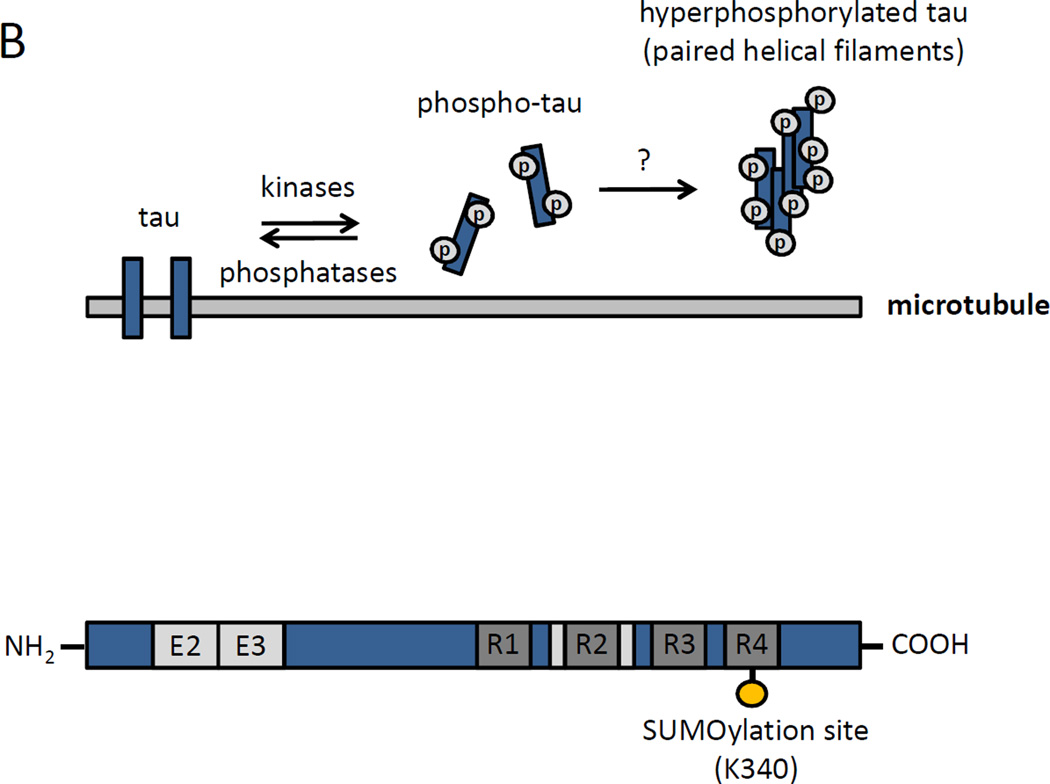
(A) Amyloid precursor protein (APP) undergoes sequential proteolytic cleavages to produce Aβ peptides. The β-site APP cleaving enzyme (BACE) releases a large soluble N-terminal domain (sAPPβ). Intramembrane cleavage by the γ-secretase complex releases Aβ peptides of varying lengths (usually 39–43 amino acids) and a C-terminal APP intracellular domain (AICD) involved in transcriptional regulation. Aβ peptides can aggregate into soluble oligomers of varying sizes (e.g. dimer, trimer, dodecamer, etc.). Aggregation can further proceed into fibrils that can deposit as amyloid plaques. There are two postulated SUMOylation sites in APP (K595, K587) located near the BACE cleavage site. (B) Tau proteins dynamically bind to and stabilize microtubules, a function that is regulated by phosphorylation. Pathogenic dysregulation of this process can lead to tau hyperphosphorylation and aggregation into paired helical filaments. These structures can further aggregate to form the neurofibrillary tangles that characterize many neurodegenerative diseases including AD. The major tau isoforms include either three or four microtubule binding repeats (R1–R4) and also the E2 and/or E3 exons. There is a potential SUMOylation site in the R4 domain (K340).
Figure 2
Figure 2. Amyloid-β and tau processing
(A) Amyloid precursor protein (APP) undergoes sequential proteolytic cleavages to produce Aβ peptides. The β-site APP cleaving enzyme (BACE) releases a large soluble N-terminal domain (sAPPβ). Intramembrane cleavage by the γ-secretase complex releases Aβ peptides of varying lengths (usually 39–43 amino acids) and a C-terminal APP intracellular domain (AICD) involved in transcriptional regulation. Aβ peptides can aggregate into soluble oligomers of varying sizes (e.g. dimer, trimer, dodecamer, etc.). Aggregation can further proceed into fibrils that can deposit as amyloid plaques. There are two postulated SUMOylation sites in APP (K595, K587) located near the BACE cleavage site. (B) Tau proteins dynamically bind to and stabilize microtubules, a function that is regulated by phosphorylation. Pathogenic dysregulation of this process can lead to tau hyperphosphorylation and aggregation into paired helical filaments. These structures can further aggregate to form the neurofibrillary tangles that characterize many neurodegenerative diseases including AD. The major tau isoforms include either three or four microtubule binding repeats (R1–R4) and also the E2 and/or E3 exons. There is a potential SUMOylation site in the R4 domain (K340).
Figure 3
Figure 3. Overview schematic of SUMO involvement in Alzheimer’s disease
(Left side) SUMO can regulate upstream APP processing and tau dynamics. A – Direct SUMOylation of APP can decrease levels of Aβ aggregates. B – SUMO may exert conjugation-independent effects on Aβ and BACE levels, although the directions of the effects are currently unclear. C – Tau SUMOylation, preferentially of free soluble tau, has cross-talk interactions with phosphorylation and ubiquitination. (Right side) Aβ aggregates and AD pathology have observed and hypothesized downstream effects on multiple pathways. D – Aβ exposure can decrease SUMOylation in astrocytes. There may also be effects on SUMO-regulated inflammatory signaling by astrocytes and microglia. E – Genetic and biochemical studies indicate potential changes in the SUMO component enzymes with AD. There may also be alterations with aging and Aβ exposure. F – Aβ may alter overall SUMOylation capacity/regulation to generally affect SUMO conjugate levels. Some high molecular weight conjugates have been observed to be decreased in an AD mouse model. G – Aβ exposure may alter post-synaptic functioning by perturbing the conjugation of known SUMOylated proteins with roles in spine morphology/development and synaptic signaling. H – Aβ could also impact the SUMOylation of presynaptic proteins, with potential effects on calcium influx and neurotransmitter release. I – Downstream signaling proteins involved in synaptic plasticity may have altered SUMOylation, along with the known Aβ-induced impairments in these signaling pathways. J – Mitochondrial dynamics (e.g. fission) may be altered from dysregulated SUMOylation of mitochondrial proteins known to be SUMOylated, such as DRP1.

References

    1. Abramov E, Dolev I, Fogel H, Ciccotosto GD, Ruff E, Slutsky I. Amyloid-beta as a positive endogenous regulator of release probability at hippocampal synapses. Nat Neurosci. 2009;12(12):1567–1576. - PubMed
    1. Akama KT, Van Eldik LJ. Beta-amyloid stimulation of inducible nitric-oxide synthase in astrocytes is interleukin-1beta- and tumor necrosis factor-alpha (TNFalpha)-dependent, and involves a TNFalpha receptor-associated factor- and NFkappaB-inducing kinase-dependent signaling mechanism. J Biol Chem. 2000;275(11):7918–7924. - PubMed
    1. Akar CA, Feinstein DL. Modulation of inducible nitric oxide synthase expression by sumoylation. J Neuroinflammation. 2009;6:12. - PMC - PubMed
    1. Alzheimer's A. 2012 Alzheimer's disease facts and figures. Alzheimers Dement. 2012;8(2):131–168. - PubMed
    1. Arendt T. Synaptic degeneration in Alzheimer's disease. Acta Neuropathol. 2009;118(1):167–179. [Review]. - PubMed

Publication types

MeSH terms

Substances