


Processing speed, attention, and working memory after treatment for medulloblastoma: an international, prospective, and longitudinal study
- PMID: 23980078
- PMCID: PMC3782147
- DOI: 10.1200/JCO.2012.47.4775
Processing speed, attention, and working memory after treatment for medulloblastoma: an international, prospective, and longitudinal study
Abstract
Purpose: The current study prospectively examined processing speed (PS), broad attention (BA), and working memory (WM) ability of patients diagnosed with medulloblastoma over a 5-year period.
Patients and methods: The study included 126 patients, ages 3 to 21 years at diagnosis, enrolled onto a collaborative protocol for medulloblastoma. Patients were treated with postsurgical risk-adapted craniospinal irradiation (n = 36 high risk [HR]; n = 90 average risk) followed by four cycles of high-dose chemotherapy with stem-cell support. Patients completed 509 neuropsychological evaluations using the Woodcock-Johnson Tests of Cognitive Abilities Third Edition (median of three observations per patient).
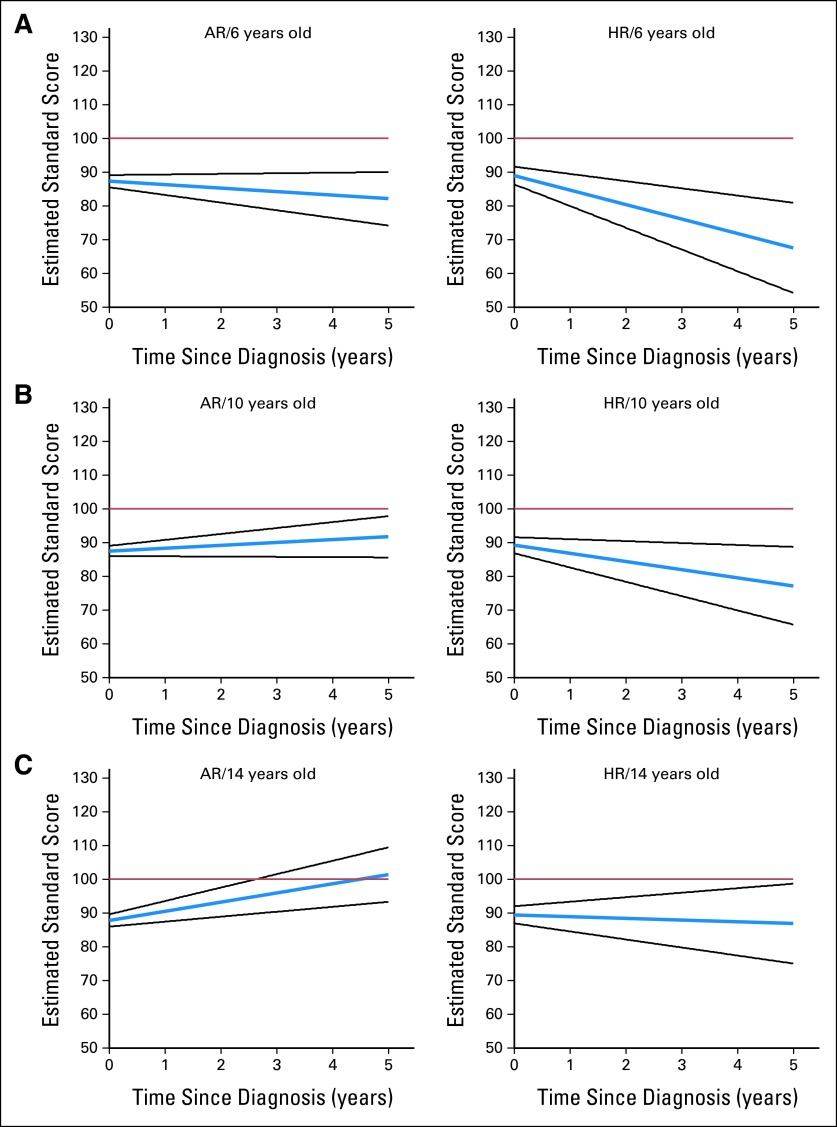
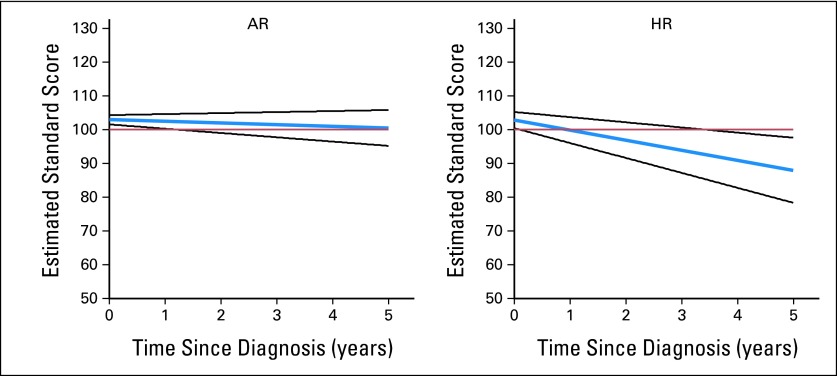
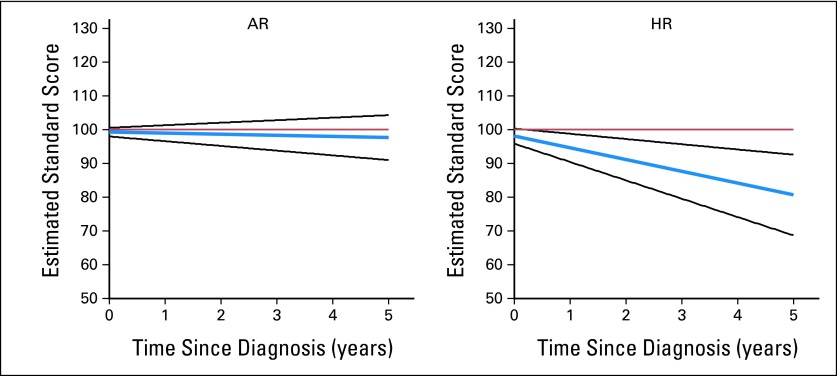
Results: Linear mixed effects models revealed that younger age at diagnosis, HR classification, and higher baseline scores were significantly associated with poorer outcomes in PS. Patients treated as HR and those with higher baseline scores are estimated to have less favorable outcomes in WM and BA over time. Parent education and marital status were significantly associated with BA and WM baseline scores but not change over time.
Conclusion: Of the three key domains, PS was estimated to have the lowest scores at 5 years after diagnosis. Identifying cognitive domains most vulnerable to decline should guide researchers who are aiming to develop efficacious cognitive intervention and rehabilitation programs, thereby improving the quality of survivorship for the pediatric medulloblastoma population.
Conflict of interest statement
Authors' disclosures of potential conflicts of interest and author contributions are found at the end of this article.
Figures
Comment in
-
Helping survivors of medulloblastoma learn from what we learn.J Clin Oncol. 2013 Oct 1;31(28):3480-2. doi: 10.1200/JCO.2013.51.0578. Epub 2013 Aug 26. J Clin Oncol. 2013. PMID: 23980080 No abstract available.
References
-
- Palmer SL, Goloubeva O, Reddick WE, et al. Patterns of intellectual development among survivors of pediatric medulloblastoma: A longitudinal analysis. J Clin Oncol. 2001;19:2302–2308. - PubMed
-
- Mulhern RK, Palmer SL, Merchant TE, et al. Neurocognitive consequences of risk-adapted therapy for childhood medulloblastoma. J Clin Oncol. 2005;23:5511–5519. - PubMed
-
- Palmer SL, Gajjar A, Reddick WE, et al. Predicting intellectual outcome among children treated with 35-40 Gy craniospinal irradiation for medulloblastoma. Neuropsychology. 2003;17:548–555. - PubMed
-
- Patel SK, Mullins WA, O'Neil SH, et al. Neuropsychological differences between survivors of supratentorial and infratentorial brain tumours. J Intellect Disabil Res. 2010;55:30–40. - PubMed
-
- Mabbott DJ, Penkman L, Witol A, et al. Core neurocognitive functions in children treated for posterior fossa tumors. Neuropsychology. 2008;22:159–168. - PubMed
Publication types
MeSH terms
Grants and funding
LinkOut - more resources
Full Text Sources
Other Literature Sources
