


Transcriptional profiling of Neisseria meningitidis interacting with human epithelial cells in a long-term in vitro colonization model
- PMID: 23980104
- PMCID: PMC3811814
- DOI: 10.1128/IAI.00397-13
Transcriptional profiling of Neisseria meningitidis interacting with human epithelial cells in a long-term in vitro colonization model
Abstract
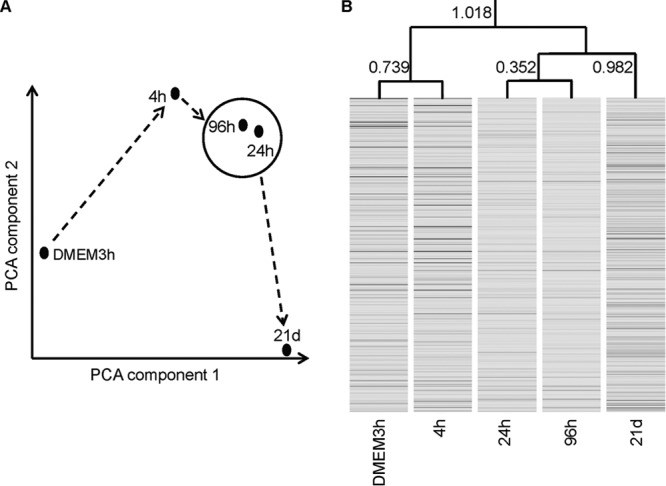
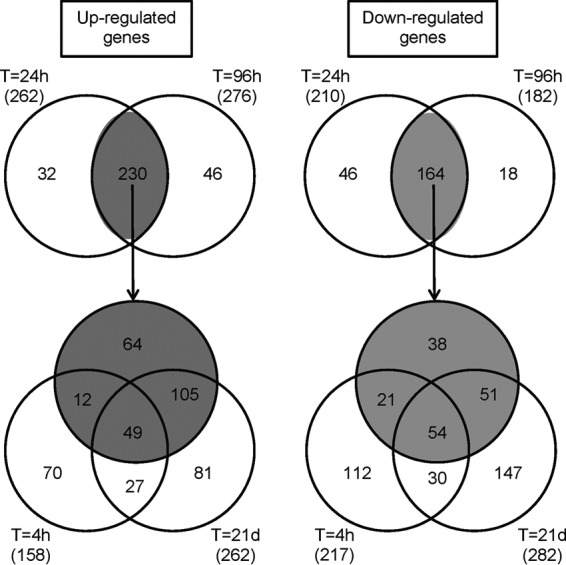
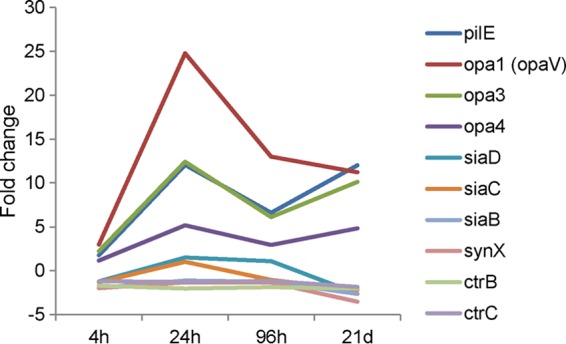
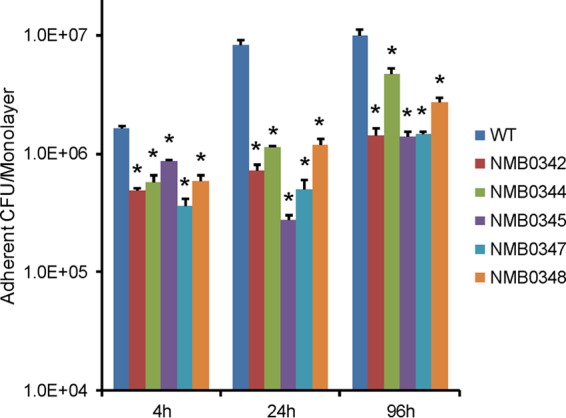
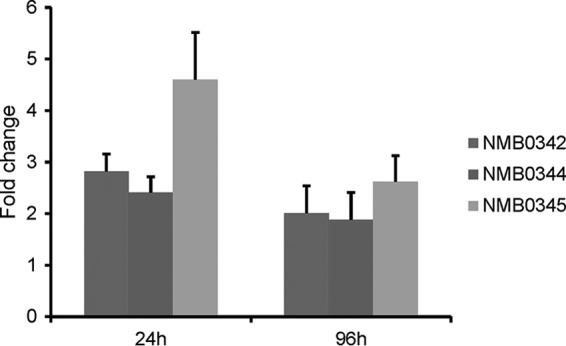
Neisseria meningitidis is a commensal of humans that can colonize the nasopharyngeal epithelium for weeks to months and occasionally invades to cause life-threatening septicemia and meningitis. Comparatively little is known about meningococcal gene expression during colonization beyond those first few hours. In this study, the transcriptome of adherent serogroup B N. meningitidis strain MC58 was determined at intervals during prolonged cocultivation with confluent monolayers of the human respiratory epithelial cell line 16HBE14. At different time points up to 21 days, 7 to 14% of the meningococcal genome was found to be differentially regulated. The transcriptome of adherent meningococci obtained after 4 h of coculture was markedly different from that obtained after prolonged cocultivation (24 h, 96 h, and 21 days). Genes persistently upregulated during prolonged cocultivation included three genes (hfq, misR/phoP, and lrp) encoding global regulatory proteins. Many genes encoding known adhesins involved in epithelial adherence were upregulated, including those of a novel locus (spanning NMB0342 to NMB0348 [NMB0342-NMB0348]) encoding epithelial cell-adhesive function. Sixteen genes (including porA, porB, rmpM, and fbpA) encoding proteins previously identified by their immunoreactivity to sera from individuals colonized long term with serogroup B meningococci were also upregulated during prolonged cocultivation, indicating that our system models growth conditions in vivo during the commensal state. Surface-expressed proteins downregulated in the nasopharynx (and thus less subject to selection pressure) but upregulated in the bloodstream (and thus vulnerable to antibody-mediated bactericidal activity) should be interesting candidate vaccine antigens, and in this study, three new proteins fulfilling these criteria have been identified: NMB0497, NMB0866, and NMB1882.
Figures
References
-
- Davila S, Wright VJ, Khor CC, Sim KS, Binder A, Breunis WB, Inwald D, Nadel S, Betts H, Carrol ED, de Groot R, Hermans PW, Hazelzet J, Emonts M, Lim CC, Kuijpers TW, Martinon-Torres F, Salas A, Zenz W, Levin M, Hibberd ML. 2010. Genome-wide association study identifies variants in the CFH region associated with host susceptibility to meningococcal disease. Nat. Genet. 42:772–776 - PubMed
-
- McCall BJ, Neill AS, Young MM. 2004. Risk factors for invasive meningococcal disease in southern Queensland, 2000-2001. Intern. Med. J. 34:464–468 - PubMed
-
- Seib KL, Pigozzi E, Muzzi A, Gawthorne JA, Delany I, Jennings MP, Rappuoli R. 2011. A novel epigenetic regulator associated with the hypervirulent Neisseria meningitidis clonal complex 41/44. FASEB J. 25:3622–3633 - PubMed
Publication types
MeSH terms
Substances
Grants and funding
LinkOut - more resources
Full Text Sources
Other Literature Sources
Miscellaneous
