. 2013 Aug 28:14:90.
doi: 10.1186/1471-2202-14-90.

The duration of sleep promoting efficacy by dual orexin receptor antagonists is dependent upon receptor occupancy threshold

Affiliations

The duration of sleep promoting efficacy by dual orexin receptor antagonists is dependent upon receptor occupancy threshold

Anthony L Gotter et al. BMC Neurosci. .

Abstract

Background: Drugs targeting insomnia ideally promote sleep throughout the night, maintain normal sleep architecture, and are devoid of residual effects associated with morning sedation. These features of an ideal compound are not only dependent upon pharmacokinetics, receptor binding kinetics, potency and pharmacodynamic activity, but also upon a compound's mechanism of action.

Results: Dual orexin receptor antagonists (DORAs) block the arousal-promoting activity of orexin peptides and, as demonstrated in the current work, exhibit an efficacy signal window dependent upon oscillating levels of endogenous orexin neuropeptide. Sleep efficacy of structurally diverse DORAs in rat and dog was achieved at plasma exposures corresponding to orexin 2 receptor (OX2R) occupancies in the range of 65 to 80%. In rats, the time course of OX2R occupancy was dependent upon receptor binding kinetics and was tightly correlated with the timing of active wake reduction. In rhesus monkeys, direct comparison of DORA-22 with GABA-A modulators at similar sleep-inducing doses revealed that diazepam produced next-day residual sleep and both diazepam and eszopiclone induced next-day cognitive deficits. In stark contrast, DORA-22 did not produce residual effects. Furthermore, DORA-22 evoked only minimal changes in quantitative electroencephalogram (qEEG) activity during the normal resting phase in contrast to GABA-A modulators which induced substantial qEEG changes.

Conclusion: The higher levels of receptor occupancy necessary for DORA efficacy require a plasma concentration profile sufficient to maintain sleep for the duration of the resting period. DORAs, with a half-life exceeding 8 h in humans, are expected to fulfill this requirement as exposures drop to sub-threshold receptor occupancy levels prior to the wake period, potentially avoiding next-day residual effects at therapeutic doses.


Figures
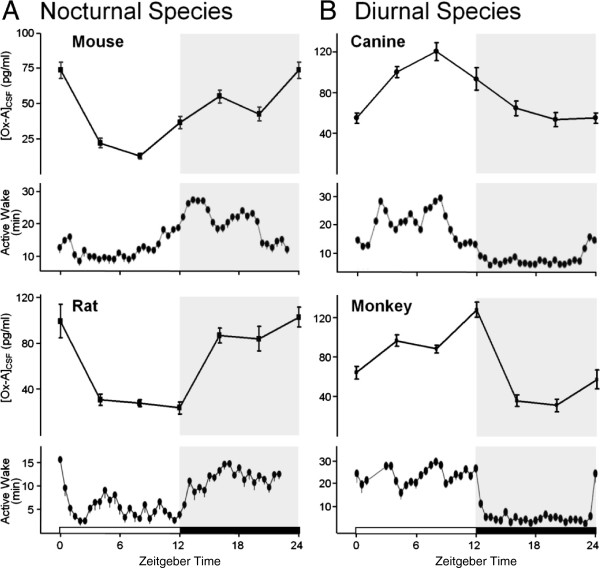
Figure 1
Figure 1
Active wake closely follows oscillating OX-A levels across preclinical species. The time course of OX-A levels in CSF and active wake were highest during the dark phase in nocturnal rodents (A) and during the light phase in diurnal species (B). Mean OX-A levels and time spent in active wake are plotted ± standard error of the mean (SEM) over a 24-h period (dark period shaded) for 6-h and 30-min intervals, respectively. OX-A levels were determined by meso-scale immunoassay at 6-h time points in mice (n = 3; 50 pooled CSF samples each), rats (n = 8 samples each), dogs (n = 8 samples each), and rhesus monkeys (n = 8 samples for ported animals, each). Mean time in active wake under baseline conditions was determined by EEG from telemeterized mice (6 days, n = 7), rats (6 days, n = 7), dogs (10 days, n = 6), and rhesus monkeys (5 days, n = 7).
Figure 2
Figure 2
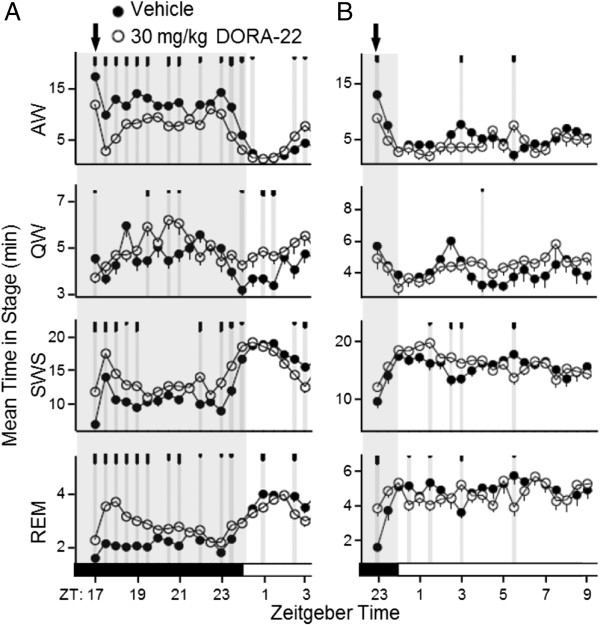
Sleep-promoting effects of DORA-22 in normal rats are diminished during the inactive phase. Vehicle (20% Vitamin E TPGS, p.o.) and DORA-22 (30 mg/kg) were administered to rats during the mid-active phase (arrow, ZT 17:00; n = 13) (A) or 1 h before the inactive phase (arrow, ZT 23:00; n = 8) (B) in a balanced cross-over design. Values represent mean time in sleep stage over 30-min intervals over 3 days of consecutive treatment. Gray shading denotes the dark or active period. AW, active wake; QW, quiet wake. Time points at which significant differences exist between vehicle and DORA-22 responses are indicated by gray vertical lines and tick marks (short, medium, long marks: P < 0.05, 0.01, 0.001, respectively).
Figure 3
Figure 3
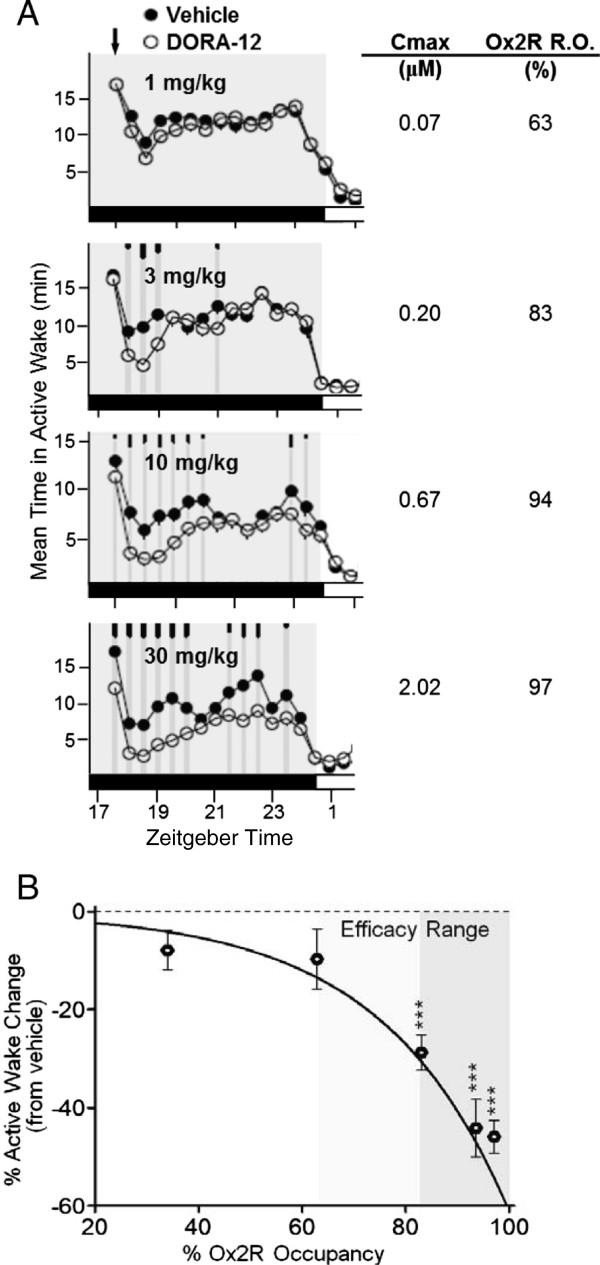
Sleep efficacy of DORA-12 in rats is associated with OX2R occupancies between 63 and 83%. A. Attenuation of mean time in active wake in rats in response to DORA-12 (1 mg/kg [n = 14], 3 mg/kg [n = 14], 10 mg/kg [n = 8], and 30 mg/kg [n = 14) relative to vehicle (20% Vitamin E TPGS, p.o.) dosed mid-active phase (arrow). Gray shading, dark period. Time points at which significant differences exist between vehicle and DORA-12 responses are indicated by gray vertical lines and tick marks (short, medium, long marks: P < 0.05, 0.01, 0.001, respectively). Maximum plasma values (Cmax) and corresponding occupancy values determined in satellite animals are listed to the right. B. The mean percent change (± SEM) in active wake quantified from individual PSG recordings from ‘A’ versus percent OX2R occupancy determined in rats (satellite animals). Light and dark shading indicates potential and definitive occupancy ranges. *** P < 0.001 (t-test) difference in percent active wake change versus baseline.
Figure 4
Figure 4
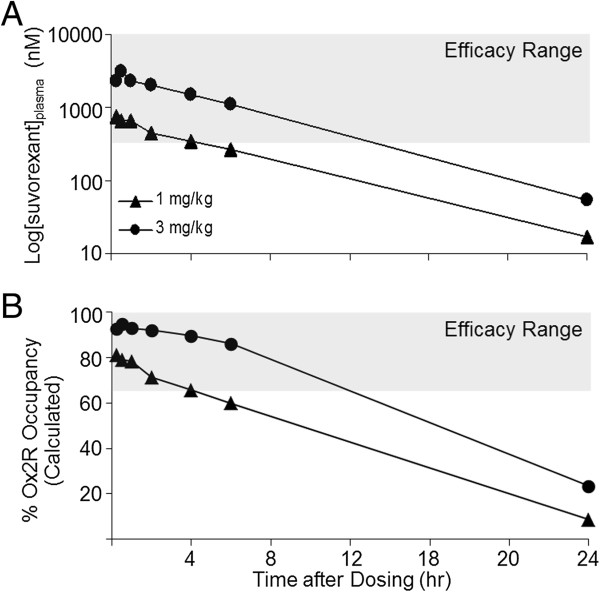
Suvorexant efficacy in dogs corresponds to plasma exposures > 342 nM and OX2R occupancies > 65%. A. Suvorexant levels in satellite animals treated with suvorexant (1 or 3 mg/kg; p.o. in 20% Vitamin E TPGS) (n = 3, each time point). B. Calculated OX2R occupancy based on rat occupancy values, and normalized for free fraction of compound in rat (1.4%) and dog (1%). Gray shading indicates time points at which active wake was significantly attenuated in dogs treated with suvorexant (1 or 3 mg/kg), the plasma and occupancy range at which efficacy has been observed [12].
Figure 5
Figure 5
Time course of DORA-12 and almorexant OX2R occupancy and efficacy in rats. A (upper panels). The time course of DORA-12 (30 mg/kg) effects on active wake was determined in rats by telemetry PSG relative to vehicle (20% Vitamin E TPGS, p.o.) following treatment in active (n = 14) or inactive phase (n = 7). Time points at which significant differences exist between vehicle and DORA-12 responses are indicated by gray vertical lines and tick marks (short, medium, long marks: P < 0.05, 0.01, 0.001, respectively). B (upper panels). Effects of almorexant (100 mg/kg) on active wake relative to vehicle following treatment in active (n = 14) or inactive phase (n = 14). Lower panels. Plasma and CSF levels as well as OX2R receptor occupancy of DORA-12 (A) and almorexant (B) following inactive phase treatment (one male, one female animal per time point). Plasma, CSF, and occupancy levels were determined in the same animals, in satellite to PSG experiments.
Figure 6
Figure 6
Diazepam and eszopiclone, but not DORA-22, exhibit next-day effects impacting cognitive performance in monkeys. Monkeys were treated (arrow) with sleep-promoting doses 2 h before the 12-h dark/inactive phase (gray shading): diazepam, 10 mg/kg, p.o. in 0.5% methylcellulose; eszopiclone, 10 mg/kg, in 20% Vitamin E TPGS; DORA-22, 30 mg/kg, in 20% Vitamin E TPGS. Memory and attention were evaluated by DMS (D) and SCRT (C) tasks 14 and 16 h after dosing, respectively. A. Time course of plasma levels after dosing (0, 0.25, 0.5, 1, 2, 4, 6, 17 h; n = 2, diazepam and eszopiclone; n = 3, DORA-22 [17 h, n = 8]). Normalized plasma levels relative to maximum (Cmax: diazepam 775 nM [1 h]; eszopiclone 1680 nM [0.5 h]; DORA-22 134 nM [2 h]) compare compound levels on the same y-axis scale. B. Mean time in active wake (+ SEM) determined by polysomnography in 30-min intervals after treatment (vehicle, closed symbols; compound, open symbols). Significant differences versus vehicle are indicated by gray vertical lines and tick marks (short, medium, long: P < 0.05, 0.01, 0.001, respectively). C. Mean qEEG power in gamma (35–100 Hz), theta (4–8 Hz), and delta (0.5–4 Hz) frequency bands following treatment. D. DMS measure of memory at 14 h after treatment. Data are mean proportions of completed trials during which a correct choice was made (+ SEM; n = 16, 16, and 15, respectively). Random responding, 25%. Significant differences from vehicle: * P < 0.05 (repeated measures ANOVA). E. SCRT evaluation of attention at 16 h after treatment. Data are the mean proportions of completed trials during which a correct choice was made following short duration cues (+ SEM; n = 16, 16, and 5, respectively). Random responding, 10%. Significant differences from vehicle: * P < 0.05.
Figure 7
Figure 7
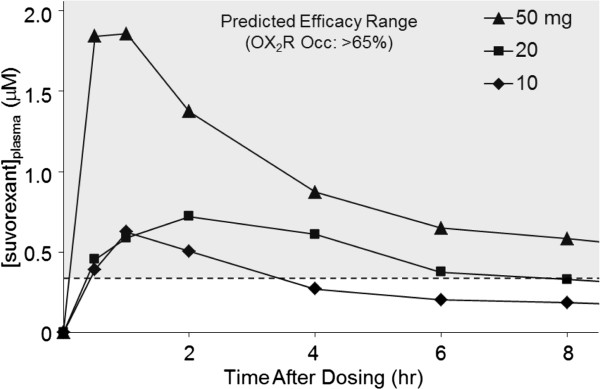
OX2R occupancy by suvorexant sufficient for sleep-promoting efficacy: restricted to 8 h following treatment. The time courses of plasma levels of suvorexant in humans collected in Phase 1 clinical trials following administration of suvorexant (indicated doses) are shown relative to the plasma values (0.33 μM) calculated to correspond to the exposure required for 65% OX2R occupancy (dashed line). The gray shaded area represents the predicted efficacy range based upon this value. occ, occupancy.
Figure 8
Figure 8
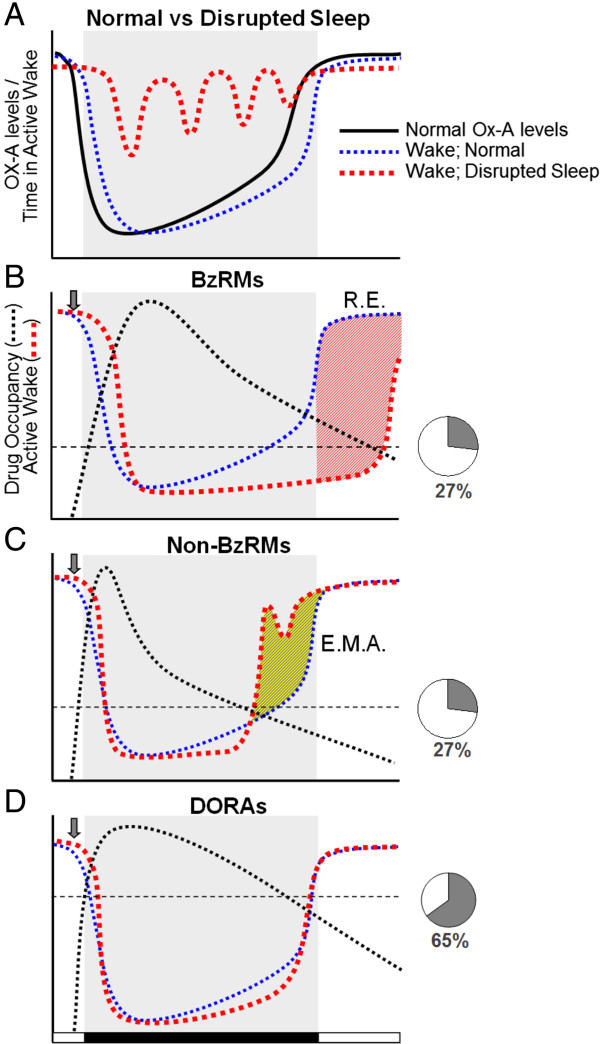
Conceptual model for DORA OX2R occupancy and efficacy based on pharmacokinetic and receptor-binding properties. A. Normal and disrupted sleep relative to OX-A levels (solid black line) during the human inactive period (gray shading). Wake during disrupted sleep (red dashed line) is punctuated by brief periods of wake after sleep onset, while normal sleep (blue dashed line) follows orexin levels. B. Time course of the sleep-promoting efficacy of benzodiazepine-based GABA-A receptor modulators (BzRMs). Following treatment (gray arrow), active wake diminishes as GABA-A receptor occupancy (black dotted line) exceeds that required for sleep efficacy, 27% (horizontal black dashed line) [25]. Red hatched area, difference from normal active wake (blue dashed line). Residual effects (R.E.) during the subsequent waking period as compound levels sufficient for GABA-A receptor occupancy are exceeded following the normal 8-h resting period. C. Efficacy time course of non-benzodiazepine GABA-A receptor modulators (non-BzRMs). GABA-A receptor occupancy (black dotted line) induced by sub-optimal doses of non-BzRMs are not sufficient to engage these receptors allowing early morning awakenings (E.M.A.). Yellow hatched area, difference from normal active wake (blue dashed line). D. DORAs, sufficiently engineered for optimal pharmacokinetic and receptor-binding kinetics, induce OX2R occupancies (black dotted line) sufficient to block the wake-promoting properties of orexin throughout the 8-h resting period and, given the high level of OX2R occupancy required for sleep-promoting efficacy, avoid residual effects persisting into the subsequent waking period even in the presence of moderate levels of compound exposure.

References

    1. Espana RA, Scammell TE. Sleep neurobiology from a clinical perspective. Sleep. 2011;34:845–858. - PMC - PubMed
    1. Gotter AL, Webber AL, Coleman PJ, Renger JJ, Winrow CJ. International Union of Basic and Clinical Pharmacology. LXXXVI. Orexin receptor function, nomenclature and pharmacology. Pharmacol Rev. 2012;64:389–420. doi: 10.1124/pr.111.005546. - DOI - PubMed
    1. Taheri S, Sunter D, Dakin C, Moyes S, Seal L, Gardiner J, Rossi M, Ghatei M, Bloom S. Diurnal variation in orexin A immunoreactivity and prepro-orexin mRNA in the rat central nervous system. Neurosci Lett. 2000;279:109–112. doi: 10.1016/S0304-3940(99)00955-6. - DOI - PubMed
    1. Zeitzer JM, Buckmaster CL, Parker KJ, Hauck CM, Lyons DM, Mignot E. Circadian and homeostatic regulation of hypocretin in a primate model: Implications for the consolidation of wakefulness. J Neurosci. 2003;23:3555–3560. - PMC - PubMed
    1. De Lecea L, Kilduff TS, Peyron C, Gao XB, Foye PE, Danielson PE, Fukuhara C, Battenberg ELF, Gautvik VT, Bartlett FS, Frankel WN, van den Pol AN, Bloom FE, Gautvik KM, Sutcliffe JG. The hypocretins: Hypothalamus-specific peptides with neuroexcitatory activity. Proc Natl Acad Sci U S A. 1998;95:322–327. doi: 10.1073/pnas.95.1.322. - DOI - PMC - PubMed

Publication types

MeSH terms