. 2013 Oct;2(10):789-96.
doi: 10.5966/sctm.2013-0032. Epub 2013 Aug 27.

Administration of murine stromal vascular fraction ameliorates chronic experimental autoimmune encephalomyelitis

Affiliations

Administration of murine stromal vascular fraction ameliorates chronic experimental autoimmune encephalomyelitis

Julie A Semon et al. Stem Cells Transl Med. 2013 Oct.

Abstract

Administration of adipose-derived stromal/stem cells (ASCs) represents a promising therapeutic approach for autoimmune diseases since they have been shown to have immunomodulatory properties. The uncultured, nonexpanded counterpart of ASCs, the stromal vascular fraction (SVF), is composed of a heterogeneous mixture of cells. Although administration of ex vivo culture-expanded ASCs has been used to study immunomodulatory mechanisms in multiple models of autoimmune diseases, less is known about SVF-based therapy. The ability of murine SVF cells to treat myelin oligodendrocyte glycoprotein35-55-induced experimental autoimmune encephalitis (EAE) was compared with that of culture-expanded ASCs in C57Bl/6J mice. A total of 1 × 10(6) SVF cells or ASCs were administered intraperitoneally concomitantly with the induction of disease. The data indicate that intraperitoneal administration of ASCs significantly ameliorated the severity of disease course. They also demonstrate, for the first time, that the SVF effectively inhibited disease severity and was statistically more effective than ASCs. Both cell therapies also demonstrated a reduction in tissue damage, a decrease in inflammatory infiltrates, and a reduction in sera levels of interferon-γ and interleukin-12. Based on these data, SVF cells effectively inhibited EAE disease progression more than culture-expanded ASCs.

Keywords: Adipose; Adult stem cells; Neuroimmune; Stem cells; Tissue-specific stem cells.


Figures
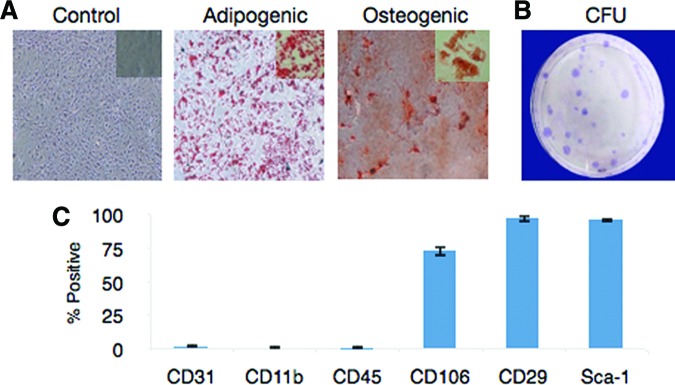
Figure 1.
Figure 1.
Characterization of mouse adipose-derived stem cells from C57Bl/6 stromal vascular fraction. Adipose-derived stromal/stem cells (ASCs) were grown in complete culture medium (CCM) until they were 70% confluent and then switched to differentiation medium. After 21 days, cells were fixed and stained with alizarin red for osteogenesis and Oil Red O for adipogenesis. Representative images for each group are shown (A). Magnification is ×10 for all panels. (B): CFUs were seeded at a density of 100 cells per 10-cm2 dish and incubated in CCM for 14 days. Cells were fixed and stained with crystal violet. A representative image is shown. (C): ASCs were stained with antibodies against the indicated antigens and analyzed by flow cytometry. Each experiment was performed in triplicate. Abbreviation: CFU, colony-forming units.
Figure 2.
Figure 2.
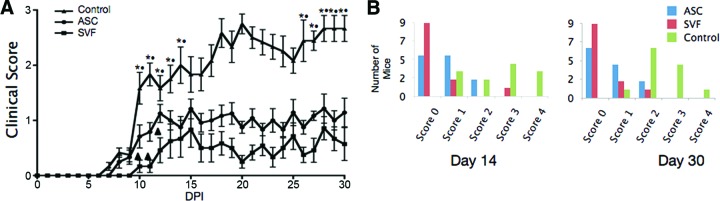
Clinical evaluation of ASC or SVF treatment in myelin oligodendrocyte glycoprotein35–55-induced experimental autoimmune encephalitis. (A): Improved clinical scores were seen in both ASC-treated (●) and SVF-treated (■) mice compared with controls (▴). Values are means from three independent reviewers. Bars indicate ±SEM. *, p ≤ .01, comparing controls and ASC-treated mice; ●, p ≤ .01 between controls and SVF-treated mice; ▴, p ≤ .05 between SVF-treated and ASC-treated mice. (B): Left: The clinical scores at day 14 DPI show the distribution during peak disease, demonstrating that the majority of SVF-treated mice displayed no symptoms and ASC-treated mice showed decreased symptoms. Right: The clinical scores at the end of the course show that the treated groups stably maintained their reduced state of disease. Abbreviations: ASC, adipose-derived stromal/stem cell; DPI, days postinjury; SVF, stromal vascular fraction.
Figure 3.
Figure 3.
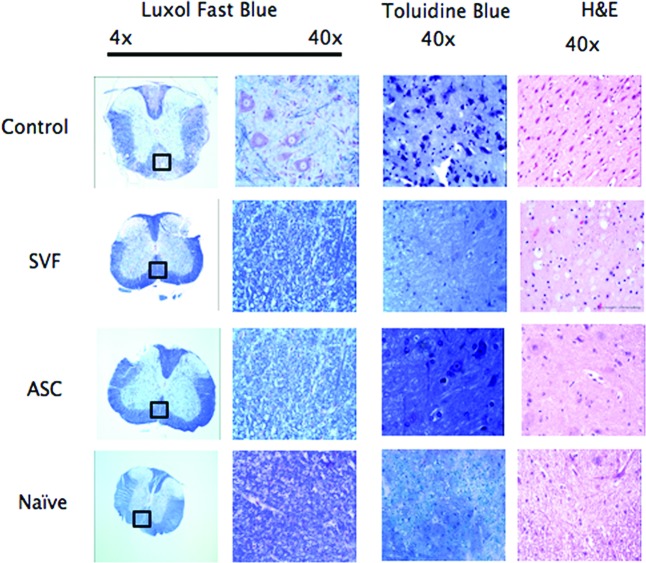
Treatment with SVF or ASCs reduces cellular infiltration and tissue damage in experimental autoimmune encephalitis (EAE). Spinal cords from Hanks' balanced saline solution (HBSS)-treated, ASC-treated, SVF-treated, and naïve mice were obtained after euthanasia at 30 days postinjury and processed for histological staining using Luxol Fast Blue (LFB), Toluidine Blue (TB), and H&E. Quantification was performed on nine random sections per animal and five animals per group. LFB staining identified multiple areas of demyelination in HBSS-treated EAE mice but only scattered foci in both treated groups. Similarly, sections labeled with TB showed increased myelin debris and greater numbers of demyelinated axons in the control mice compared with naïve or treated mice. Comparisons of the H&E images show a decrease in the number of infiltrating immune cells in the spinal cord after administration of both ASCs and SVF. Abbreviations: ASC, adipose-derived stromal/stem cell; H&E, hematoxylin and eosin; SVF, stromal vascular fraction.
Figure 4.
Figure 4.
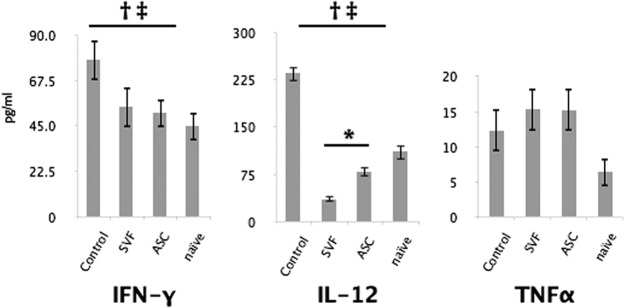
Serum levels of inflammatory cytokines. At 30 days after disease induction, blood was collected from all mice during intracardial perfusion and analyzed by ELISA Immunoassay. IL-12 levels were decreased in ASC-treated mice and further decreased in SVF-treated mice compared with control mice (middle). Both treatment groups had a similar decrease in levels of IFN-γ (left). No difference was seen in TNFα (right). Bars indicate ±SD. †, p ≤ .05 between controls and SVF-treated mice; ‡, p ≤ .05 between controls and ASC-treated mice; *, p ≤ .05 between treatment groups. Abbreviations: ASC, adipose-derived stromal/stem cell; IFN-γ, interferon-γ; IL-12, interleukin-12; SVF, stromal vascular fraction; TNFα, tumor necrosis factor-α.

References

    1. Vlahiotis A, Sedjo R, Cox ER, et al. Gender differences in self-reported symptom awareness and perceived ability to manage therapy with disease-modifying medication among commercially insured multiple sclerosis patients. J Manag Care Pharm. 2010;16:206–216. - PMC - PubMed
    1. The MS disease-modifying medications. [Accessed April 11, 2012]. Available at http://www.nationalmssociety.org.
    1. Tran TT, Kahn CR. Transplantation of adipose tissue and stem cells: Role in metabolism and disease. Nat Rev Endocrinol. 2010;6:195–213. - PMC - PubMed
    1. Kilroy GE, Foster SJ, Wu X, et al. Cytokine profile of human adipose-derived stem cells: Expression of angiogenic, hematopoietic, and pro-inflammatory factors. J Cell Physiol. 2007;212:702–709. - PubMed
    1. Peinado JR, Pardo M, de la Rosa O, et al. Proteomic characterization of adipose tissue constituents, a necessary step for understanding adipose tissue complexity. Proteomics. 2012;12:607–620. - PubMed

Publication types