. 2013:3:2534.
doi: 10.1038/srep02534.

Ligand modified nanoparticles increases cell uptake, alters endocytosis and elevates glioma distribution and internalization

Affiliations

Ligand modified nanoparticles increases cell uptake, alters endocytosis and elevates glioma distribution and internalization

Huile Gao et al. Sci Rep. 2013.

Erratum in

  • Sci Rep. 2014;4:5138

Abstract

Nanoparticles (NPs) were widely used in drugs/probes delivery for improved disease diagnosis and/or treatment. Targeted delivery to cancer cells is a highly attractive application of NPs. However, few studies have been performed on the targeting mechanisms of these ligand-modified delivery systems. Additional studies are needed to understand the transport of nanoparticles in the cancer site, the interactions between nanoparticles and cancer cells, the intracellular trafficking of nanoparticles within the cancer cells and the subcellular destiny and potential toxicity. Interleukin 13 (IL-13) peptide can specifically bind IL-13Rα2, a receptor that is highly expressed on glioma cells but is expressed at low levels on other normal cells. It was shown that the nanoparticels modification with the IL-13 peptide could improve glioma treatment by selectively increasing cellular uptake, facilitating cell internalization, altering the uptake pathway and increasing glioma localization.


Figures
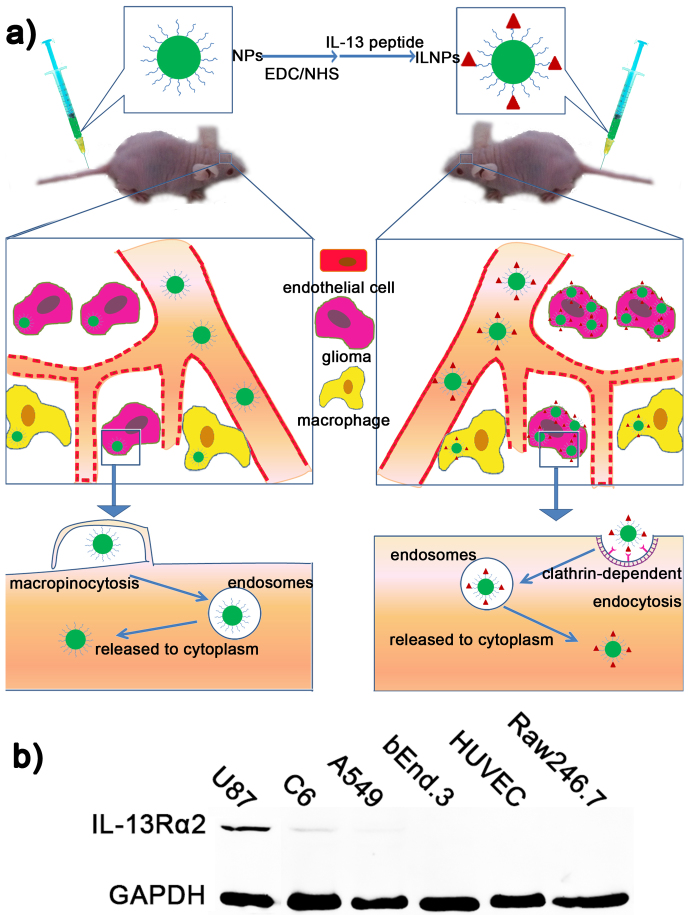
Figure 1
Figure 1. Elucidation of the study.
(a) Elucidation of cancer targeting mechanisms of ligand-modified NPs. IL-13 peptide modification increases glioma distribution, selectively elevates internalization by glioma cells rather than macrophages and microvessels, and changes the dominant internalization pathway from macropinocytosis to receptor-mediated clathrin-dependent endocytosis. The photos and images shown were produced by Dr Huile Gao. (b) IL-13Rα2 expression in various cells including U87, Raw246.7, HUVEC (human umbilical vein endothelial cells), bEnd.3 (cell line used as brain microvessel endothelial cells), A549 (human non-small-cell lung carcinoma cell line) and C6 (rat glioma cell line). Full length original picture can be found as Supplementary Fig. S1.
Figure 2
Figure 2. Anti glioma effect of DTX-loaded ILNPs.
(a) Cumulative survival study of glioma bearing mice treated with 10 mg/kg DTX, DTX-loaded NPs, DTX-loaded ILNPs or saline (n = 6). (b) Terminal deoxynucleotide transferase dUTP Nick End Labeling (TUNEL) assay of slices of glioma bearing brains from mice treated with different formulations. Blue represents nuclei, while green represents apoptosis cells. The scale bar represents 200 μm.
Figure 3
Figure 3. Cellular uptake of ILNPs.
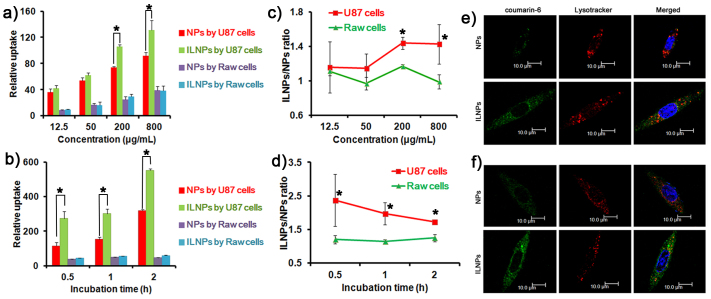
(a) and (c) In vitro cellular uptake of different concentrations of coumarin-6-loaded NPs or ILNPs for 1 h. (b) and (d) Cellular uptake of 200 μg/mL coumarin-6-loaded NPs or ILNPs for different times. (e) Intracellular localization of coumarin-6-loaded NPs and ILNPs incubated with U87 cells for 0.5 h. (f) Intracellular localization of coumarin-6-loaded NPs and ILNPs incubated with U87 cells for 2 h. The nuclei were stained with DAPI and the endosomes were marked with LysoTracker Red.
Figure 4
Figure 4. Mechanisms of uptake of NPs and ILNPs by U87 cells.
Cells were treated with 200 μg/mL coumarin-6-loaded ILNPs of NPs for 1 h in the presence of various inhibitors (a), different concentrations of chlorpromazine and sucrose (b), and different concentrations of nocodazole and Cytochalasin D (c). The uptake was presented as percentage of the control (n = 3). *p < 0.05 vs control, #p < 0.05 between NPs and ILNPs.
Figure 5
Figure 5. In vitro internalization of ILNPs.
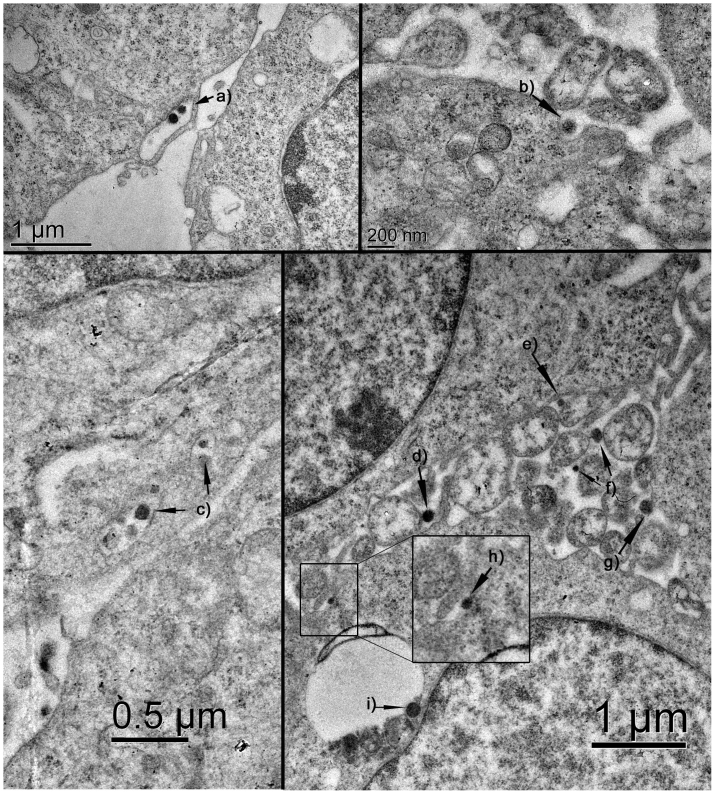
The SPIO-loaded ILNPs were observed internalized near the cell membrane, mediated by clathrin-dependent pinocytosis or receptor-mediated endocytosis (b), macropinocytosis (h and e), clathrin-independent pinocytosis (d) or phagocytosis (g). SPIO-loaded ILNPs were also observed in the gaps between cells (f), in the macropinosomes mediated by macropinocytosis (a), in the phagosomes mediated by phagocytosis (i) and in the endosomes (c).
Figure 6
Figure 6. In vivo and ex vivo imaging.
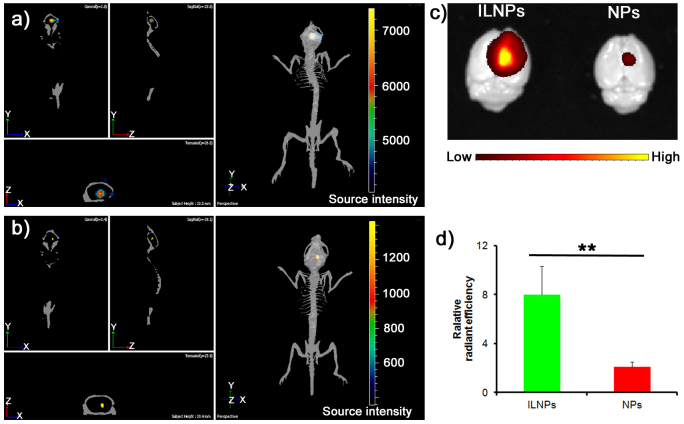
(a) Fluorescent imaging of glioma bearing mice 2 h after administered DiR-loaded ILNPs. (b) Fluorescent imaging of glioma bearing mice 2 h after administration of DiR-loaded NPs. (c) Ex vivo imaging of brains 2 h after administration of DiR-loaded ILNPs and NPs. (d) Semi-quantitative results of fluorescence intensity of gliomas, **p < 0.01 vs control.
Figure 7
Figure 7. Brain glioma distribution of DiR-loaded ILNPs.
(a) The colocalization of ILNPs with macrophages stained with anti-F4/80 antibody. (b) The colocalization of ILNPs with microvessels stained with anti-CD31 antibody. Blue represents nuclei stained by DAPI, green are macrophages (a) or microvessels (b), red are glioma cells pre-stained by DiI, pink are DiR-loaded NPs or ILNPs, and the scale bar represents 100 μm.

References

    1. Matsumura Y. & Maeda H. A new concept for macromolecular therapeutics in cancer chemotherapy: mechanism of tumoritropic accumulation of proteins and the antitumor agent smancs. Cancer Res 46, 6387–92 (1986). - PubMed
    1. Jain R. K. Delivery of molecular and cellular medicine to solid tumors. Adv Drug Deliv Rev 46, 149–68 (2001). - PubMed
    1. Mickler F. M. et al. Tuning Nanoparticle Uptake: Live-Cell Imaging Reveals Two Distinct Endocytosis Mechanisms Mediated by Natural and Artificial EGFR Targeting Ligand. Nano Lett 12, 3417–23 (2012). - PubMed
    1. Liu Y. & Lu W. Recent advances in brain tumor-targeted nano-drug delivery systems. Expert Opin Drug Deliv 9, 671–86 (2012). - PubMed
    1. Bae Y. H. & Park K. Targeted drug delivery to tumors: myths, reality and possibility. J Control Release 153, 198–205 (2011). - PMC - PubMed

Publication types

MeSH terms