


Relationship between platelet count and hemodialysis membranes
- PMID: 23983482
- PMCID: PMC3751386
- DOI: 10.2147/IJNRD.S46440
Relationship between platelet count and hemodialysis membranes
Abstract
Background: One factor associated with poor outcomes in hemodialysis patients is exposure to a foreign membrane. Older membranes are very bioincompatible and increase complement activation, cause leukocytosis by activating circulating factors, which sequesters leukocytes in the lungs, and activates platelets. Recently, newer membranes have been developed that were designed to be more biocompatible. We tested if the different "optiflux" hemodialysis membranes had different effects on platelet levels.
Methods: Ninety-nine maintenance hemodialysis patients with no known systemic or hematologic diseases affecting their platelets had blood drawn immediately prior to, 90 minutes into, and immediately following their first hemodialysis session of the week. All patients were dialyzed using a Fresenius Medical Care Optiflux polysulfone membrane F160, F180, or F200 (polysulfone synthetic dialyzer membranes, 1.6 m(2), 1.8 m(2), and 2.0 m(2) surface area, respectively, electron beam sterilized). Platelet counts were measured from each sample by analysis using a CBC analyzer.
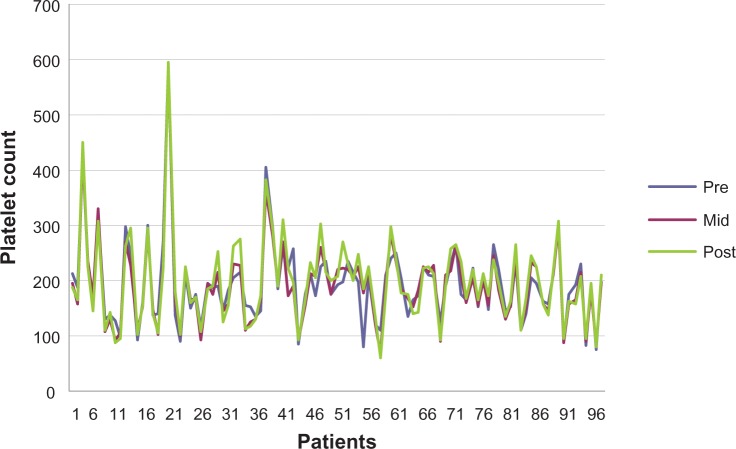
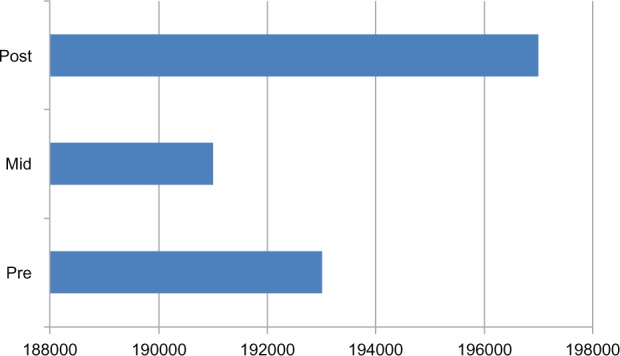
Results: The average age of the patients was 62.7 years; 36 were female and 63 were male. The mean platelet count pre, mid, and post dialysis was 193 (standard deviation ±74.86), 191 (standard deviation ±74.67), and 197 (standard deviation ±79.34) thousand/mm3, respectively, with no statistical differences.
Conclusion: Newer membranes have no significant effect on platelet count. This suggests that they are, in fact, more biocompatible than their predecessors and may explain their association with increased survival.
Keywords: bioincompatible events; cellulosic membranes; complement activation; electron beam sterilized; platelet count; polysulfone membranes.
Figures
References
-
- Floege J, Johnson RJ, Feehally J. Comprehensive Clinical Nephrology. 4th ed. St. Louis, MO: Elsevier; 2010.
-
- Verbeelen D, Jochmans K, Herman AG, Van der Niepen P, Sennesael J, De Waele M. Evaluation of platelets and hemostasis during hemodialysis with six different membranes. Nephron. 1991;59(4):567–572. - PubMed
-
- Vicks SL, Gross ML, Schmitt GW. Massive hemorrhage due to hemodialysis-associated thrombocytopenia. Am J Nephrol. 1983;3(1):30–33. - PubMed
-
- Post JB. Thrombocytopenia associated with use of a biocompatible hemodialysis membrane: a case report. Am J Kidney Dis. 2010;55(6):e25–e28. - PubMed
-
- Raymond MH, Schutte BC, Torner JC, Burns TL, Willing MC. Osteocalcin: genetic and physical mapping of the human gene BGLAP and its potential role in postmenopausal osteoporosis. 1999;Genomics60(2):210–217. - PubMed
LinkOut - more resources
Full Text Sources
Other Literature Sources
