


Dietary intake of vitamin D in a northern Canadian Dené First Nation community
- PMID: 23984265
- PMCID: PMC3752286
- DOI: 10.3402/ijch.v72i0.20723
Dietary intake of vitamin D in a northern Canadian Dené First Nation community
Abstract
Background: Increased awareness of the wide spectrum of activity of vitamin D has focused interest on its role in the health of Canada's Aboriginal peoples, who bear a high burden of both infectious and chronic disease. Cutaneous vitamin D synthesis is limited at northern latitudes, and the transition from nutrient-dense traditional to nutrient-poor market foods has left many Canadian Aboriginal populations food insecure and nutritionally vulnerable.
Objective: The study was undertaken to determine the level of dietary vitamin D in a northern Canadian Aboriginal (Dené) community and to determine the primary food sources of vitamin D.
Design: Cross-sectional study.
Methods: Dietary vitamin D intakes of 46 adult Dené men and women were assessed using a food frequency questionnaire and compared across age, gender, season and body mass index. The adequacy of dietary vitamin D intake was assessed using the 2007 Adequate Intake (AI) and the 2011 Recommended Dietary Allowance (RDA) values for Dietary Reference Intake (DRI).
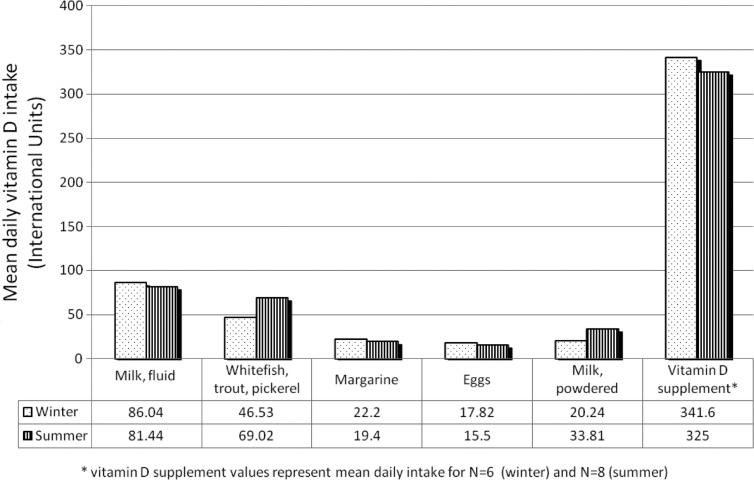
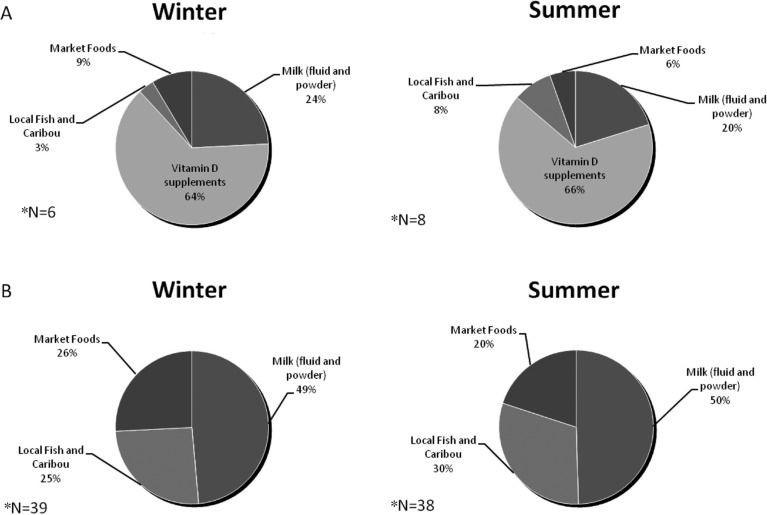
Results: Mean daily vitamin D intake was 271.4 IU in winter and 298.3 IU in summer. Forty percent and 47.8% of participants met the vitamin D 1997 AI values in winter and summer, respectively; this dropped to 11.1 and 13.0% in winter and summer using 2011 RDA values. Supplements, milk, and local fish were positively associated with adequate vitamin D intake. Milk and local fish were the major dietary sources of vitamin D.
Conclusions: Dietary intake of vitamin D in the study population was low. Only 2 food sources, fluid milk and fish, provided the majority of dietary vitamin D. Addressing low vitamin D intake in this population requires action aimed at food insecurity present in northern Aboriginal populations.
Keywords: Aboriginal; First Nations; diet; food security; indigenous; nutrition; vitamin D.
Figures
References
-
- Agriculture and Agri-Food Canada. Canada's action plan for food security. 2009. [cited 2012 May 17]. Available from: http://www.agr.gc.ca/index_e.php?s1=misb&s2=fsec-seca&page=action.
-
- Receveur O, Boulay M, Kuhnlein HV. Decreasing traditional food use affects diet quality for adult Dené/Metis in 16 communities of the Canadian Northwest Territories. J Nutr. 1997;127:2179–86. - PubMed
-
- Kuhnlein HV, Receveur O, Soueida R, Egeland GM. Arctic indigenous peoples experience the nutrition transition with changing dietary patterns and obesity. J Nutr. 2004;134:1447–53. - PubMed
-
- Lambden J, Receveur O, Marshall J, Kuhnlein HV. Traditional and market food access in Arctic Canada is affected by economic factors. Int J Circumpolar Health. 2006;65:331–40. - PubMed
-
- Willows ND, Veugelers P, Raine K, Kuhle S. Prevalence and sociodemographic risk factors related to household food security in Aboriginal peoples in Canada. Public Health Nutr. 2009;12:1150–6. - PubMed
MeSH terms
Substances
LinkOut - more resources
Full Text Sources
Other Literature Sources
Medical
Miscellaneous
