


The expression of V-ATPase is associated with drug resistance and pathology of non-small-cell lung cancer
- PMID: 23984887
- PMCID: PMC3846167
- DOI: 10.1186/1746-1596-8-145
The expression of V-ATPase is associated with drug resistance and pathology of non-small-cell lung cancer
Abstract
Objective: This article aims to investigate the expression of vacuolar-H + -ATPase (V-ATPase) in non-small cell lung cancer (NSCLC) and its variations with pathological type and grade. Furthermore, to evaluate the chemotherapy drug sensitivity of different cancer tissues as well as its correlation with V-ATPase expression in NSCLC.
Methods: V-ATPase expression was examined in 92 NSCLC tissue samples using the immunohistochemical Envision method and immunofluorescence assay. The location of V-ATPase expression was observed by confocal laser scanning microscopy and the difference of its expression rate was evaluated. The sensitivity of cancer tissues to chemotherapy drug was examined using MTT assay and its correlation with the V-ATPase expression was tested in NSCLC by Spearman rank correlation analysis.
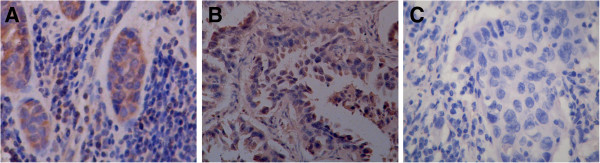
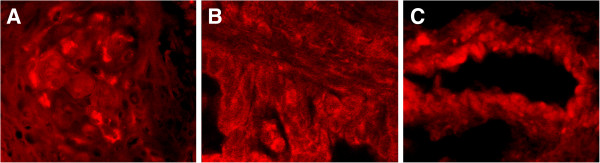
Results: V-ATPase expression was mainly localized in the cell membrane and cytoplasm. The expression rate of V-ATPase was 71.43% in squamous cell lung cancer, significantly lower than that of the lung adenocarcinoma (83.72%, P = 0.000). In different pathological grades of squamous cell lung cancer, the expression rate of V-ATPase was 58.33% in grade II, significantly lower than that of the grade III (84.00%, P = 0.014). The expression rate of V-ATPase in grade II lung adenocarcinoma was 76.67%, significantly lower than that of the grade ΙΙΙ adenocarcinoma (100.0%, P = 0.012). Correlation analysis showed that the sensitivity of NSCLC tissues to cyclophosphamide, gemcitabine, doxorubicin, paclitaxel and cisplatin was significantly correlated with the V-ATPase expression rate (P < 0.05).
Conclusions: V-ATPase was overexpressed in NSCLC. The expression of V-ATPase was related to the pathological type and grade of cancer and was likely associated with chemotherapy drug resistance in NSCLC.
Virtual slides: The virtual slide(s) for this article can be found here: http://www.diagnosticpathology.diagnomx.eu/vs/7515811511020000.
Figures
References
-
- Ho CC, Kuo SH, Huang PH, Huang HY, Yang CH, Yang PC. Caveolin-1 expression is significantly associated with drug resistance and poor prognosis in advanced non-small cell lung cancer patients treated with gemcitabine-based chemotherapy. Lung Cancer. 2008;59:105–110. doi: 10.1016/j.lungcan.2007.07.024. - DOI - PubMed
-
- Ohashi K, Sequist LV, Arcila ME, Moran T, Chmielecki J, Lin YL, Pan Y, Wang L, de Stanchina E, Shien K. et al. Lung cancers with acquired resistance to EGFR inhibitors occasionally harbor BRAF gene mutations but lack mutations in KRAS, NRAS, or MEK1. Proc Natl Acad Sci U S A. 2012;109:E2127–E2133. doi: 10.1073/pnas.1203530109. - DOI - PMC - PubMed
Publication types
MeSH terms
Substances
LinkOut - more resources
Full Text Sources
Other Literature Sources
Medical
