


Efficient production of l-lactic acid by an engineered Thermoanaerobacterium aotearoense with broad substrate specificity
- PMID: 23985133
- PMCID: PMC3766646
- DOI: 10.1186/1754-6834-6-124
Efficient production of l-lactic acid by an engineered Thermoanaerobacterium aotearoense with broad substrate specificity
Abstract
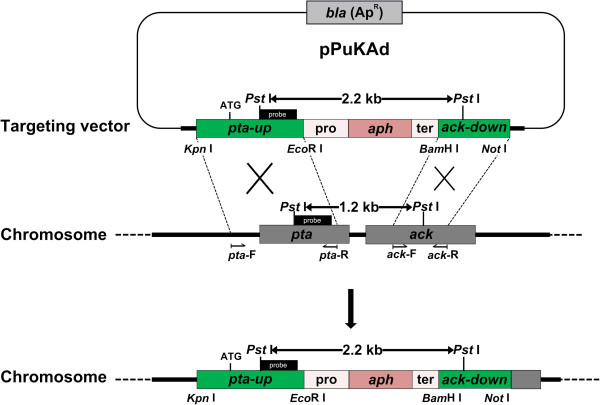
Background: Efficient conversion of lignocellulosic biomass to optically pure lactic acid is a key challenge for the economical production of biodegradable poly-lactic acid. A recently isolated strain, Thermoanaerobacterium aotearoense SCUT27, is promising as an efficient lactic acid production bacterium from biomass due to its broad substrate specificity. Additionally, its strictly anaerobic and thermophilic characteristics suppress contamination from other microoragnisms. Herein, we report the significant improvements of concentration and yield in lactic acid production from various lignocellulosic derived sugars, achieved by the carbon flux redirection through homologous recombination in T. aotearoense SCUT27.
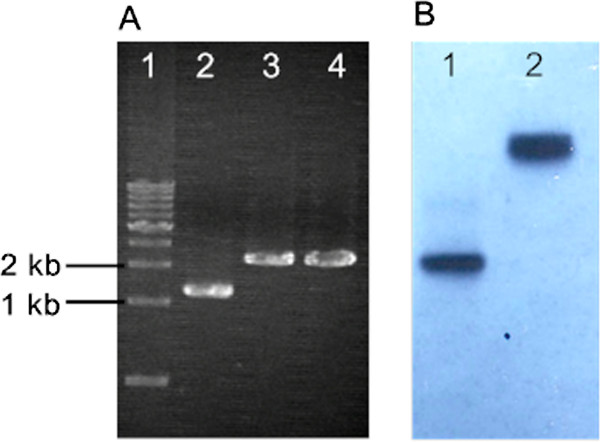
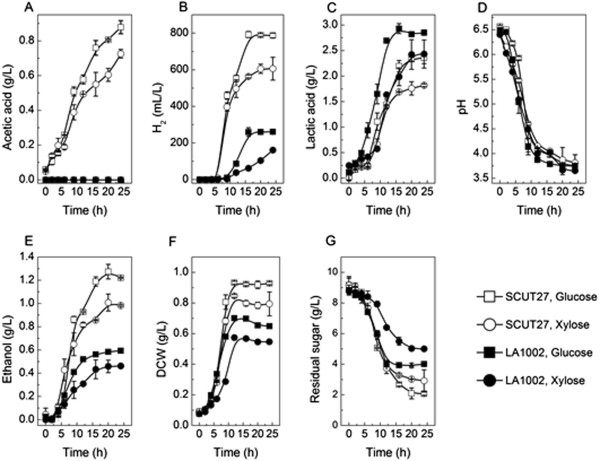
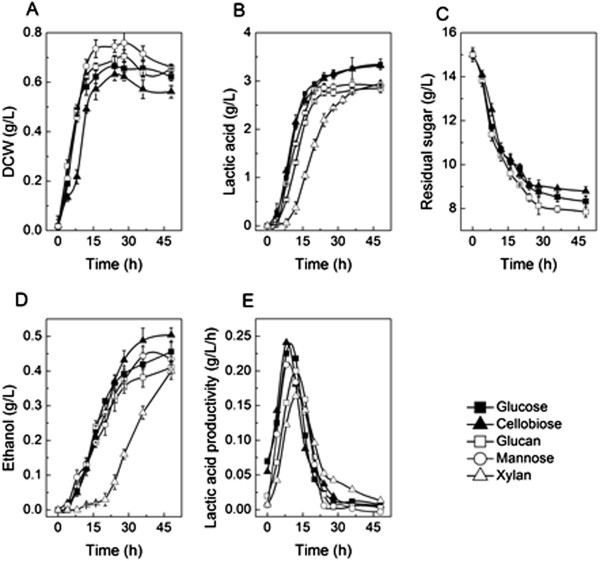
Results: T. aotearoense SCUT27 was engineered to block the acetic acid formation pathway to improve the lactic acid production. The genetic manipulation resulted in 1.8 and 2.1 fold increase of the lactic acid yield using 10 g/L of glucose or 10 g/L of xylose as substrate, respectively. The maximum l-lactic acid yield of 0.93 g/g glucose with an optical purity of 99.3% was obtained by the engineered strain, designated as LA1002, from 50 g/L of substrate, which is very close to the theoretical value (1.0 g/g of glucose). In particular, LA1002 produced lactic acid at an unprecedented concentration up to 3.20 g/L using 10 g/L xylan as the single substrate without any pretreatment after 48 h fermentation. The non-sterilized fermentative production of l-lactic acid was also carried out, achieving values of 44.89 g/L and 0.89 g/g mixed sugar for lactic acid concentration and yield, respectively.
Conclusions: Blocking acetic acid formation pathway in T. aotearoense SCUT27 increased l-lactic acid production and yield dramatically. To our best knowledge, this is the best performance of fermentation on lactic acid production using xylan as the sole carbon source, considering the final concentration, yield and fermentation time. In addition, it should be mentioned that the performance of non-sterilized simultaneous fermentation from glucose and xylose was very close to that of normal sterilized cultivation. All these results used the mutant strain, LA1002, indicated that it is a new promising candidate for the effective production of optically pure l-lactic acid from lignocellulosic biomass.
Figures
References
-
- John RP, Anisha GS, Nampoothiri KM, Pandey A. Direct lactic acid fermentation: focus on simultaneous saccharification and lactic acid production. Biotechnol Adv. 2009;27:145–152. - PubMed
-
- Wee YJ, Kim JN, Ryu HW. Biotechnological production of lactic acid and its recent applications. Food Technol Biotech. 2006;44:163–172.
-
- Datta R, Henry M. Lactic acid: recent advances in products, processes and technologies - a review. J Chem Technol Biot. 2006;81:1119–1129. doi: 10.1002/jctb.1486. - DOI
-
- Södergård A, Stolt M. Properties of lactic acid based polymers and their correlation with composition. Prog Polym Sci. 2002;27:1123–1163. doi: 10.1016/S0079-6700(02)00012-6. - DOI
LinkOut - more resources
Full Text Sources
Other Literature Sources
