Observational Study
. 2013 Aug 28;17(4):R182.
doi: 10.1186/cc12865.

Electrical activity of the diaphragm (EAdi) as a monitoring parameter in difficult weaning from respirator: a pilot study

Observational Study

Electrical activity of the diaphragm (EAdi) as a monitoring parameter in difficult weaning from respirator: a pilot study

Jürgen Barwing et al. Crit Care. .

Abstract

Introduction: A reliable prediction of successful weaning from respiratory support may be crucial for the overall outcome of the critically ill patient. The electrical activity of the diaphragm (EAdi) allows one to monitor the patients' respiratory drive and their ability to meet the increased respiratory demand. In this pilot study, we compared the EAdi with conventional parameters of weaning failure, such as the ratio of respiratory rate to tidal volume.

Methods: We studied 18 mechanically ventilated patients considered difficult to wean. For a spontaneous breathing trial (SBT), the patients were disconnected from the ventilator and given oxygen through a T-piece. The SBT was evaluated by using standard criteria.

Results: Twelve patients completed the SBT successfully, and six failed. The EAdi was significantly different in the two groups. We found an early increase in EAdi in the failing patients that was more pronounced than in any of the patients who successfully passed the SBT. Changes in EAdi predicted an SBT failure earlier than did conventional parameters.

Conclusions: EAdi monitoring adds valuable information during weaning from the ventilator and may help to identify patients who are not ready for discontinuation of respiratory support.


Figures
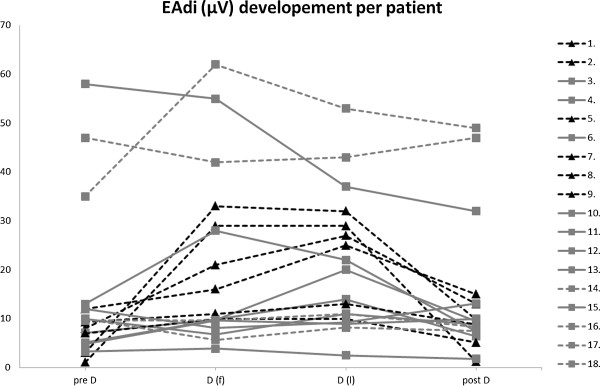
Figure 1
Figure 1
EAdimax values of patients before, during, and after the spontaneous breathing trial. The figure shows the EAdimax values in microvolts for each patient before (pre D) during (D(f) and D(l)), and after a spontaneous breathing trial (SBT). Light grey squares depict EAdimax values of patients successfully passing the SBT (n = 12), with dashed lines highlighting those patients still needing ventilator support after 72 hours (n = 4 of 12). Black triangles depict EAdimax values of patients failing the SBT (n = 6). pre D, baseline values before SBT; D(f), first values after disconnection from the ventilator (after about 5 minutes); D(l), last values before reconnecting to the ventilator; post D, values after about 5 minutes after reconnecting to the ventilator.
Figure 2
Figure 2
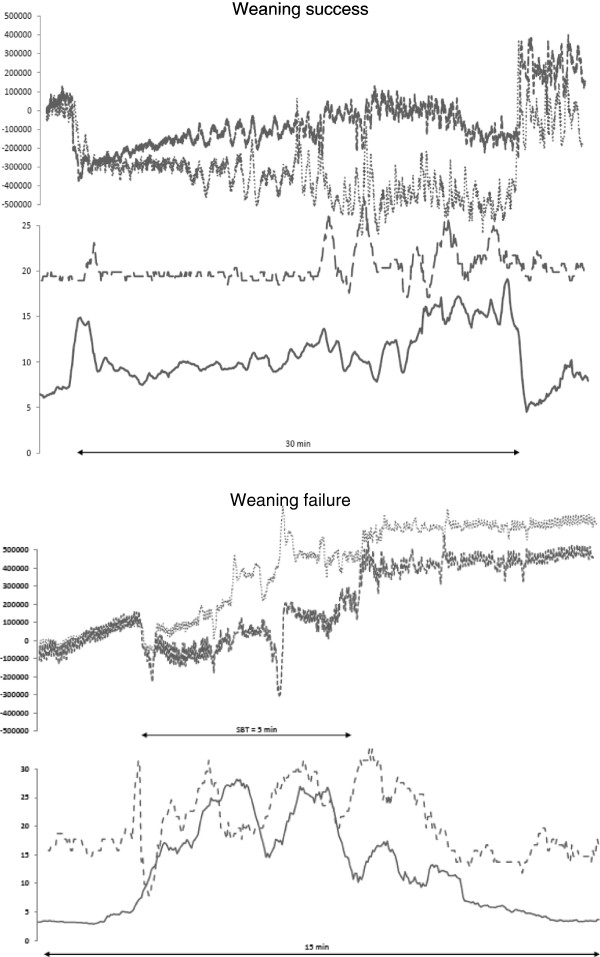
Electrical activity of the diaphragm (EAdimax), respiratory inductive plethysmography (RIP), and respiratory rate (RR) tracings (y-axes) over time (x-axis) of a success (number 6) and a failure patient (number 2) during a spontaneous breathing trial (SBT). The figure shows patient 6 successfully passing the SBT (top), and patient 2, who failed to pass the SBT (bottom). The horizontal line (number 6 SBT, 30 minutes; number 2 SBT, 5 minutes) indicates the duration of the SBT. In each patient, the upper part of the graph shows the RIP tracings from the thoracic (fine dots) and abdominal band (bold dots); the lower part shows the respiratory rate (dashed line) and the EAdimax (solid line). Note the steep increase in EAdimax in patient 2 after disconnection from the ventilator.
Figure 3
Figure 3
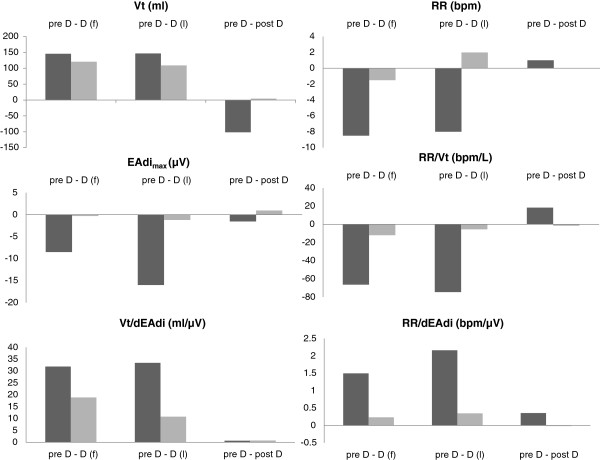
Changes of tidal volume, respiratory rate, electrical activity of the diaphragm, and weaning indices in relation to pre D in failure (n = 6) and success (n = 12) patients. The figure shows the median differences between D(f) and pre D, D(l) and pre D, and post D and pre D for tidal volume (VT), electrical activity of the diaphragm (EAdimax), respiratory rate (RR), and derived indices (RR/dEAdi, VT/dEAdi, and RR/VT) for failure and success patients. Dark columns show failure patients; light columns, success patients.
Figure 4
Figure 4
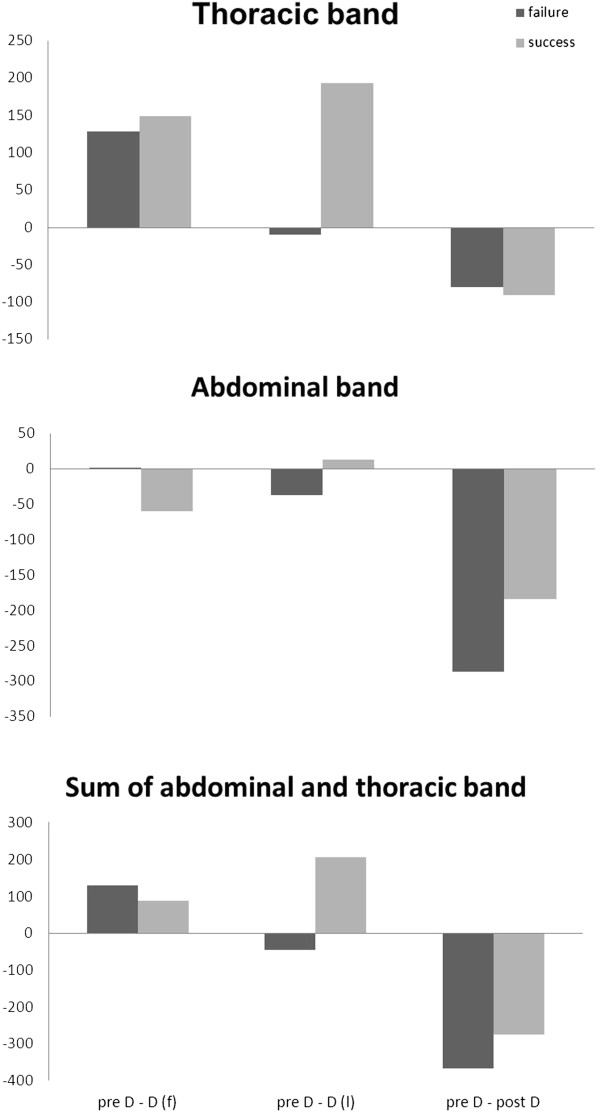
Respiratory inductive plethysmography (RIP) data illustrating changes in lung volume in relation to pre D during the spontaneous breathing trial (in arbitrary units). The figure shows RIP data during an SBT, presented as differences from pre-disconnetion values. Therefore, positive differences stand for a decrease in RIP, and negative differences stand for an increase in RIP. Dark columns represent failure patients, and light columns, the success patients. Please note: Compared with preD, there is a decrease in RIP values to D(f), and D(l); only the failure patients show increased RIP values.

Comment in

  • Probing with the ventilator.
    Tobin MJ. Tobin MJ. Crit Care. 2013 Oct 3;17(5):198. doi: 10.1186/cc13038. Crit Care. 2013. PMID: 24090345 Free PMC article.

References

    1. Yang KL, Tobin MJ. A prospective study of indexes predicting the outcome of trials of weaning from mechanical ventilation. N Engl J Med. 1991;17:1445–1450. doi: 10.1056/NEJM199105233242101. - DOI - PubMed
    1. Berg KM, Lang J, Salciccioli JD, Bak E, Cocchi MN, Gautam S, Donnin MW. The Rapid Shallow Breathing Index as a predictor of failure of noninvasive ventilation for patients with acute respiratory failure. Respir Care. 2012;17:1548–1554. doi: 10.4187/respcare.01597. - DOI - PubMed
    1. Sinderby C, Navalesi P, Beck J, Skrobik Y, Comtois N, Friberg S, Gottfried SB, Lindström L. Neural control of mechanical ventilation in respiratory failure. Nat Med. 1999;17:1433–1436. doi: 10.1038/71012. - DOI - PubMed
    1. Beck J, Reilly M, Grasselli G, Mirabella L, Slutsky AS, Dunn MS, Sinderby C. Patient-ventilator interaction during neurally adjusted ventilatory assist in low birth weight infants. Pediatr Res. 2009;17:663–668. doi: 10.1203/PDR.0b013e31819e72ab. - DOI - PMC - PubMed
    1. Grasselli G, Beck J, Comtois N, Brunet F, Sinderby C. Determination of patient’s contribution to a breath during mechanical ventilation [abstract] Am J Respir Crit Care Med. 2009;17:3070.

Publication types

LinkOut - more resources