. 2013 Nov;51(11):3700-10.
doi: 10.1128/JCM.01605-13. Epub 2013 Aug 28.

Detection of cytomegalovirus drug resistance mutations by next-generation sequencing

Affiliations

Detection of cytomegalovirus drug resistance mutations by next-generation sequencing

Malaya K Sahoo et al. J Clin Microbiol. 2013 Nov.

Abstract

Antiviral therapy for cytomegalovirus (CMV) plays an important role in the clinical management of solid organ and hematopoietic stem cell transplant recipients. However, CMV antiviral therapy can be complicated by drug resistance associated with mutations in the phosphotransferase UL97 and the DNA polymerase UL54. We have developed an amplicon-based high-throughput sequencing strategy for detecting CMV drug resistance mutations in clinical plasma specimens using a microfluidics PCR platform for multiplexed library preparation and a benchtop next-generation sequencing instrument. Plasmid clones of the UL97 and UL54 genes were used to demonstrate the low overall empirical error rate of the assay (0.189%) and to develop a statistical algorithm for identifying authentic low-abundance variants. The ability of the assay to detect resistance mutations was tested with mixes of wild-type and mutant plasmids, as well as clinical CMV isolates and plasma samples that were known to contain mutations that confer resistance. Finally, 48 clinical plasma specimens with a range of viral loads (394 to 2,191,011 copies/ml plasma) were sequenced using multiplexing of up to 24 specimens per run. This led to the identification of seven resistance mutations, three of which were present in <20% of the sequenced population. Thus, this assay offers more sensitive detection of minor variants and a higher multiplexing capacity than current methods for the genotypic detection of CMV drug resistance mutations.


Figures
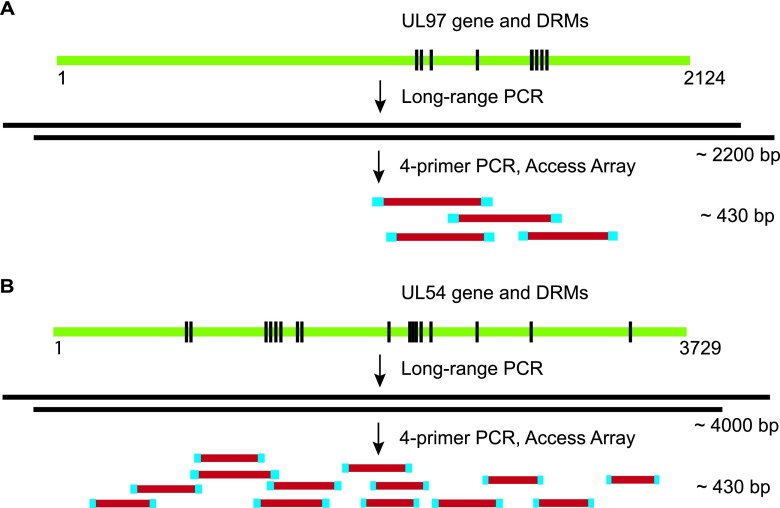
Fig 1
Fig 1
CMV drug resistance mutation testing approach. Long-range PCR, followed by library preparation and bar coding using the Fluidigm Access Array, is shown relative to the UL97 (A) and UL54 (B) genes and known drug resistance mutations across the genes (not drawn to scale). This approach produces 4 overlapping amplicons for UL97 and 13 for UL54, which were pooled and subjected to 454 pyrosequencing using the Roche GS Junior sequencer.
Fig 2
Fig 2
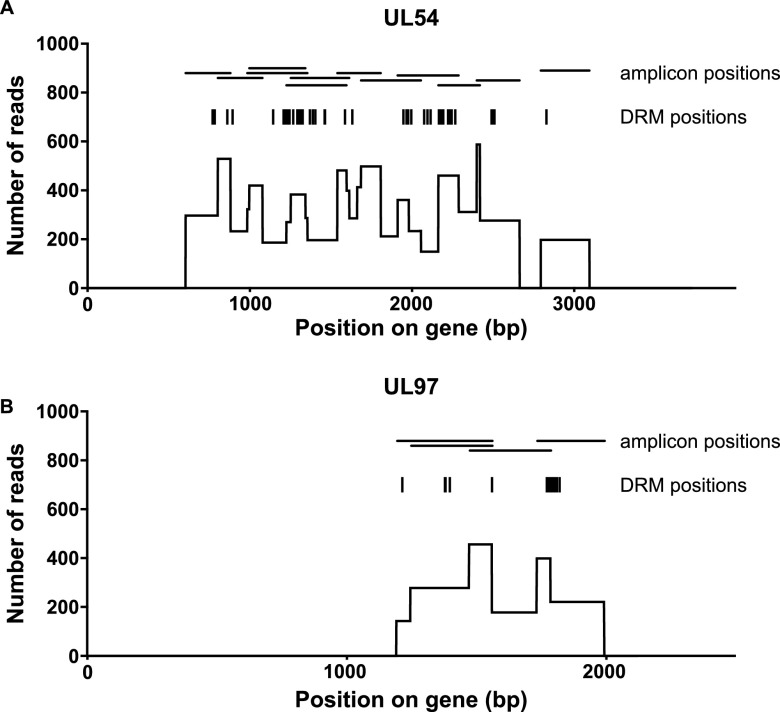
Average read coverage per nucleotide when 24 specimens are sequenced. The data are presented as the mean number of sequencing reads per nucleotide from 24 patient specimens processed and sequenced in a single run. Also shown are the locations of the known drug resistance mutations (DRMs) that were considered in this study and the overlapping amplicons generated during library preparation for the UL54 (A) and UL97 (B) genes.
Fig 3
Fig 3
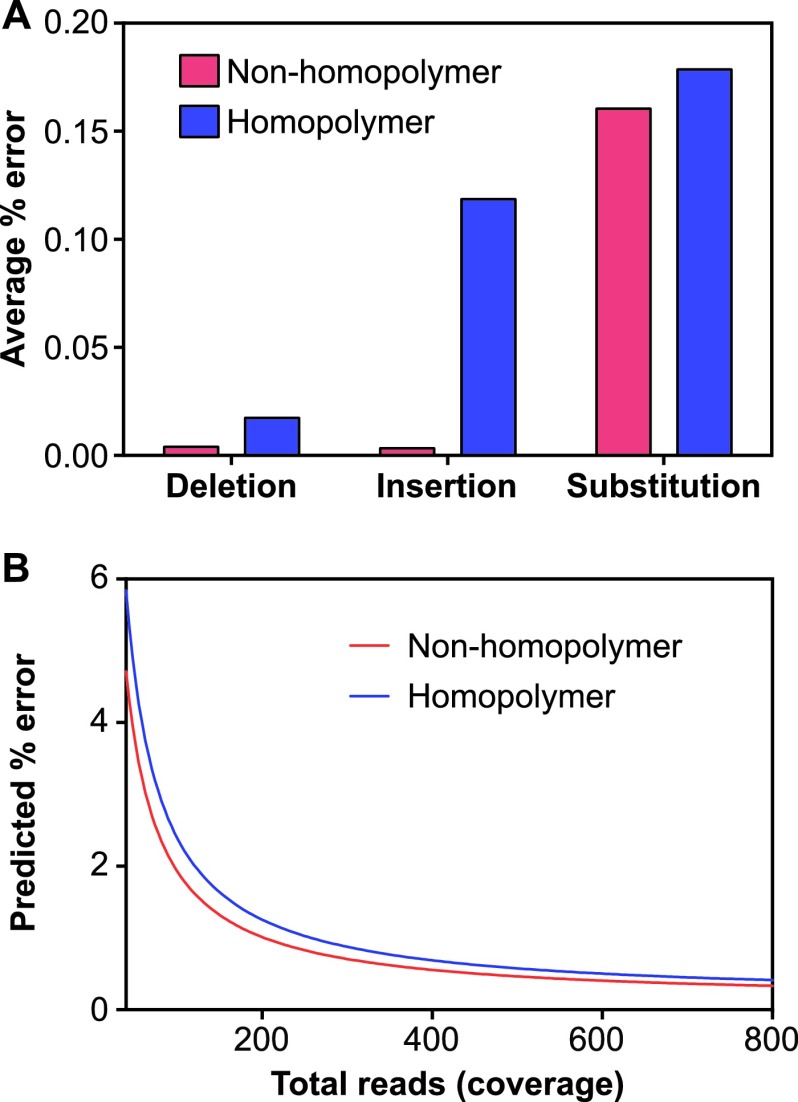
Error rates for plasmid clones in homopolymer and nonhomopolymer regions. (A) Observed error rates per error type and sequence context. UL54 and UL97 plasmid clones mixed at 1,000 copies/ml plasma were processed and sequenced in duplicate. All variant reads called by the GS amplicon variant analyzer compared to Sanger sequencing of the plasmids were considered errors and were calculated as the percentage of the total reads covering a given nucleotide. The data are presented as the average percent error for substitutions, insertions, and deletions in the homopolymer and nonhomopolymer regions. The averages from two independent experiments are shown. (B) Threshold for minor variant detection relative to total read coverage based on empirical error rates for plasmid clones. The covariates included in the negative binomial model were total_reads (number of reads covering a given nucleotide position), copy number (1,000 or 10,000 copies/ml plasma), and location in homopolymer versus nonhomopolymer regions. The average from two independent experiments is shown.
Fig 4
Fig 4
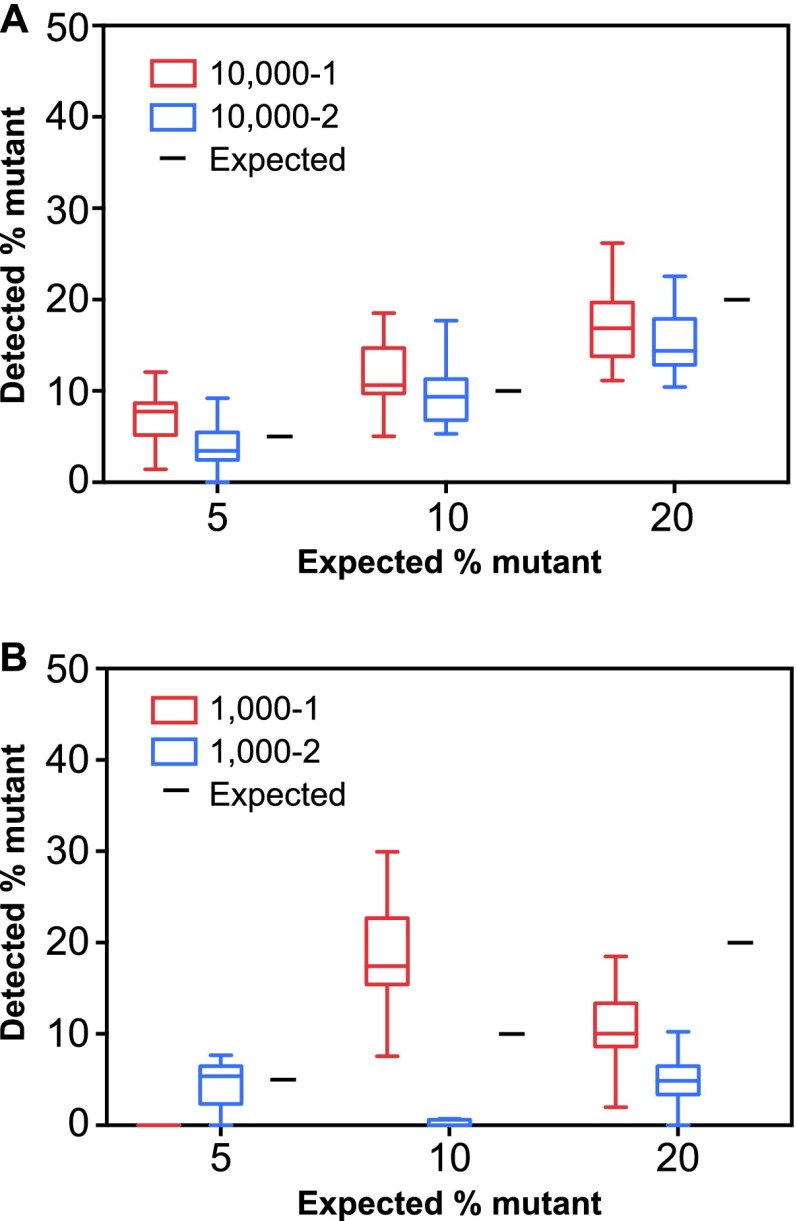
Minor variant detection in mixed plasmid samples. Plasmid clones of UL54 and UL97 derived from wild-type (WT) AD169 and a patient specimen containing multiple resistance mutations (MUT) were mixed at different proportions, such that MUT plasmids represented 5, 10, or 20% of the mixture. There were 33 UL54 and UL97 nucleotide positions where MUT plasmids represented a minority population. The mixing studies were performed at two dilutions, representing 10,000 (A) and 1,000 (B) copies/ml plasma. Each mixture was tested on two separate occasions, indicated as 1 (red) and 2 (blue) on the graphs. The data are presented as box whisker plots of the interquartile ranges (1.5 interquartile range [IQR], Tukey method) of the 33 UL54 and UL97 nucleotide positions for each replicate. The black lines represent the expected MUT percentages.
Fig 5
Fig 5
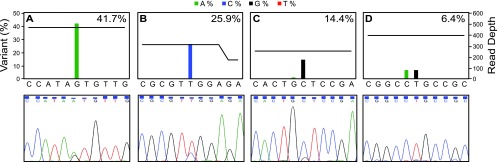
Comparison of next-generation and Sanger sequencing for detecting drug resistance mutations present as minor variants. Sequencing flowgrams (upper panels) and Sanger sequencing electropherograms (lower panels) are shown for four resistance mutations detected in the clinical plasma specimens: T503I in UL54 (A), L595S in UL97 (B), C603W in UL97 (C), and L595S in UL97 (D). The percent variant calls from the amplicon variant analyzer are indicated on the right of each flowgram. The horizontal black line on each flowgram represents the total number of reads covering each mutation and the 5 nucleotides 3′ and 5′ of the mutation.

References

    1. Boeckh M, Geballe AP. 2011. Cytomegalovirus: pathogen, paradigm, and puzzle. J. Clin. Invest. 121:1673–1680 - PMC - PubMed
    1. Baroco AL, Oldfield EC. 2008. Gastrointestinal cytomegalovirus disease in the immunocompromised patient. Curr. Gastroenterol. Rep. 10:409–416 - PubMed
    1. Castagnola E, Cappelli B, Erba D, Rabagliati A, Lanino E, Dini G. 2004. Cytomegalovirus infection after bone marrow transplantation in children. Hum. Immunol. 65:416–422 - PubMed
    1. Owers DS, Webster AC, Strippoli GF, Kable K, Hodson EM. 2013. Pre-emptive treatment for cytomegalovirus viraemia to prevent cytomegalovirus disease in solid organ transplant recipients. Cochrane Database Syst. Rev. 2:CD005133.10.1002/14651858.CD006133.pub3 - DOI - PMC - PubMed
    1. Hodson EM, Ladhani M, Webster AC, Strippoli GF, Craig JC. 2013. Antiviral medications for preventing cytomegalovirus disease in solid organ transplant recipients. Cochrane Database Syst. Rev. 2:CD003774.10.1002/14651858.CD003774.pub3 - DOI - PubMed

Publication types

MeSH terms

LinkOut - more resources