


Optimal multimodal integration in spatial localization
- PMID: 23986259
- PMCID: PMC3756764
- DOI: 10.1523/JNEUROSCI.0523-13.2013
Optimal multimodal integration in spatial localization
Abstract
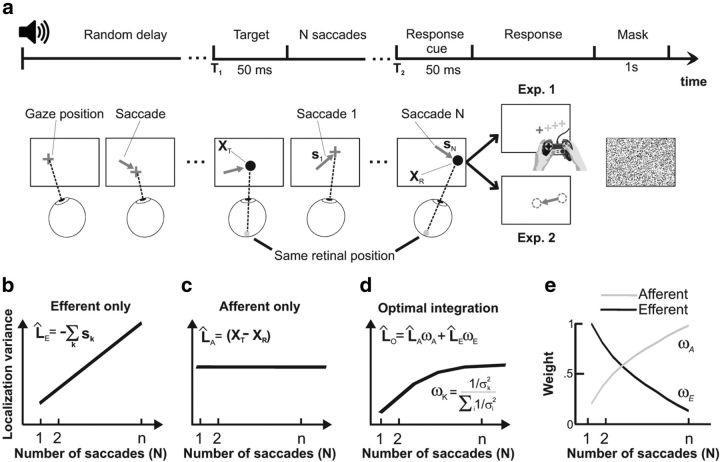
Saccadic eye movements facilitate rapid and efficient exploration of visual scenes, but also pose serious challenges to establishing reliable spatial representations. This process presumably depends on extraretinal information about eye position, but it is still unclear whether afferent or efferent signals are implicated and how these signals are combined with the visual input. Using a novel gaze-contingent search paradigm with highly controlled retinal stimulation, we examined the performance of human observers in locating a previously fixated target after a variable number of saccades, a task that generates contrasting predictions for different updating mechanisms. We show that while localization accuracy is unaffected by saccades, localization precision deteriorates nonlinearly, revealing a statistically optimal combination of retinal and extraretinal signals. These results provide direct evidence for optimal multimodal integration in the updating of spatial representations and elucidate the contributions of corollary discharge signals and eye proprioception.
Figures


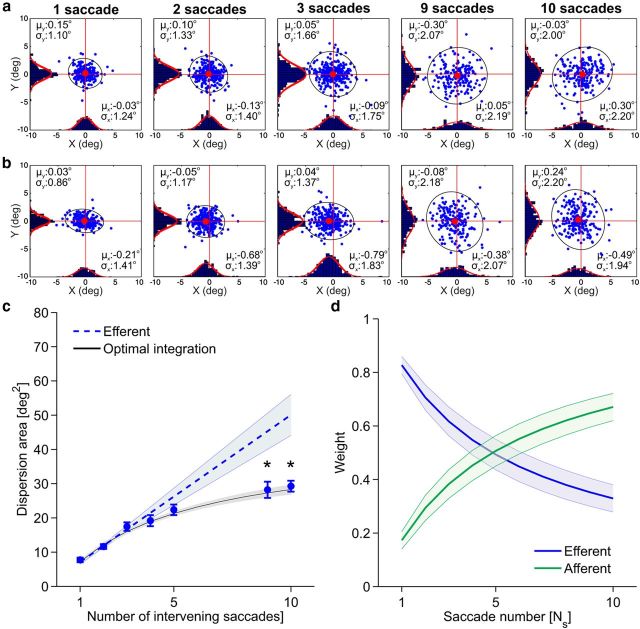
 (μ, σ) (red curves). Data from all subjects (N = 4) were pooled together. b, Same data as in a after rotating the axes to align the abscissa with the cue-target direction. c, Mean dispersion area across subjects as a function of the number of saccades. Asterisks mark significant deviations (p < 0.001, two-tailed paired t tests), from the predictions of a purely efferent estimate, as given by the linear regression of the measurements obtained with the first three saccades (blue line). The black curve represents the least-squares fit of the ideal observer model. d, Optimal weighting of afferent and efferent estimates. As the number of saccades increases, proprioception is weighted more strongly and eventually becomes the predominant source of information. Error bars and shaded regions in c and d represent SEM.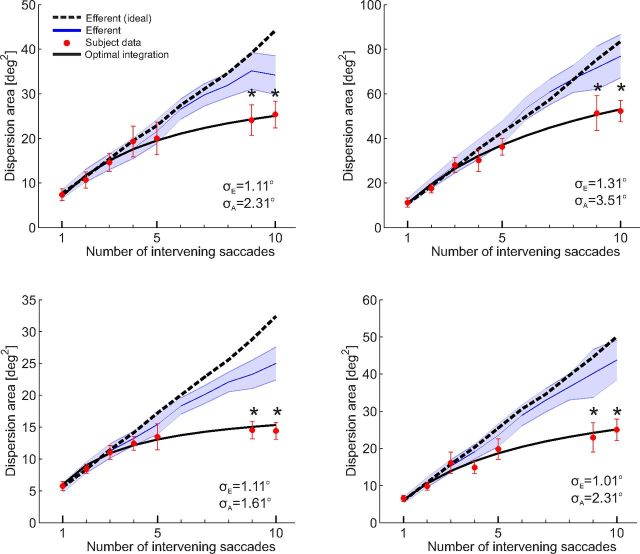


References
-
- Akaike H. A new look at the statistical model identification. IEEE Trans Automat Control. 1974;19:716–723. doi: 10.1109/TAC.1974.1100705. - DOI
-
- Allin F, Velay JL, Bouquerel A. Shift in saccadic direction induced in humans by proprioceptive manipulation: a comparison between memory-guided and visually guided saccades. Exp Brain Res. 1996;110:473–481. - PubMed
Publication types
MeSH terms
Grants and funding
LinkOut - more resources
Full Text Sources
Other Literature Sources
