. 2013 Aug 29;6(1):125.
doi: 10.1186/1754-6834-6-125.

Carbon dioxide fixation by Calvin-Cycle enzymes improves ethanol yield in yeast

Affiliations

Carbon dioxide fixation by Calvin-Cycle enzymes improves ethanol yield in yeast

Víctor Guadalupe-Medina et al. Biotechnol Biofuels. .

Abstract

Background: Redox-cofactor balancing constrains product yields in anaerobic fermentation processes. This challenge is exemplified by the formation of glycerol as major by-product in yeast-based bioethanol production, which is a direct consequence of the need to reoxidize excess NADH and causes a loss of conversion efficiency. Enabling the use of CO2 as electron acceptor for NADH oxidation in heterotrophic microorganisms would increase product yields in industrial biotechnology.

Results: A hitherto unexplored strategy to address this redox challenge is the functional expression in yeast of enzymes from autotrophs, thereby enabling the use of CO2 as electron acceptor for NADH reoxidation. Functional expression of the Calvin cycle enzymes phosphoribulokinase (PRK) and ribulose-1,5-bisphosphate carboxylase (Rubisco) in Saccharomyces cerevisiae led to a 90% reduction of the by-product glycerol and a 10% increase in ethanol production in sugar-limited chemostat cultures on a mixture of glucose and galactose. Co-expression of the Escherichia coli chaperones GroEL and GroES was key to successful expression of CbbM, a form-II Rubisco from the chemolithoautotrophic bacterium Thiobacillus denitrificans in yeast.

Conclusions: Our results demonstrate functional expression of Rubisco in a heterotrophic eukaryote and demonstrate how incorporation of CO2 as a co-substrate in metabolic engineering of heterotrophic industrial microorganisms can be used to improve product yields. Rapid advances in molecular biology should allow for rapid insertion of this 4-gene expression cassette in industrial yeast strains to improve production, not only of 1st and 2nd generation ethanol production, but also of other renewable fuels or chemicals.


Figures
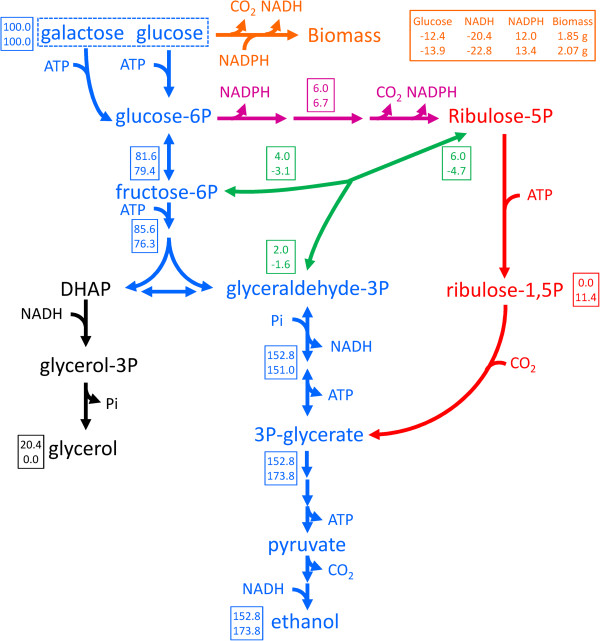
Figure 1
Figure 1
Schematic representation of central carbon metabolism and the introduced Calvin-cycle enzymes in Saccharomyces cerevisiae. Orange: Formation of biomass and NADH from glucose and NADPH. Stoichiometries are according to Verduyn et al.[7]; Blue: Redox-neutral, ATP-yielding alcoholic fermentation of glucose and galactose via the Embden-Meyerhof-Parnas glycolysis and Leloir pathways, respectively; Magenta: NADPH generation via the oxidative part of the pentose-phosphate pathway; Green: rearrangement of sugar-phosphate carbon skeletons via the non-oxidative pentose-phosphate pathway; Black: NADH oxidation by formation of glycerol through glycerol-3-phosphate dehydrogenase and glycerol-3-phosphatase; Red: heterologously expressed Calvin-cycle enzymes phosphoribulokinase and Rubisco. Numbers in boxes represents the distribution of carbon along the different pathways (in mmol) normalized for a combined glucose and galactose uptake of 100 mmol for a wild-type, glycerol-producing reference strain (top) and for a scenario in which the alternative pathways via the Calvin cycle enzymes completely replace glycerol formation as the mechanism for reoxidizing NADH formed in biosynthetic reactions (bottom). In the scenario with the Calvin cycle enzymes, ribulose-5-phosphate was assumed to be preferentially derived from the oxidative reactions of the pentose phosphate pathway. Once the generation of NADPH from these reactions matched the requirement for NADPH in biosynthesis, further ribulose-5-phosphate was derived from glycolytic intermediates via the non-oxidative pentose-phosphate pathway rearrangement reactions. The biomass yield on ATP was assumed to be identical for both scenarios.
Figure 2
Figure 2
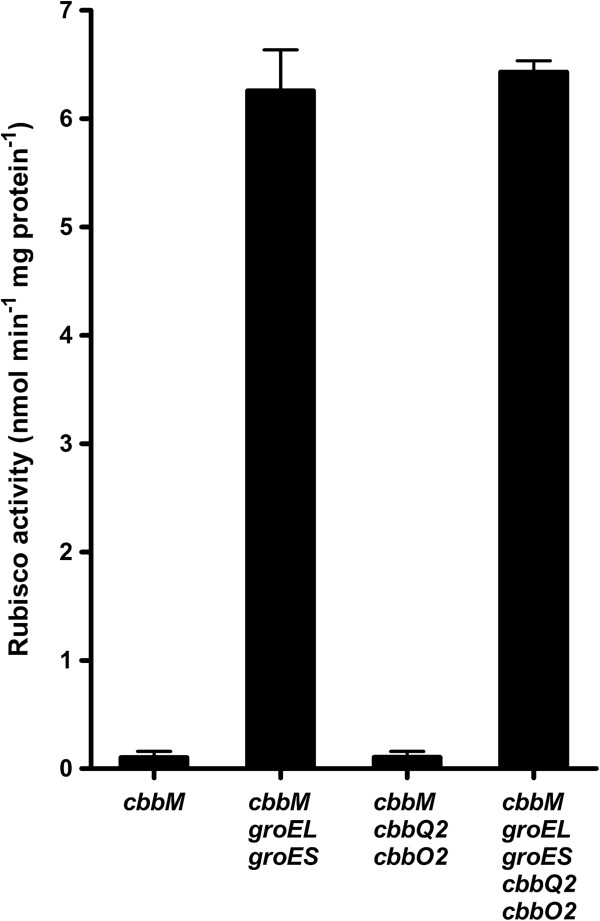
Rubisco enzymatic activity in S. cerevisiae strains expressing different synthetic constructs. Specific ribulose-1,5-bisphosphate carboxylase (Rubisco) activity in cell extracts of S. cerevisiae expressing Rubisco form II CbbM from T. denitrificans, either alone (IMC033) or in combination with the E. coli chaperones GroEL/GroES [18] (IMC035), the T. denitrificans chaperones CbbO2/CbbQ2 [20] (IMC034) or all four chaperones (IMC014). Heterologously expressed genes were codon optimised for expression in yeast and expressed from a single centromeric vector. Biomass samples were taken from anaerobic batch cultures on synthetic media (pH 5.0, 30°C), sparged with nitrogen and containing 20 g l-1 glucose as carbon source. Rubisco activities, measured as 14CO2-fixation in cell extracts, in a wild-type reference strain and in S. cerevisiae strains expressing cbbM and cbbM-cbbQ2-cbbO2 were below the detection limit of the enzyme assay (0.2 nmol CO2 min-1 mg protein-1).
Figure 3
Figure 3
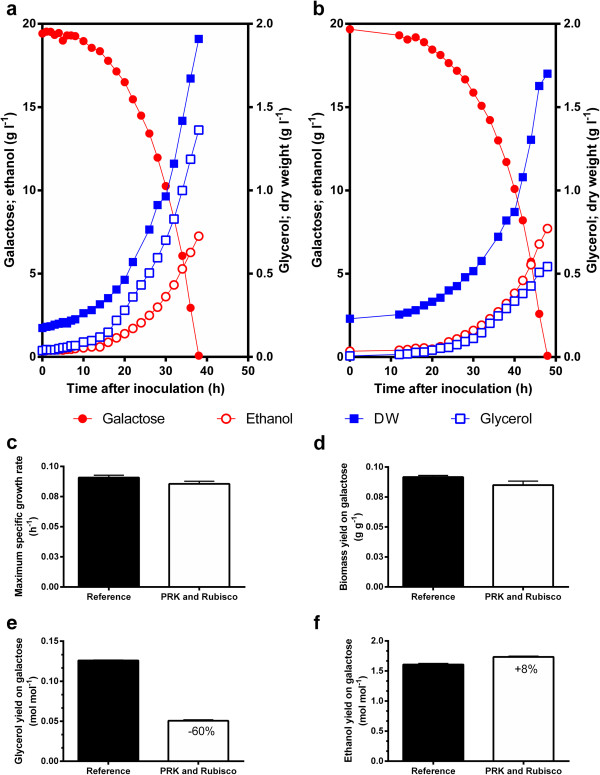
Physiological impact of expression of Calvin cycle enzymes on growth, substrate consumption and product formation in galactose-grown anaerobic batch cultures of S. cerevisiae. a: growth curves of isogenic reference strain S. cerevisiae IMU032, b: growth curves of S. cerevisiae IMU033 expressing PRK and Rubisco. Growth conditions: T = 30°C, pH 5.0, 10% CO2 in inlet gas. Each graph represents values for one of two independent replicate experiments, whose growth kinetic parameters differed by less than 5%. c-f: Calculated parameters: Maximum specific growth rate (c), biomass yield (d), glycerol yield (e), and ethanol yield (f) on galactose of the isogenic S. cerevisiae reference (black bars) and strain expressing PRK and Rubisco (white bars). Results are represented as average ± mean deviations of data from independent duplicate cultures. Values inside the white bars represent statistically significant differences in a standard t-test (p value < 0.02) relative to the reference strain.
Figure 4
Figure 4
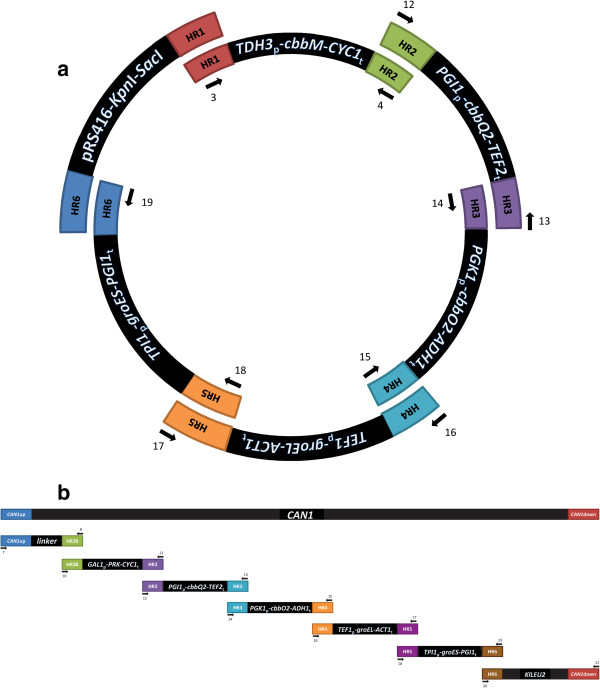
Strategy for the heterologous expression of Rubisco and PRK in S. cerevisiae. (a)In vivo assembly of Rubisco expression plasmid pUDC075, and (b)in vivo assembly and integration of PRK and chaperone proteins in CAN1 locus of Saccharomyces cerevisiae strain IMI229. Each fragment represents a different expression cassette or plasmid backbone. All fragments used in assembly experiments were flanked by 60-bp sequences used for in vivo recombination, either enabling the assembly of plasmids or the integration assembled constructs into the S. cerevisiae genome. Arrows and numbers indicate primers used in the construction of the cassette.

References

    1. World Fuel Ethanol Production. http://ethanolrfa.org/pages/World-Fuel-Ethanol-Production.
    1. Hong KK, Nielsen J. Metabolic engineering of Saccharomyces cerevisiae: a key cell factory platform for future biorefineries. Cell Mol Life Sci. 2012;69:2671–2690. doi: 10.1007/s00018-012-0945-1. - DOI - PMC - PubMed
    1. Nielsen J, Larsson C, van Maris A, Pronk J. Metabolic engineering of yeast for production of fuels and chemicals. Curr Opin Biotechnol. 2013;24:398–404. doi: 10.1016/j.copbio.2013.03.023. - DOI - PubMed
    1. van Dijken JP, Scheffers WA. Redox balances in the metabolism of sugars by yeasts. FEMS Microbiol Rev. 1986;32:199–224.
    1. Nissen TL, Kielland-Brandt MC, Nielsen J, Villadsen J. Optimization of ethanol production in Saccharomyces cerevisiae by metabolic engineering of the ammonium assimilation. Metab Eng. 2000;2:69–77. doi: 10.1006/mben.1999.0140. - DOI - PubMed