


Review
doi: 10.1159/000353602.
Epub 2013 Aug 28.
The Anopheles innate immune system in the defense against malaria infection
Affiliations
- PMID: 23988482
- PMCID: PMC3939431
- DOI: 10.1159/000353602
Item in Clipboard
Review
The Anopheles innate immune system in the defense against malaria infection
J Innate Immun.
2014.
Abstract
The multifaceted innate immune system of insects is capable of fighting infection by a variety of pathogens including those causing human malaria. Malaria transmission by the Anopheles mosquito depends on the Plasmodium parasite's successful completion of its lifecycle in the insect vector, a process that involves interactions with several tissues and cell types as well as with the mosquito's innate immune system. This review will discuss our current understanding of the Anopheles mosquito's innate immune responses against the malaria parasite Plasmodium and the influence of the insect's intestinal microbiota on parasite infection.
Copyright © 2013 S. Karger AG, Basel.
Figures
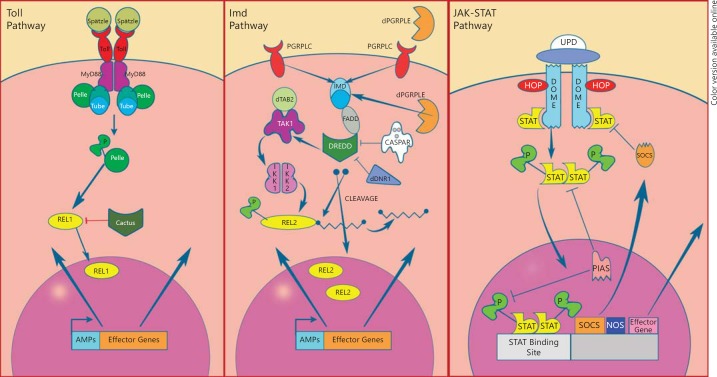
The Toll, Imd and JAK-STAT immune signaling pathways. Upon the recognition of bacteria or Plasmodium, the Toll pathway is stimulated by the binding of the ligand Spätzle with the Toll transmembrane receptor. This triggers a series of molecular events that culminate in the activation and translocation of Rel1 into the nucleus, upregulating the transcription of immune genes that are responsible for microbial killing. Numerous studies conducted in Anopheles have highlighted the Imd pathway as the most efficient immune pathway in the defense against the human malaria parasite, P. falciparum. The Imd pathway is stimulated when the transmembrane PGRP-LC receptor recognizes bacteria or Plasmodium. This leads to a signaling cascade that will result in the cleavage of Rel2-F and the translocation of active Rel2-S into the nucleus, upregulating the transcription of immune genes. The JAK-STAT immune signaling pathwayhas been implicated in antibacterial, antiviral and antiplasmodial defense in mosquitoes. The JAK-STAT pathway is initiated by the binding of the cytokine ligand UPD to the transmembrane receptor DOME. This then leads to the eventual nuclear translocation of STAT and transcriptional activation of immune effector genes.
References
-
- Baton LA, Ranford-Cartwright LC. How do malaria ookinetes cross the mosquito midgut wall? Trends Parasitol. 2005;21:22–28. - PubMed
-
- Whitten MM, Shiao SH, Levashina EA. Mosquito midguts and malaria: cell biology, compartmentalization and immunology. Parasite Immunol. 2006;28:121–130. - PubMed
-
- Sinden RE, Billingsley PF. Plasmodium invasion of mosquito cells: hawk or dove? Trends Parasitol. 2001;17:209–212. - PubMed
-
- Baton LA, Ranford-Cartwright LC. Plasmodium falciparum ookinete invasion of the midgut epithelium of Anopheles stephensi is consistent with the time bomb model. Parasitology. 2004;129:663–676. - PubMed
Publication types
MeSH terms
Grants and funding
LinkOut - more resources
Full Text Sources
Other Literature Sources
Medical
