


Nutrient profiles of vegetarian and nonvegetarian dietary patterns
- PMID: 23988511
- PMCID: PMC4081456
- DOI: 10.1016/j.jand.2013.06.349
Nutrient profiles of vegetarian and nonvegetarian dietary patterns
Abstract
Background: Differences in nutrient profiles between vegetarian and nonvegetarian dietary patterns reflect nutritional differences that can contribute to the development of disease.
Objective: Our aim was to compare nutrient intakes between dietary patterns characterized by consumption or exclusion of meat and dairy products.
Design: We conducted a cross-sectional study of 71,751 subjects (mean age=59 years) from the Adventist Health Study 2. Data were collected between 2002 and 2007. Participants completed a 204-item validated semi-quantitative food frequency questionnaire. Dietary patterns compared were nonvegetarian, semi-vegetarian, pesco vegetarian, lacto-ovo vegetarian, and strict vegetarian. Analysis of covariance was used to analyze differences in nutrient intakes by dietary patterns and was adjusted for age, sex, and race. Body mass index and other relevant demographic data were reported and compared by dietary pattern using χ(2) tests and analysis of variance.
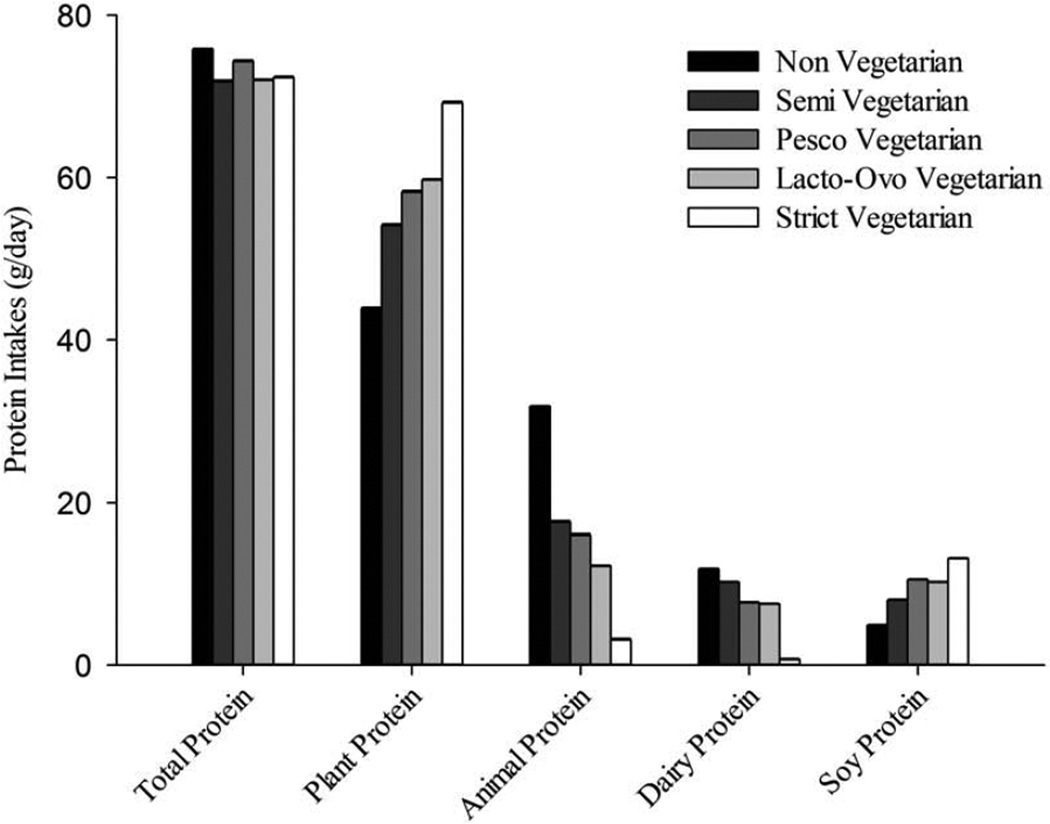
Results: Many nutrient intakes varied significantly between dietary patterns. Nonvegetarians had the lowest intakes of plant proteins, fiber, beta carotene, and magnesium compared with those following vegetarian dietary patterns, and the highest intakes of saturated, trans, arachidonic, and docosahexaenoic fatty acids. The lower tails of some nutrient distributions in strict vegetarians suggested inadequate intakes by a portion of the subjects. Energy intake was similar among dietary patterns at close to 2,000 kcal/day, with the exception of semi-vegetarians, who had an intake of 1,707 kcal/day. Mean body mass index was highest in nonvegetarians (mean=28.7 [standard deviation=6.4]) and lowest in strict vegetarians (mean=24.0 [standard deviation=4.8]).
Conclusions: Nutrient profiles varied markedly among dietary patterns that were defined by meat and dairy intakes. These differences are of interest in the etiology of obesity and chronic diseases.
Keywords: Dietary pattern; Minerals; Nutrient profile; Vegetarian; Vitamins.
Copyright © 2013 Academy of Nutrition and Dietetics. Published by Elsevier Inc. All rights reserved.
Figures
Comment in
-
Inadequate vitamin B-12 intake may be a problem not just for a small number of Adventist vegans.J Acad Nutr Diet. 2014 Feb;114(2):197. doi: 10.1016/j.jand.2013.12.004. J Acad Nutr Diet. 2014. PMID: 24439818 No abstract available.
-
Authors' response.J Acad Nutr Diet. 2014 Feb;114(2):197-198. doi: 10.1016/j.jand.2013.12.003. J Acad Nutr Diet. 2014. PMID: 24439819 No abstract available.
References
-
- Willett W. Lessons from dietary studies in Adventists and questions for the future. Am J Clin Nutr. 2003;78:539S–543S. - PubMed
-
- Vang A, Singh PN, Lee JW, Haddad EH, Brinegar CH. Meats, processed meats, obesity, weight gain and occurrence of diabetes among adults: findings from Adventist Health Studies. Ann Nutr Metab. 2008;52:96–104. - PubMed
-
- Fraser GE. Diet as primordial prevention in Seventh-Day Adventists. Prev Med. 1999;29:S18–S23. - PubMed
Publication types
MeSH terms
Substances
Grants and funding
LinkOut - more resources
Full Text Sources
Other Literature Sources
Medical
