


Effect of early antiretroviral therapy on sexual behaviors and HIV-1 transmission risk among adults with diverse heterosexual partnership statuses in Côte d'Ivoire
- PMID: 23990567
- PMCID: PMC3883172
- DOI: 10.1093/infdis/jit470
Effect of early antiretroviral therapy on sexual behaviors and HIV-1 transmission risk among adults with diverse heterosexual partnership statuses in Côte d'Ivoire
Abstract
Background: The effect of early initiation of antiretroviral therapy (ART; ie, at CD4(+) T-cell counts >350 cells/mm(3)) on sexual behaviors and human immunodeficiency virus type 1 (HIV) transmission risk has not been documented in populations other than HIV-serodiscordant couples in stable relationships.
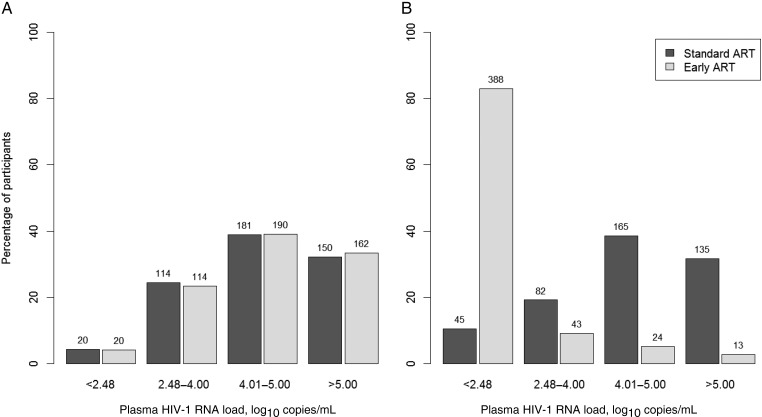
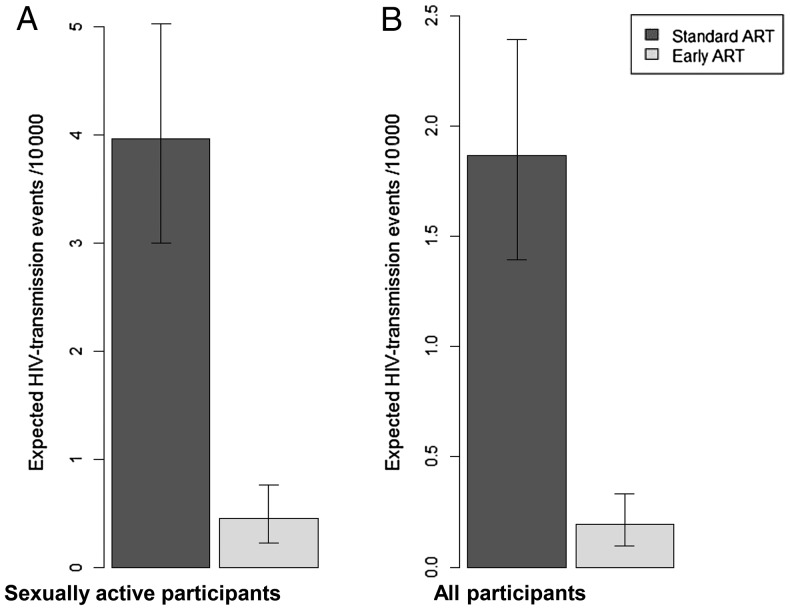
Methods: On the basis of data from a behavioral study nested in a randomized, controlled trial (Temprano-ANRS12136) of early ART, we compared proportions of risky sex (ie, unprotected sex with a partner of negative/unknown HIV status) reported 12 months after inclusion between participants randomly assigned to initiate ART immediately (hereafter, "early ART") or according to ongoing World Health Organization criteria. Group-specific HIV transmission rates were estimated on the basis of sexual behaviors and viral load-specific per-act HIV transmission probabilities. The ratio of transmission rates was computed to estimate the protective effect of early ART.
Results: Among 957 participants (baseline median CD4(+) T-cell count, 478 cells/mm(3)), 46.0% reported sexual activity in the past month; of these 46.0%, sexual activity for 41.5% involved noncohabiting partners. The proportion of subjects who engaged in risky sex was 10.0% in the early ART group, compared with 12.8% in the standard ART group (P = .17). After accounting for sexual behaviors and viral load, we estimated that the protective effect of early ART was 90% (95% confidence interval, 81%-95%).
Conclusion: Twelve months after inclusion, patients in the early and standard ART groups reported similar sexual behaviors. Early ART decreased the estimated risk of HIV transmission by 90%, suggesting a major prevention benefit among seronegative sex partners in stable or casual relationships with seropositive individuals.
Keywords: HIV prevention; HIV-1 sexual transmission; antiretroviral treatment; epidemiology; sexual behaviors; sub-Saharan Africa; treatment as prevention.
Figures
References
-
- Quinn TC, Wawer MJ, Sewankambo N, et al. Viral load and heterosexual transmission of human immunodeficiency virus type 1. Rakai Project Study Group. N Engl J Med. 2000;342:921–9. - PubMed
-
- Vernazza P, Hirschel B, Bernasconi E, Flepp M. Les personnes séropositives ne souffrant d'aucune autre MST et suivant un traitement antirétroviral efficace ne transmettent pas le VIH par voie sexuelle. Bull Med Suisse. 2008 89:5, pp165–169.
-
- Granich RM, Gilks CF, Dye C, De Cock KM, Williams BG. Universal voluntary HIV testing with immediate antiretroviral therapy as a strategy for elimination of HIV transmission: a mathematical model. Lancet. 2009;373:48–57. - PubMed
Publication types
MeSH terms
Substances
LinkOut - more resources
Full Text Sources
Other Literature Sources
Medical
Research Materials
Miscellaneous
