Review
. 2013 Dec;94(6):1167-84.
doi: 10.1189/jlb.0313153. Epub 2013 Aug 29.

Cellular stress response and innate immune signaling: integrating pathways in host defense and inflammation

Affiliations
Review

Cellular stress response and innate immune signaling: integrating pathways in host defense and inflammation

Sujatha Muralidharan et al. J Leukoc Biol. 2013 Dec.

Abstract

Extensive research in the past decade has identified innate immune recognition receptors and intracellular signaling pathways that culminate in inflammatory responses. Besides its role in cytoprotection, the importance of cell stress in inflammation and host defense against pathogens is emerging. Recent studies have shown that proteins in cellular stress responses, including the heat shock response, ER stress response, and DNA damage response, interact with and regulate signaling intermediates involved in the activation of innate and adaptive immune responses. The effect of such regulation by cell stress proteins may dictate the inflammatory profile of the immune response during infection and disease. In this review, we describe the regulation of innate immune cell activation by cell stress pathways, present detailed descriptions of the types of stress response proteins and their crosstalk with immune signaling intermediates that are essential in host defense, and illustrate the relevance of these interactions in diseases characteristic of aberrant immune responses, such as chronic inflammatory diseases, autoimmune disorders, and cancer. Understanding the crosstalk between cellular stress proteins and immune signaling may have translational implications for designing more effective regimens to treat immune disorders.

Keywords: DNA damage; ER stress; PRR signaling; heat shock; innate immune response; oxidative stress.


Figures
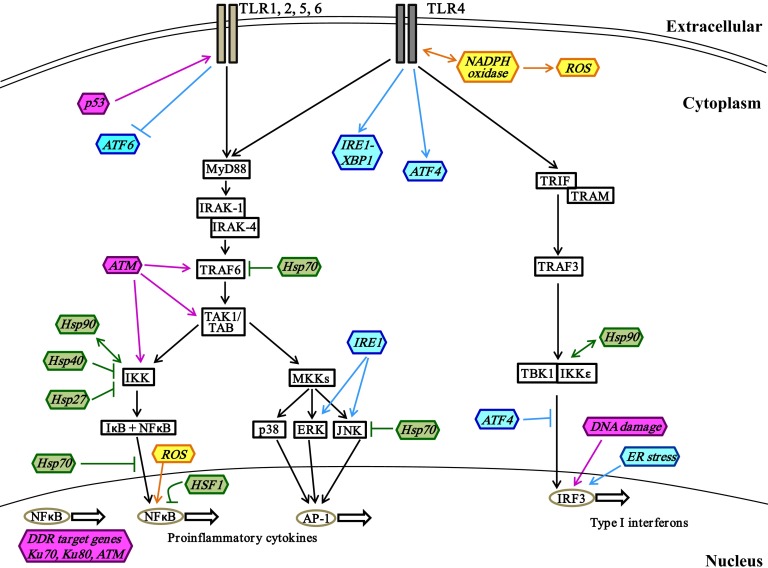
Figure 1.
Figure 1.. Interactions of stress proteins and cell surface TLR signaling pathways.
Engagement of cell surface TLR1, -2, -4, -5, or -6 initiates the MyD88-dependent signaling pathway, which results in activation of the downstream IKK and MKK signaling branches. Each of these branches induces expression of proinflammatory cytokines such as TNFα, IL-6, and IL-1β by the transcription factors NF-κB and AP-1. The TRIF-dependent signaling branch downstream of TLR4 results in expression of type I IFNs mediated by IRF3. The regulatory roles of stress proteins important in oxidative stress (yellow), heat shock response (green), UPR (blue), and DDR (pink) in these TLR signaling pathways are illustrated. →, stimulation; ↔, direct interaction; ⫞, inhibition.
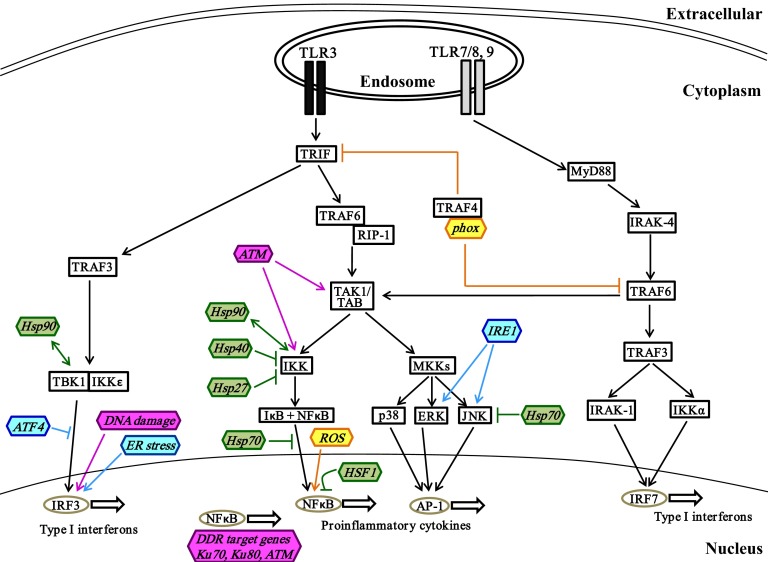
Figure 2.
Figure 2.. Interactions of stress proteins and endosomal TLR signaling pathways.
Endosomal TLR7/8 or -9 activation induces the expression of type I IFNs such as IFNα and -β via MyD88-dependent activation of IRF7, in addition to NF-κB- and AP-1-induced proinflammatory cytokines. The TRIF-dependent signaling branch downstream of TLR3 results in expression of type I IFNs mediated by IRF3. The regulatory roles of stress proteins important in oxidative stress (yellow), heat shock response (green), UPR (blue), and DDR (pink) in these TLR signaling pathways are illustrated. →, stimulation; ↔, direct interaction; ⫞, inhibition.
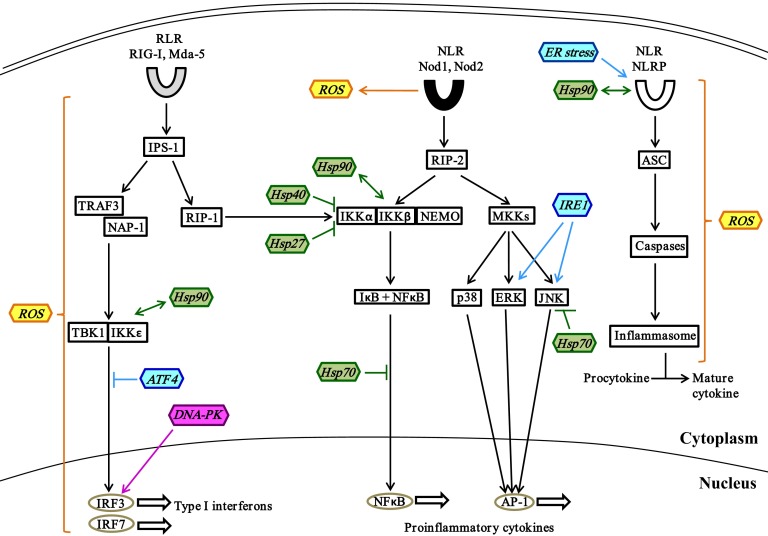
Figure 3.
Figure 3.. Stress proteins in crosstalk with cytoplasmic PRR signaling.
Activation of cytoplasmic RLRs by viral RNA leads to IRF3- and -7-mediated induction of type I IFNs via the IPS-1–TRAF3–TBK1 pathway. DNA-PK, a DDR protein, can also act as a cytoplasmic PRR to induce expression of type I IFNs. IPS-1-activated RIP-1 also induces the expression of proinflammatory cytokines by activating the NF-κB pathway. The recognition of bacterial peptidoglycans by the NLRs Nod1 and -2 upregulates the expression of proinflammatory cytokines via activation of NF-κB and MKK pathways. Cytoplasmic NLRPs induce activation of inflammasomes via ASC and caspases and is essential for processing of procytokines into their active forms. The crosstalk of stress proteins generated by oxidative stress (yellow), heat shock response (green), UPR (blue), DDR (pink) and cytoplasmic PRR signaling is illustrated. →, stimulation; ↔, direct interaction; ⫞, inhibition.
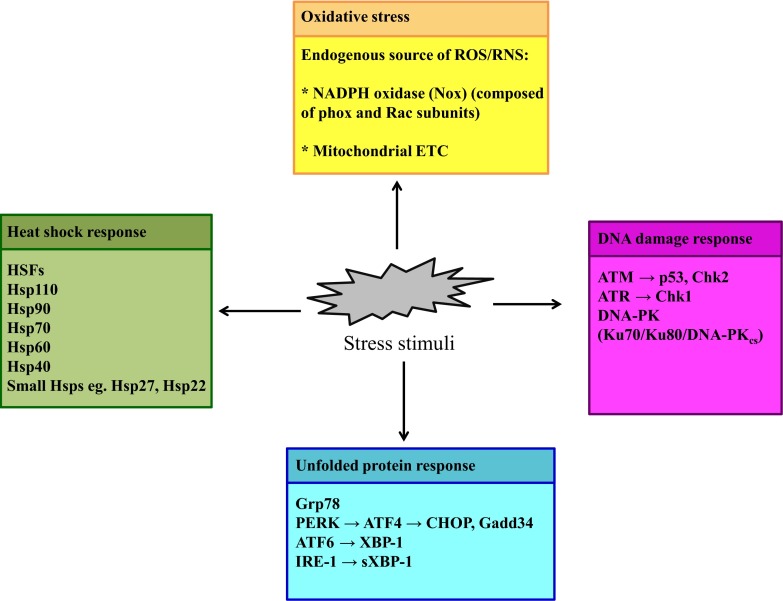
Figure 4.
Figure 4.. Cellular stress responses.
Exposure to stress stimuli (e.g., bacteria, viruses, radiation, and environmental toxins) induces cytoprotective responses that restore cellular homeostasis. Oxidative stress (yellow) is an example of stress that is a result of an oxidant–antioxidant imbalance in cells. The stress responses are categorized into heat shock response (green), UPR (blue), and DDR (pink). The major proteins or molecules responsible for mediating these stresses and stress responses and that play a pivotal role in innate immune signaling are enumerated.
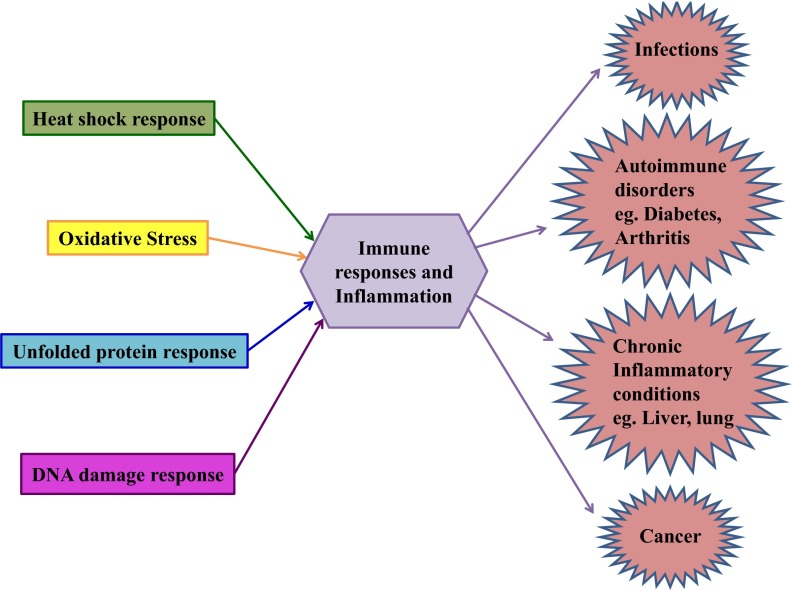
Figure 5.
Figure 5.. Clinical consequences of crosstalk between stress proteins and immune signaling molecules.
The clinical consequences of crosstalk between immune signaling and the individual stress responses in the context of infection, autoimmunity, chronic inflammation, and cancer are illustrated. The cellular stresses are categorized into oxidative stress (yellow), heat shock response (green), UPR(blue), and DDR (pink).

References

    1. Kumar H., Kawai T., Akira S. (2011) Pathogen recognition by the innate immune system. Int. Rev. Immunol. 30, 16–34 - PubMed
    1. Kawai T., Akira S. (2011) Regulation of innate immune signalling pathways by the tripartite motif (TRIM) family proteins. EMBO Mol. Med. 3, 513–527 - PMC - PubMed
    1. Akira S., Takeda K., Kaisho T. (2001) Toll-like receptors: critical proteins linking innate and acquired immunity. Nat. Immunol. 2, 675–680 - PubMed
    1. Medzhitov R., Janeway C. A., Jr. (1997) Innate immunity: impact on the adaptive immune response. Curr. Opin. Immunol. 9, 4–9 - PubMed
    1. Fulda S., Gorman A. M., Hori O., Samali A. (2010) Cellular stress responses: cell survival and cell death. Int. J. Cell Biol. 2010, 214074. - PMC - PubMed

Publication types