Anginal symptoms, coronary artery disease, and adverse outcomes in Black and White women: the NHLBI-sponsored Women's Ischemia Syndrome Evaluation (WISE) study
- PMID: 23992103
- PMCID: PMC3768228
- DOI: 10.1089/jwh.2012.4031
Anginal symptoms, coronary artery disease, and adverse outcomes in Black and White women: the NHLBI-sponsored Women's Ischemia Syndrome Evaluation (WISE) study
Abstract
Background: Black women are less likely to be evaluated and treated for anginal symptoms, despite a higher premature cardiac mortality rate compared to white women. Our objective was to compare angina symptoms in black versus white women regarding (1) angina symptoms characterization; (2) relationship with obstructive coronary artery disease (CAD); and (3) relationship with subsequent mortality.
Methods: A cohort of 466 women (69 black and 397 white) undergoing coronary angiography for suspected ischemia and without prior history of CAD completed symptom checklists. Four symptom clusters (CHEST, UPPER, STOMACH, and TYPICAL TRIGGERS) were derived by factor analysis. All angiograms were analyzed by core lab. Mortality data over 10 years were obtained from National Death Index.
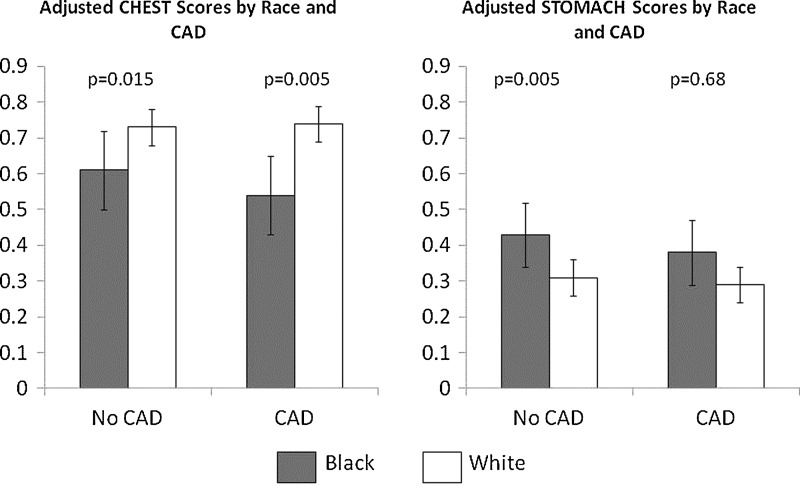
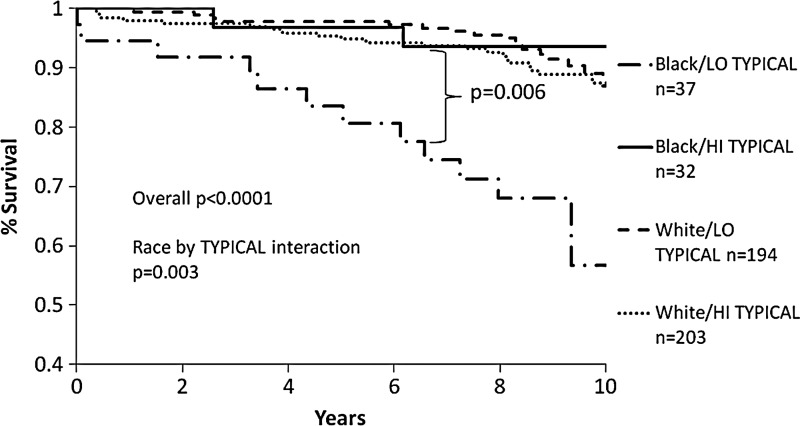
Results: (1) Black women had lower mean CHEST cluster scores (0.60±0.30 vs. 0.73±30, p=0.002), but higher STOMACH scores (0.41±0.25 vs. 0.30±0.25, p=0.011) than white women. (2) Prevalence and severity of CAD did not differ in black and white women and was not predicted by symptom cluster scores. (3) All-cause mortality rates were 24.9% in blacks versus 14.5% in whites, p=0.007; and cardiovascular mortality 22.5% vs.8.8%, p=0.001. Symptom clusters were not predictive of adverse events in white women. However, black women with a low TYPICAL score had significantly higher mortality compared to those with a high TYPICAL score (43% vs. 10%, p=0.006).
Conclusions: Among women undergoing coronary angiography, black women report fewer chest-related and more stomach-related symptoms, regardless of presence or severity of CAD, and these racial symptom presentation differences are linked with the more adverse prognosis observed in the black women. Atypical symptom presentation may be a barrier to appropriate and timely diagnosis and treatment and contribute to poorer outcomes for black women.
Figures
References
-
- Ford ES. Capewell S. Coronary heart disease mortality among young adults in the U.S. from 1980 through 2002: Concealed leveling of mortality rates. J Am Coll Cardiol. 2007;50:2128–2132. - PubMed
-
- Barnhart J. Bernstein SJ. Is coronary angiography underused in an inner-city population? Ethn Dis. 2006;16:659–665. - PubMed
-
- Hendricks AS. Goodman B. Stein JH. Carnes M. Gender differences in acute myocardial infarction: the University of Wisconsin experience. WMJ. 1999;98:30–33. , 36. - PubMed
-
- Klingler D. Green-Weir R. Nerenz D, et al. Perceptions of chest pain differ by race. Am Heart J. 2002;144:51–59. - PubMed
Publication types
MeSH terms
LinkOut - more resources
Full Text Sources
Other Literature Sources
Medical
Miscellaneous