


Review
doi: 10.1016/j.cell.2013.08.014.
Cyclic dinucleotides and the innate immune response
Affiliations
- PMID: 23993090
- PMCID: PMC3931520
- DOI: 10.1016/j.cell.2013.08.014
Item in Clipboard
Review
Cyclic dinucleotides and the innate immune response
Cell.
.
Abstract
Cyclic dinucleotides (CDNs) have been previously recognized as important secondary signaling molecules in bacteria and, more recently, in mammalian cells. In the former case, they represent secondary messengers affecting numerous responses of the prokaryotic cell, whereas in the latter, they act as agonists of the innate immune response. Remarkable new discoveries have linked these two patterns of utilization of CDNs as secondary messengers and have revealed unexpected influences they likely had on shaping human genetic variation. This Review summarizes these recent insights and provides a perspective on future unanswered questions in this exciting field.
Copyright © 2013 Elsevier Inc. All rights reserved.
Figures
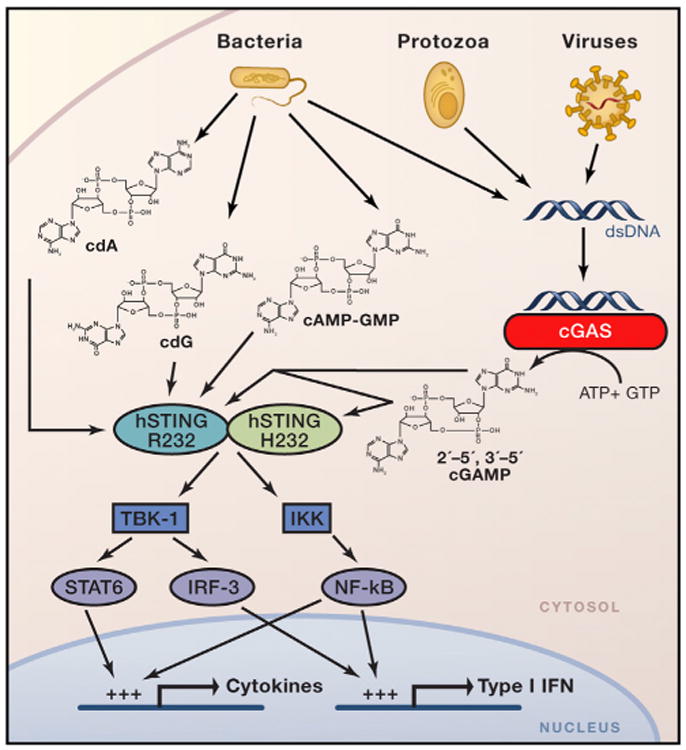
Infection of eukaryotic cells with viruses, protozoa, and bacteria leads to accumulation of extracellular DNA that signals the presence of pathogens to the cellular immune system. Cytosolic dsDNA is recognized by cGAS in a sequence-independent manner. cGAS induces production of 2′-5′, 3′-5′cGAMP to stimulate STING. At least some STING alleles (such as R232) can additionally be activated by CDNs produced by bacteria that include cdA, cdG, and 3′-5′, 3′-5′cGAMP (cAMP-GMP), whereas other STING alleles (such as H232) are not responsive to bacterial CDNs. Binding of STING to an activating ligand induces conformational change in STING, resulting in formation of a “closed form” in which ligand is tightly bound to the binding pocket. Following relocation of STING to discrete foci in the cell cytosol, activated STING recruits TBK1 and IKK kinases, which in turn activate IRF-3, STAT6, and NF-κB. Upon translocation of activated transcriptional factors to the nucleus, they bind to corresponding promoters, thus resulting in induction of type I IFN and cytokines.
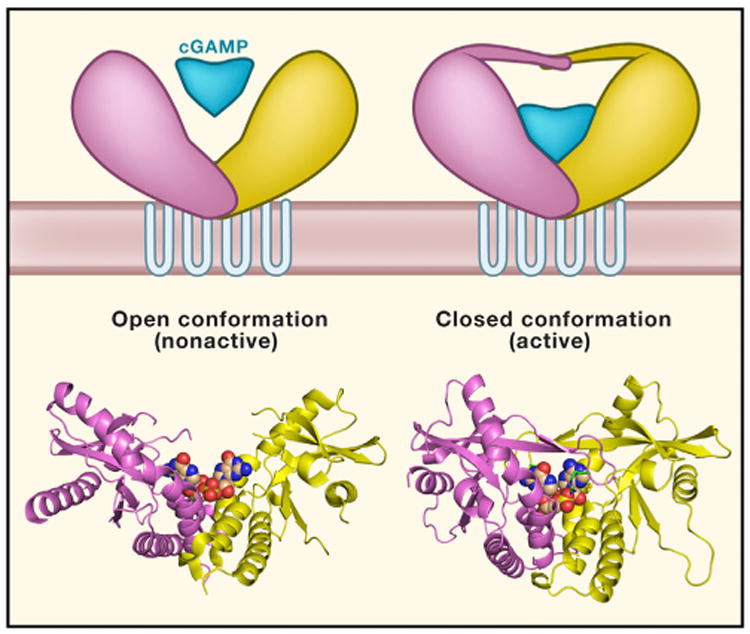
In its “open” form, STING does not fully encapsulate cdG and possibly other bacterial 3′-5′, 3′-5′CDNs. STING structure is more flexible; partially disoriented loops are covering the binding pocket. Binding of 2′-5′, 3′-5′cGAMP to STING happens at a deeper pocket compared to cdG and results in formation of the “closed” form. STING it its closed form is more compact, and the binding pocket is covered by a four-stranded β sheet cap. RCSB Protein Data Bank coordinates: cdG-hSTING H232 complex (4EF4) and 2′-5′, 3′-5′cGAMP-hSTING H232 complex (4LOH).
References
-
- Antonelli LR, Gigliotti Rothfuchs A, Gonçalves R, Roffê E, Cheever AW, Bafica A, Salazar AM, Feng CG, Sher A. Intranasal Poly-IC treatment exacerbates tuberculosis in mice through the pulmonary recruitment of a pathogen-permissive monocyte/macrophage population. J Clin Invest. 2010;120:1674–1682. - PMC - PubMed
-
- Barber GN. Cytoplasmic DNA innate immune pathways. Immunol Rev. 2011a;243:99–108. - PubMed
Publication types
MeSH terms
Substances
Grants and funding
LinkOut - more resources
Full Text Sources
Other Literature Sources
