


Diversity of lactase persistence alleles in Ethiopia: signature of a soft selective sweep
- PMID: 23993196
- PMCID: PMC3769926
- DOI: 10.1016/j.ajhg.2013.07.008
Diversity of lactase persistence alleles in Ethiopia: signature of a soft selective sweep
Abstract
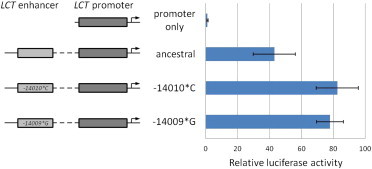
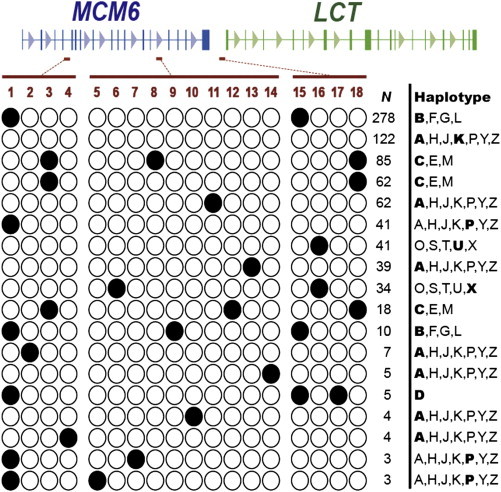
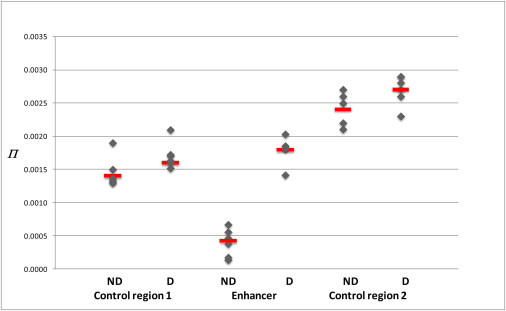
The persistent expression of lactase into adulthood in humans is a recent genetic adaptation that allows the consumption of milk from other mammals after weaning. In Europe, a single allele (-13910(∗)T, rs4988235) in an upstream region that acts as an enhancer to the expression of the lactase gene LCT is responsible for lactase persistence and appears to have been under strong directional selection in the last 5,000 years, evidenced by the widespread occurrence of this allele on an extended haplotype. In Africa and the Middle East, the situation is more complicated and at least three other alleles (-13907(∗)G, rs41525747; -13915(∗)G, rs41380347; -14010(∗)C, rs145946881) in the same LCT enhancer region can cause continued lactase expression. Here we examine the LCT enhancer sequence in a large lactose-tolerance-tested Ethiopian cohort of more than 350 individuals. We show that a further SNP, -14009T>G (ss 820486563), is significantly associated with lactose-digester status, and in vitro functional tests confirm that the -14009(∗)G allele also increases expression of an LCT promoter construct. The derived alleles in the LCT enhancer region are spread through several ethnic groups, and we report a greater genetic diversity in lactose digesters than in nondigesters. By examining flanking markers to control for the effects of mutation and demography, we further describe, from empirical evidence, the signature of a soft selective sweep.
Copyright © 2013 The Authors. Published by Elsevier Inc. All rights reserved.
Figures
References
-
- Ingram C.J., Mulcare C.A., Itan Y., Thomas M.G., Swallow D.M. Lactose digestion and the evolutionary genetics of lactase persistence. Hum. Genet. 2009;124:579–591. - PubMed
-
- Poulter M., Hollox E., Harvey C.B., Mulcare C., Peuhkuri K., Kajander K., Sarner M., Korpela R., Swallow D.M. The causal element for the lactase persistence/non-persistence polymorphism is located in a 1 Mb region of linkage disequilibrium in Europeans. Ann. Hum. Genet. 2003;67:298–311. - PubMed
-
- Anagnostou P., Battaggia C., Coia V., Capelli C., Fabbri C., Pettener D., Destro-Bisol G., Luiselli D. Tracing the distribution and evolution of lactase persistence in Southern Europe through the study of the T(-13910) variant. Am. J. Hum. Biol. 2009;21:217–219. - PubMed
Publication types
MeSH terms
Substances
Grants and funding
LinkOut - more resources
Full Text Sources
Other Literature Sources
Research Materials
