


Pathophysiology of thoracic aortic aneurysm (TAA): is it not one uniform aorta? Role of embryologic origin
- PMID: 23993239
- PMCID: PMC3759819
- DOI: 10.1016/j.pcad.2013.04.002
Pathophysiology of thoracic aortic aneurysm (TAA): is it not one uniform aorta? Role of embryologic origin
Abstract
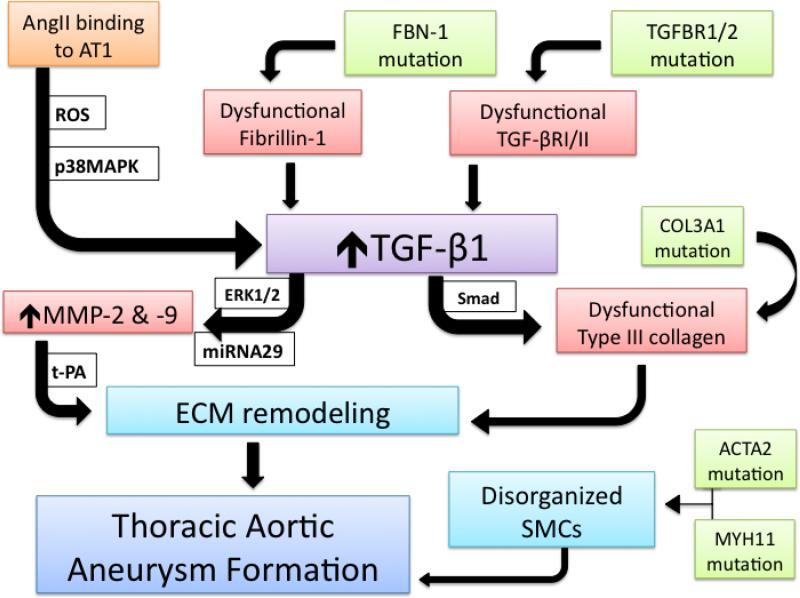
Thoracic aortic aneurysm (TAA) is a clinically silent and potentially fatal disease whose pathophysiology is poorly understood. Application of data derived from animal models and human tissue analysis of abdominal aortic aneurysms may prove misleading given current evidence of structural and biochemical aortic heterogeneity above and below the diaphragm. Genetic predisposition is more common in TAA and includes multi-faceted syndromes such as Marfan, Loeys-Dietz, and type IV Ehlers-Danlos as well as autosomal-dominant familial patterns of inheritance. Investigation into the consequences of these known mutations has provided insight into the cell signaling cascades leading to degenerative remodeling of the aortic medial extracellular matrix (ECM) with TGF-β playing a major role. Targeted research into modifying the upstream regulation or downstream effects of the TGF-β1 pathway may provide opportunities for intervention to attenuate TAA progression.
Keywords: AAA; AT1; AngII; ECM; ERK; Extracellular matrix remodeling; MMP; Matrix metalloproteinases; TAA; TGF-β; TGF-βR1 & 2; Thoracic Aortic Aneurysm; Transforming growth factor-beta; VSMC; abdominal aortic aneurysm; angiotensin II; angiotensin receptor 1; extracellular matrix; extracellular signal-regulated kinase; matrix metalloproteinase; t-PA; thoracic aortic aneurysm; tissue plasminogen activator; transforming growth factor beta; transforming growth factor beta receptor 1 & 2; vascular smooth muscle cell.
Copyright © 2013 Elsevier Inc. All rights reserved.
Figures
References
-
- National Center for Injury Prevention and Control WISQARS Leading Causes of Death Reports, 1999-2006. available at http://webappa.cdc.gov/sasweb/ncipc/leadcaus10.html.
-
- Coady MA, Rizzo JA, Elefteriades JA. Developing surgical intervention criteria for thoracic aortic aneurysms. Card Clin. 1999;17:827–39. - PubMed
-
- Castellano JM, Kovacic JC, Sanz J, Fuster V. Are we ignoring the dilated thoracic aorta? Ann N Y Acad Sci. 2012;1254:164–74. - PubMed
-
- Wolinsky H. Comparison of medial growth of human thoracic and abdominal aortas. Circ Res. 1970;27:531–8. - PubMed
Publication types
MeSH terms
Substances
Grants and funding
LinkOut - more resources
Full Text Sources
Other Literature Sources
Research Materials
Miscellaneous
