Aurora kinases in head and neck cancer
- PMID: 23993387
- PMCID: PMC4139969
- DOI: 10.1016/S1470-2045(13)70128-1
Aurora kinases in head and neck cancer
Abstract
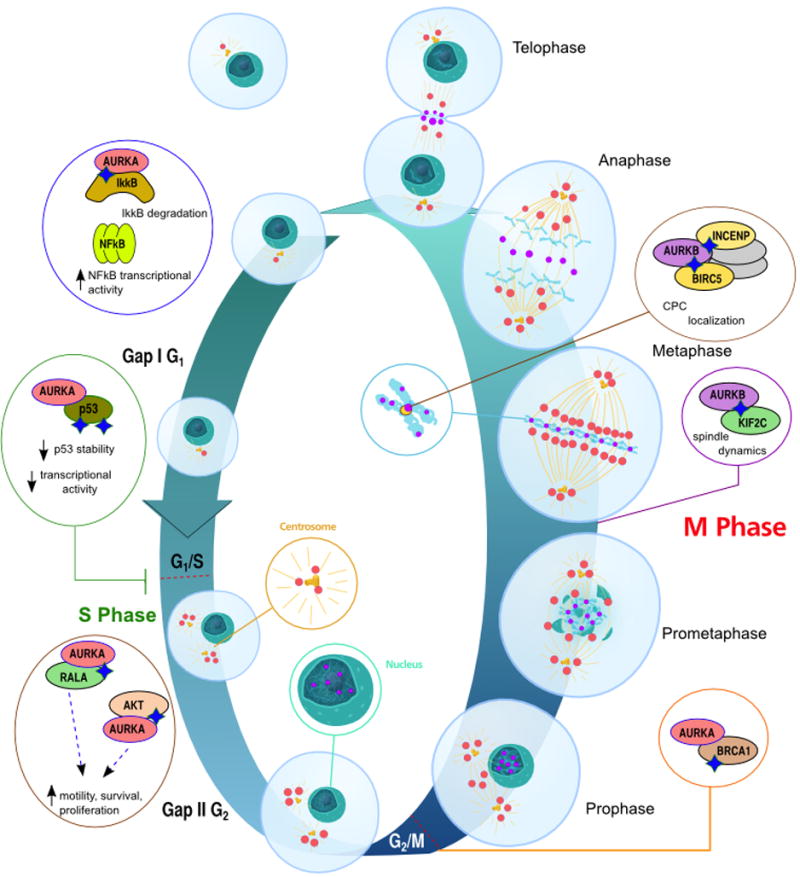
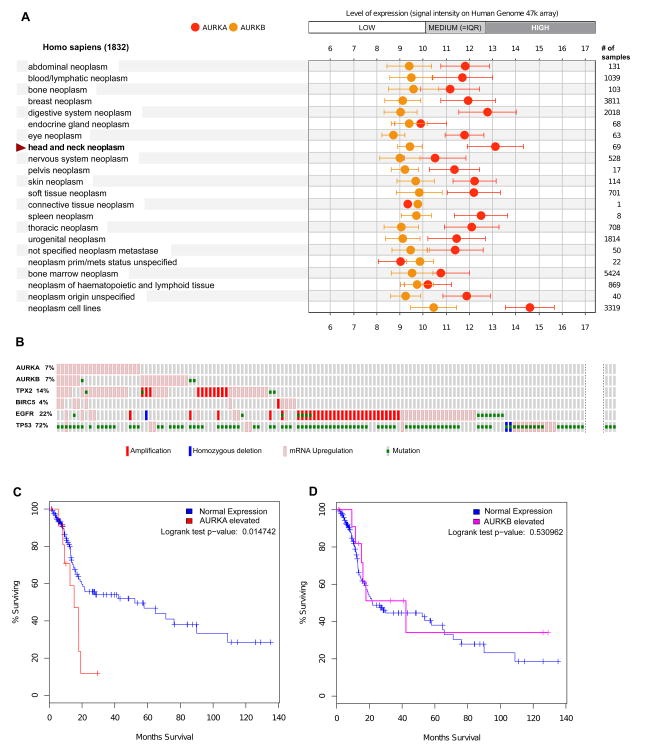
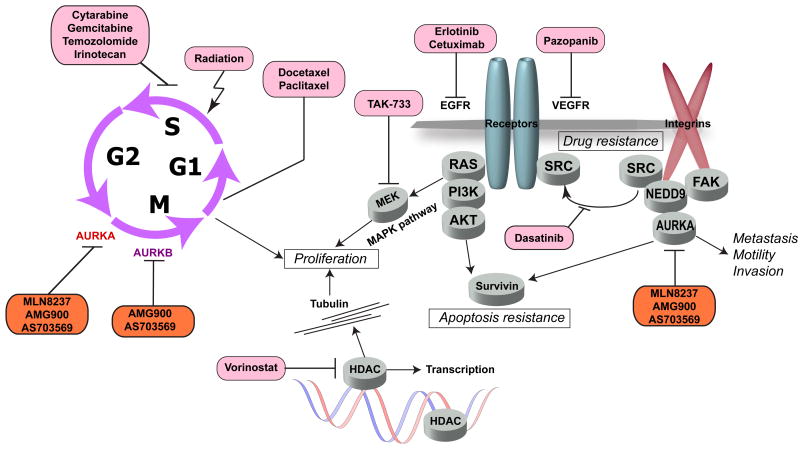
In healthy cells, controlled activation of aurora kinases regulates mitosis. Overexpression and hyperactivation of aurora kinases A and B have major roles in tumorigenesis, and can induce aneuploidy and genomic instability. In squamous-cell carcinomas of the head and neck, overexpression of aurora kinase A is associated with decreased survival, and a reduction in aurora kinase A and aurora kinase B expression inhibits cell growth and increases apoptosis. In this Review, we provide an overview of the biological functions of aurora kinases in healthy cells and in cancer cells, and we review small studies and high-throughput datasets that particularly implicate aurora kinase A in the pathogenesis of squamous-cell carcinomas of the head and neck. Early phase trials are beginning to assess the activity of small-molecule inhibitors of aurora kinases. We summarise trials of aurora kinase inhibitors in squamous-cell carcinomas of the head and neck, and discuss directions for future drug combination trials and biomarkers to use with drugs that inhibit aurora kinases.
Copyright © 2013 Elsevier Ltd. All rights reserved.
Conflict of interest statement
Burtness - funding from Boehringer Ingelheim and Genentech
Golemis - no conflicts of interest
Astsaturov - no conflicts of interest
Serebriiskii – no conflicts of interest
Figures
References
-
- Parkin DM, Bray F, Ferlay J, Pisani P. Global cancer statistics, 2002. CA: a cancer journal for clinicians. 2005 Mar-Apr;55(2):74–108. - PubMed
-
- Siegel R, Desantis C, Virgo K, Stein K, Mariotto A, Smith T, et al. Cancer treatment and survivorship statistics, 2012. CA: a cancer journal for clinicians. 2012 Jul;62(4):220–41. - PubMed
-
- D'Souza G, Kreimer AR, Viscidi R, Pawlita M, Fakhry C, Koch WM, et al. Case-control study of human papillomavirus and oropharyngeal cancer. The New England journal of medicine. 2007 May 10;356(19):1944–56. - PubMed
-
- Fakhry C, Westra WH, Li S, Cmelak A, Ridge JA, Pinto H, et al. Improved survival of patients with human papillomavirus-positive head and neck squamous cell carcinoma in a prospective clinical trial. Journal of the National Cancer Institute. 2008 Feb 20;100(4):261–9. - PubMed
Publication types
MeSH terms
Substances
Grants and funding
- K22 CA-160725/CA/NCI NIH HHS/United States
- R21 CA164205/CA/NCI NIH HHS/United States
- R01 CA63366/CA/NCI NIH HHS/United States
- U54 CA149147/CA/NCI NIH HHS/United States
- U54 CA 149147/CA/NCI NIH HHS/United States
- R01 CA063366/CA/NCI NIH HHS/United States
- R01 CA-633/CA/NCI NIH HHS/United States
- P50 CA083638/CA/NCI NIH HHS/United States
- R01 CA050633/CA/NCI NIH HHS/United States
- K22 CA160725/CA/NCI NIH HHS/United States
- P50CAD83638/PHS HHS/United States
- R21 CA 164205/CA/NCI NIH HHS/United States
- P30 CA006927/CA/NCI NIH HHS/United States
- CA-06927/CA/NCI NIH HHS/United States
- R01CA-50633/CA/NCI NIH HHS/United States
LinkOut - more resources
Full Text Sources
Other Literature Sources
Medical
Miscellaneous