. 2013 Sep 19;20(9):1135-46.
doi: 10.1016/j.chembiol.2013.07.012. Epub 2013 Aug 29.

Probing the selectivity and protein·protein interactions of a nonreducing fungal polyketide synthase using mechanism-based crosslinkers

Affiliations

Probing the selectivity and protein·protein interactions of a nonreducing fungal polyketide synthase using mechanism-based crosslinkers

Joel Bruegger et al. Chem Biol. .

Erratum in

  • Chem Biol. 2014 Jul 17;21(7):913. Haushalter, Bob [corrected to Haushalter, Robert W]; Vagstad, Anna [corrected to Vagstad, Anna L]

Abstract

Protein·protein interactions, which often involve interactions among an acyl carrier protein (ACP) and ACP partner enzymes, are important for coordinating polyketide biosynthesis. However, the nature of such interactions is not well understood, especially in the fungal nonreducing polyketide synthases (NR-PKSs) that biosynthesize toxic and pharmaceutically important polyketides. Here, we employ mechanism-based crosslinkers to successfully probe ACP and ketosynthase (KS) domain interactions in NR-PKSs. We found that crosslinking efficiency is closely correlated with the strength of ACP·KS interactions and that KS demonstrates strong starter unit selectivity. We further identified positively charged surface residues by KS mutagenesis, which mediates key interactions with the negatively charged ACP surface. Such complementary/matching contact pairs can serve as "adapter surfaces" for future efforts to generate new polyketides using NR-PKSs.


Figures

Figure 1
Figure 1
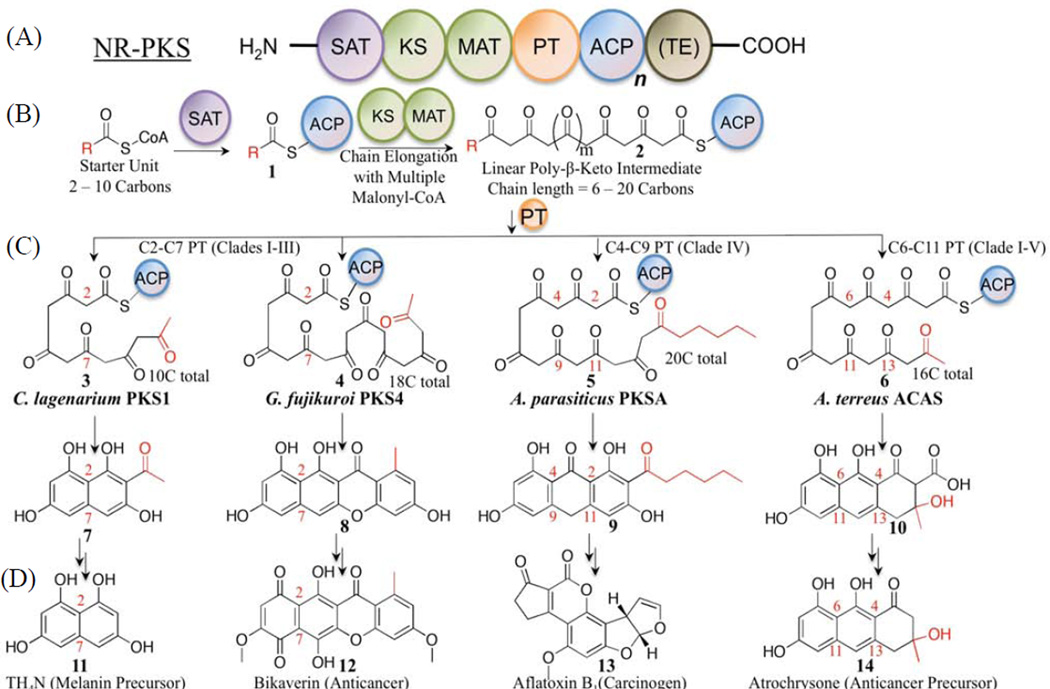
(A) Domain architecture of a typical NR-PKS: there may be multiple ACPs (n=1–3), and TE is optional (in brackets). (B) NR-PKS enzymatic steps: chain initiation by SAT results in 1 (starter unit in red), followed by chain elongation by KS-AT (2); (C) cyclization is promoted by PT in 3 patterns: C2–C7 (Clades I–III, 3–4), C4–C9 (Clade IV, 5), and C6–C11 (Clade V, 6). Target PKSs are indicated in (C) and their final products in (D) (1114).
Figure 2
Figure 2
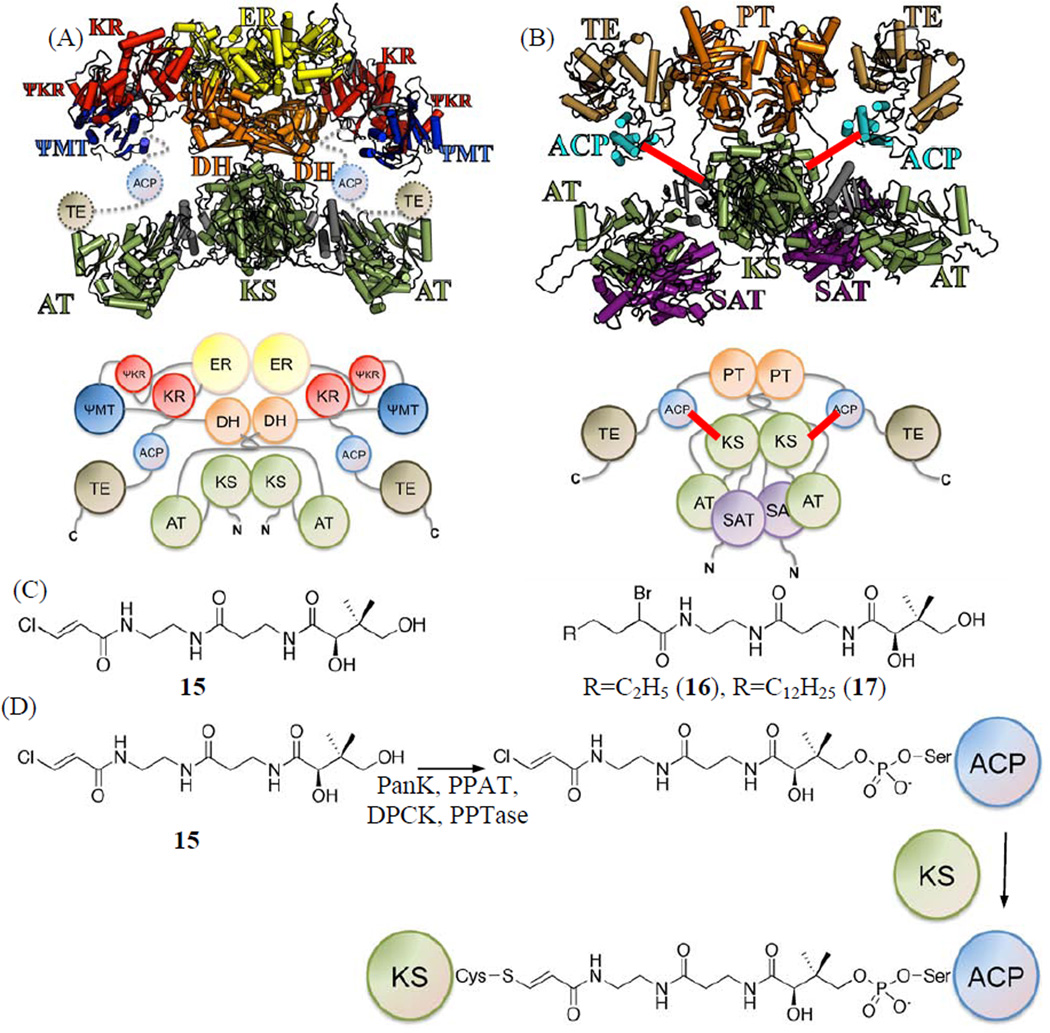
(A) Crystal structure and cartoon of porcine FAS model as a homo-dimer, where KS is located at the center as a dimer. (B) Protein sizing studies of PksA supports an overall architecture similar to that of porcine FAS, where KS also exists as a dimer, and two ACPs on either side of the torso as shown in this homology model and cartoon. The cross-linking between KS and ACP is shown as red lines. (C) Pantetheinylated probes with a chloroacryl 15, 2-bromo hexyl 16 or 2-bromo palmitoyl 17 chemical groups that target the nucleophilic cysteine of the KS domain. (D) Chemo-enzymatic attachment of 15, 16 or 17 to ACP is followed by KS crosslinking the nucleophilic cysteine of the KS domain.
Figure 3
Figure 3
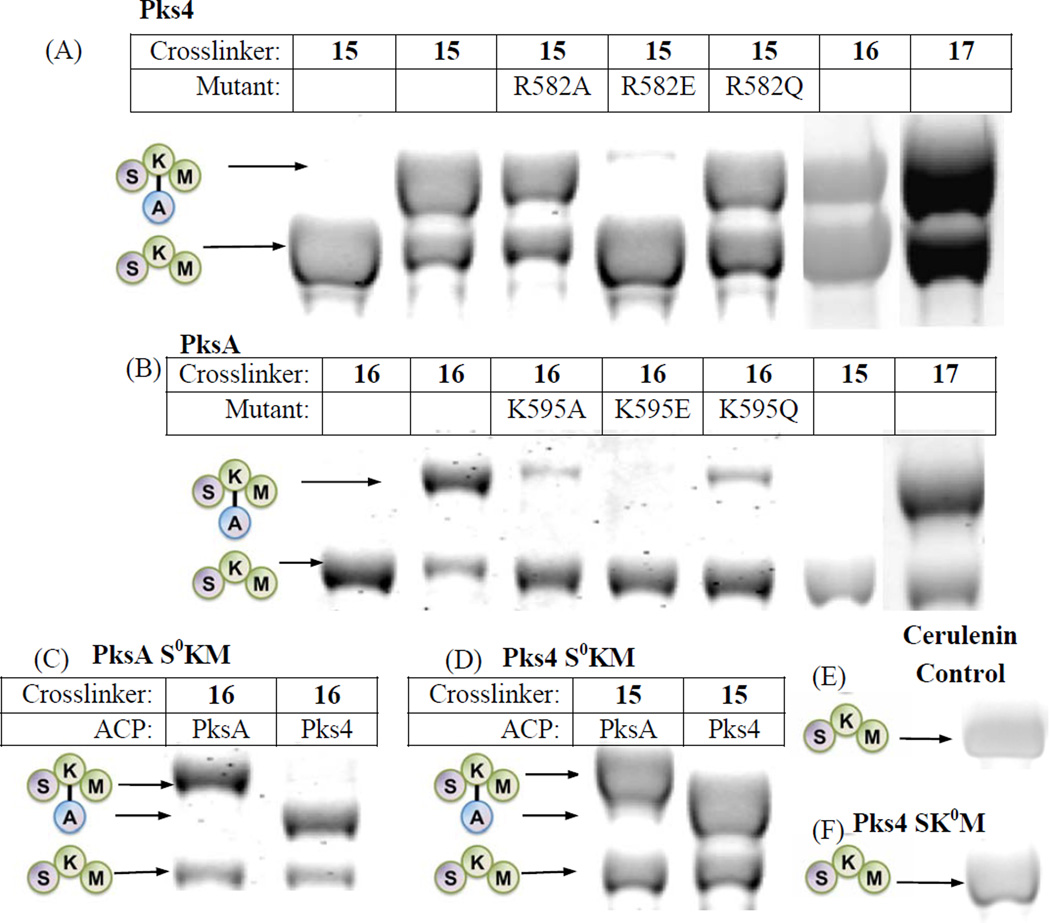
see also Figures S1–6. SKM crosslinking gels. (A) Pks4 ACP crosslinked to Pks4 S0KM and KS surface mutants. Pks4 can crosslink by crosslinkers with acyl chains ranging from 2 – 16 carbons (15 – 17). Surface mutations of Pks4 R582 (and K593 in the SI, Fig. S1A) abolished crosslinking when the side chain charge is reversed (R582E), which can be rescued by mutation to a polar amino acid (R582Q). (B) PksA ACP crosslinked to PksA S0KM and additional KS surface mutants. PksA requires a minimum of 6 carbons in the acyl chain of the crosslinkers (16–17). Reversing the charge of K595 (K595E) abolishes crosslinking, which can be rescued by mutation to a polar amino acid (K595Q). Similar results were found for K584 mutants (detailed in the SI, Fig. S1C) When comparing (A) and (B) or PksA vs Pks4, the alanine mutation do not necessarily abolish protein-protein interactions. Rather, the reversal of charge (the mutation to glutamate) effectively abolishes the KS-ACP interactions. The difference is likely due to the distinct character at the protein interface of different PKSs. (C) A comparison of PksA S0KM crosslinked to PksA and Pks4 ACP, showing comparable crosslinking efficiency for the two ACPs from NR-PKSs. (D) A comparison of Pks4 S0KM crosslinked to PksA and Pks4 ACP, showing comparable crosslinking efficiency for the two ACPs from NR-PKSs. (E) The negative control of cerulenin, which binds KS and prevents crosslinking. The result supports that the KS active site must be accessible for crosslinking to occur. (F) As an additional control, the KS0 mutant abolishes crosslinking, supporting that KS active site must be present for crosslinking to occur.
Figure 4
Figure 4
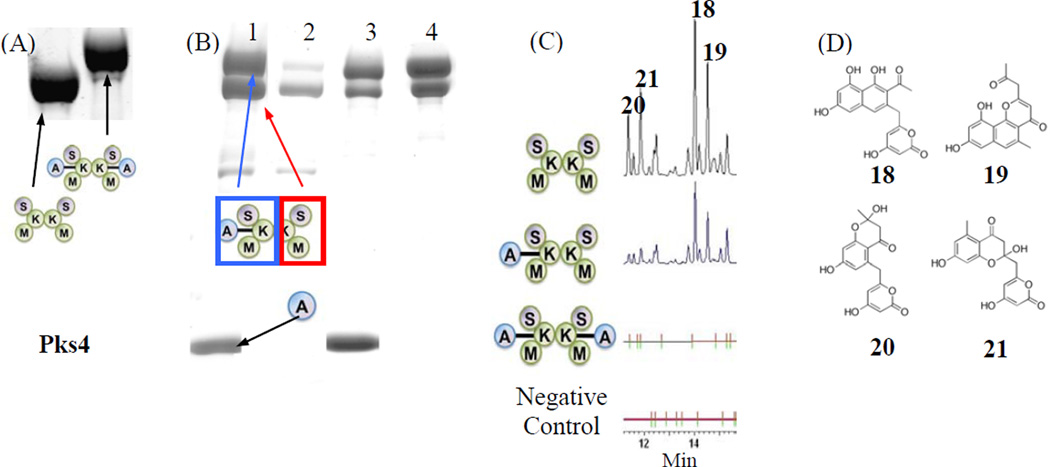
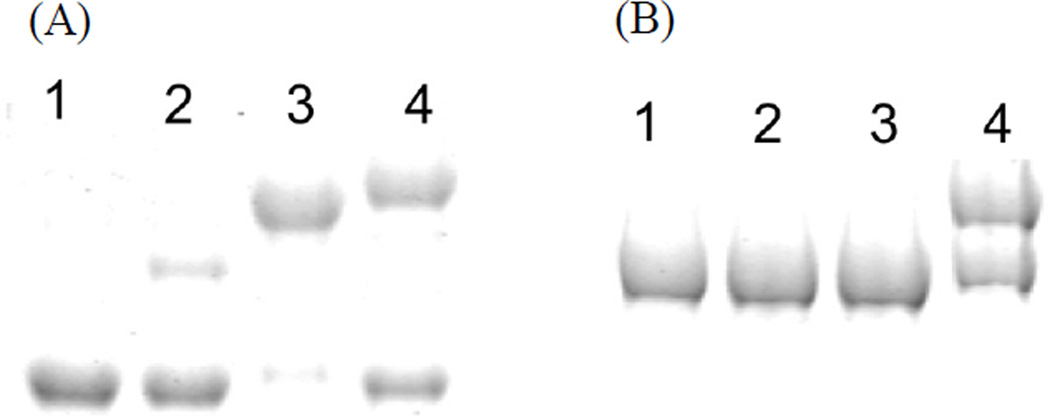
Composite gels. (A) In comparison with Fig 3 (one hour incubation), overnight incubation with doubling concentration of crosslinker and ATP, and triple concentration of ACP resulted in 100% crosslinking. (B) Purification of Strep-tagged Pks4 ACP crosslinked to His-tagged Pks4 S0KM. Lane 1: Crosslinking reaction before purification steps, lane 2: StrepTrap flow-through indicates that excess S0KM purified away from the crosslinked S0KM=ACP, lane 3: StrepTrap elution shows the resulting cross-linked S0KM=ACP and its co-purifying un-crosslinked S0KM, plus contaminating Strep-tagged ACP, lane 4: gel filtration-purified Pks4 S0KM crosslinked to ACP. (C) Pks4 in vitro reconstitution. The major products are PK8 (18), naphthopyrone (19), Sek4 (20) and Sek4b (21). All reactions are incubated with ACP and malonyl-CoA. In addition, reaction 1 contains pure SKM, reaction 2 contains pure, partially-crosslinked SKM to ACP, reaction 3 contains fully crosslinked SKM to ACP, and reaction 4 has no protein present. The result supports that crosslinking abolishes enzyme activity. (D) Chemical structures of 1821.
Figure 5
Figure 5
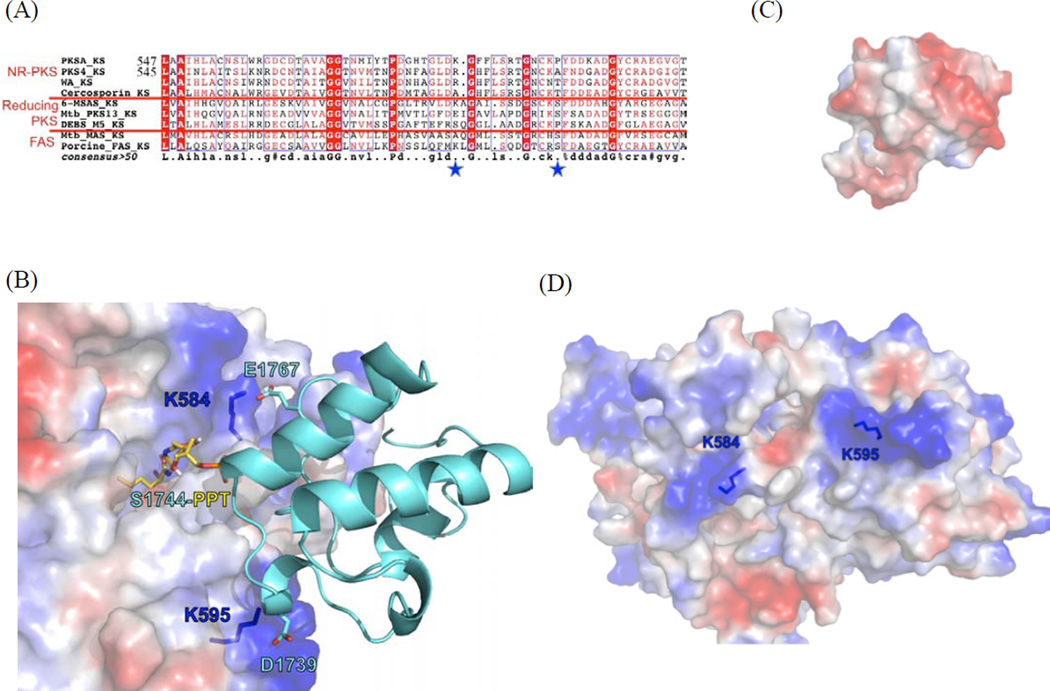
see also Figure S7. Probing surface residues important for KS-ACP interactions. (A) Sequence alignment identified two relatively conserved, positively charged residues (star). The boxed residues are conserved ones. (B) Homology modeling and docking simulation of KS domains of PksA with PksA ACP suggests that K584 and K595 of PksA are located at the protein surface, where positively-charged lysines are docked with acid residues of ACP, while active site Ser tethered 2-bromohexyl pantetheine docks into the active site. D1739 and E1767 of PksA ACP were identified based on protein-protein docking simulation (Fig. S8). (C) The negatively-charged ACP surface that is docked to KS. (D) The positively-charged KS surface that is docked to ACP
Figure 6
Figure 6
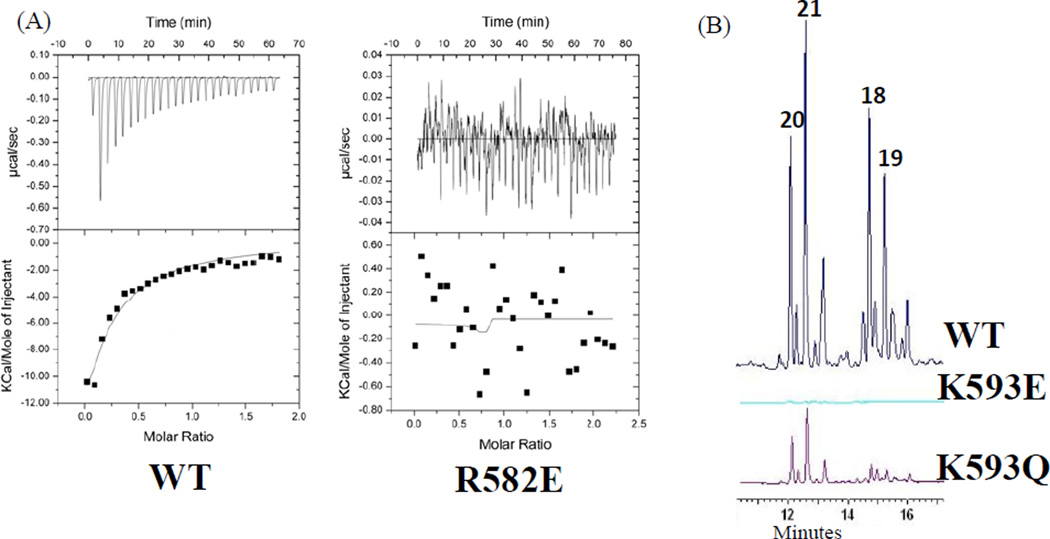
ITC and in vitro reconstitution results that compare Pks4 wild type (wild type refers to C117A SAT inactive mutant) with KS surface mutants. (A) ITC results show that interactions between Pks4 S0KM WT and ACP are disrupted with the KS surface mutant R582E. (B) Similarly, in vitro reconstitution shows that the surface mutant K593E disrupts interactions with ACP, whose in vitro activity is rescued by the K593Q mutant.
Figure 7
Figure 7
Crosslinking gel with Type II ACP using pantetheine analogue 15. (A) FabF crosslinked to the following ACPs: lane 1: negative control, lane 2: Act ACP, lane 3: AcpP, lane 4: Pks4 ACP. (B) Pks4 S0KM that is crosslinked to the following ACPs: lane 1: negative control, lane 2: Act ACP, lane 3: AcpP, lane 4: Pks4 ACP. The result showed that KS-ACP pair is specific within the similar type of FAS or PKS.

Comment in

References

    1. Cox RJ. Polyketides, proteins and genes in fungi: programmed nano-machines begin to reveal their secrets. Org Biomol Chem. 2007;5:2010–2026. - PubMed
    1. Crawford JM, Dancy BCR, Hill EA, Udwary DW, Townsend CA. Identification of a starter unit acyl-carrier protein transacylase domain in an iterative type I polyketide synthase. Proc Natl Acad Sci USA. 2006;103:16728–16733. - PMC - PubMed
    1. Crawford JM, Korman TP, Labonte JW, Vagstad AL, Hill EA, Kamari-Bidkorpeh O, Tsai SC, Townsend CA. Structural basis for biosynthetic programming of fungal aromatic polyketide cyclization. Nature. 2009;461:1139–1143. - PMC - PubMed
    1. Crawford JM, Thomas PM, Scheerer JR, Vagstad AL, Kelleher NL, Townsend CA. Deconstruction of iterative multidomain polyketide synthase function. Science. 2008;320:243–246. - PMC - PubMed
    1. Crawford JM, Townsend CA. New insights into the formation of fungal aromatic polyketides. Nat Rev Microbiol. 2010;8:879–889. - PMC - PubMed

Publication types

MeSH terms