


Replacement of the Y450 (c234) phenyl ring in the carboxyl-terminal region of coagulation factor IX causes pleiotropic effects on secretion and enzyme activity
- PMID: 23994528
- PMCID: PMC3778434
- DOI: 10.1016/j.febslet.2013.08.019
Replacement of the Y450 (c234) phenyl ring in the carboxyl-terminal region of coagulation factor IX causes pleiotropic effects on secretion and enzyme activity
Abstract
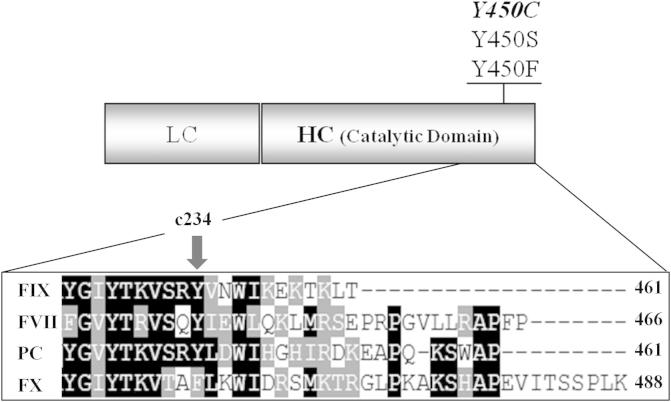
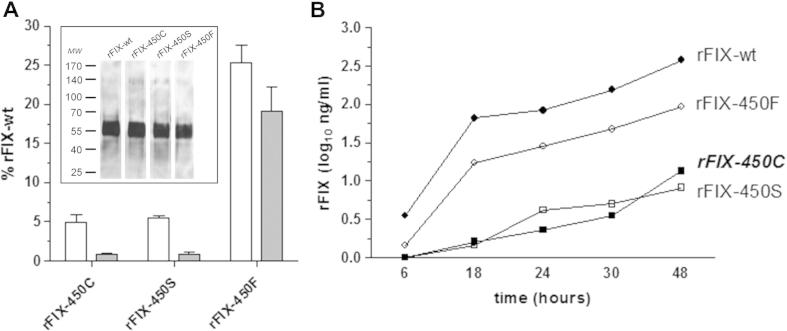
The interplay between impaired protein biosynthesis and/or function caused by missense mutations, particularly in relation to specific protein regions, has been poorly investigated. As model we chose the severe p.Y450C mutation in the carboxyl-terminal region of coagulation factor IX (FIX) and, by expression of a panel of recombinant variants, demonstrated the key role of the tyrosine phenyl group for both FIX secretion and coagulant activity. Comparison among highly homologous coagulation serine proteases indicate that additive or compensatory pleiotropic effects on secretion and function by carboxyl-terminal mutations produce life-threatening or mild phenotypes in the presence of similarly reduced protein amounts.
Keywords: Carboxyl-terminal region; Coagulation factor IX; Dysfunctional enzyme; Gene expression; Impaired secretion; Missense mutations.
Copyright © 2013 Federation of European Biochemical Societies. Published by Elsevier B.V. All rights reserved.
Figures

References
-
- Lillicrap D. The molecular basis of haemophilia B. Haemophilia. 1998;4:350–357. - PubMed
-
- Bernardi F., Dolce A., Pinotti M., Shapiro A.D., Santagostino E., Peyvandi F., Batorova A., Lapecorella M., Schved J.F., Ingerslev J., Mariani G. V.I.I.D.S.G. International Factor, Major differences in bleeding symptoms between factor VII deficiency and hemophilia B. J. Thrombosis Haemostasis: JTH. 2009;7:774–779. - PubMed
-
- Yoshitake S., Schach B.G., Foster D.C., Davie E.W., Kurachi K. Nucleotide sequence of the gene for human factor IX (antihemophilic factor B) Biochemistry. 1985;24:3736–3750. - PubMed
-
- Hertzberg M.S., Facey S.L., Hogg P.J. An Arg/Ser substitution in the second epidermal growth factor-like module of factor IX introduces an O-linked carbohydrate and markedly impairs activation by factor XIa and factor VIIa/Tissue factor and catalytic efficiency of factor IXa. Blood. 1999;94:156–163. - PubMed
Publication types
MeSH terms
Substances
Grants and funding
LinkOut - more resources
Full Text Sources
Other Literature Sources
Molecular Biology Databases
Research Materials
