


Green tea phenolics inhibit butyrate-induced differentiation of colon cancer cells by interacting with monocarboxylate transporter 1
- PMID: 23994611
- PMCID: PMC4889458
- DOI: 10.1016/j.bbadis.2013.08.009
Green tea phenolics inhibit butyrate-induced differentiation of colon cancer cells by interacting with monocarboxylate transporter 1
Abstract
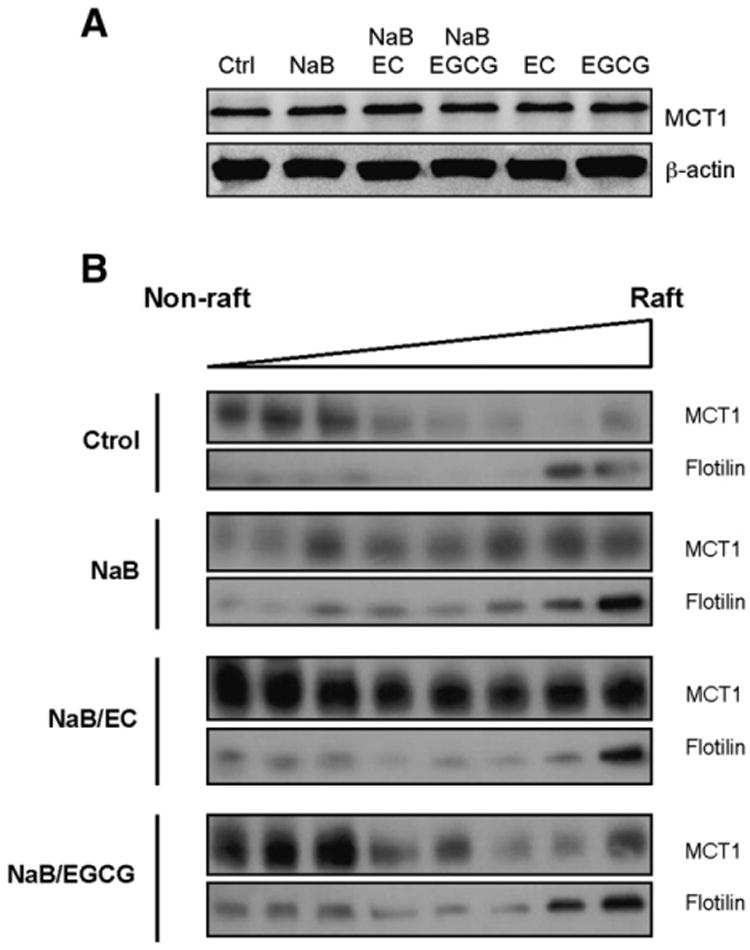
Diet has a significant impact on colorectal cancer and both dietary fiber and plant-derived compounds have been independently shown to be inversely related to colon cancer risk. Butyrate (NaB), one of the principal products of dietary fiber fermentation, induces differentiation of colon cancer cell lines by inhibiting histone deacetylases (HDACs). On the other hand, (-)-epicatechin (EC) and (-)-epigallocatechin gallate (EGCG), two abundant phenolic compounds of green tea, have been shown to exhibit antitumoral properties. In this study we used colon cancer cell lines to study the cellular and molecular events that take place during co-treatment with NaB, EC and EGCG. We found that (i) polyphenols EC and EGCG fail to induce differentiation of colon adenocarcinoma cell lines; (ii) polyphenols EC and EGCG reduce NaB-induced differentiation; (iii) the effect of the polyphenols is specific for NaB, since differentiation induced by other agents, such as trichostatin A (TSA), was unaltered upon EC and EGCG treatment, and (iv) is independent of the HDAC inhibitory activity of NaB. Also, (v) polyphenols partially reduce cellular NaB; and (vi) on a molecular level, reduction of cellular NaB uptake by polyphenols is achieved by impairing the capacity of NaB to relocalize its own transporter (monocarboxylate transporter 1, MCT1) in the plasma membrane. Our findings suggest that beneficial effects of NaB on colorectal cancer may be reduced by green tea phenolic supplementation. This valuable information should be of assistance in choosing a rational design for more effective diet-driven therapeutic interventions in the prevention or treatment of colorectal cancer.
Keywords: (−)-epicatechin; (−)-epigallocatechin gallate; 3-(4,5-dimethylthiazol-2-yl)-2,5-diphenyltetrazolium bromide; AP; Butyrate; Colon cancer; Differentiation; EC; EGCG; Epicatechin; Epigallocatechin gallate; HDAC; MCT1; MTT; NaB; TSA; alkaline phosphatase; butyrate; histone deacetylase; monocarboxylate transporter 1; trichostatin A.
© 2013.
Conflict of interest statement
Figures
References
-
- Jemal A, Center MM, DeSantis C, Ward EM. Global patterns of cancer incidence and mortality rates and trends. Cancer Epidemiol Biomarkers Prev. 2010;19:1893–1907. - PubMed
-
- Watson AJ, Collins PD. Colon cancer: a civilization disorder. Digest Dis (Basel, Switzerland) 2011;29:222–228. - PubMed
-
- Ferguson LR, Chavan RR, Harris PJ. Changing concepts of dietary fiber: implications for carcinogenesis. Nutr Cancer. 2001;39:155–169. - PubMed
-
- Juskiewicz J, Milala J, Jurgonski A, Krol B, Zdunczyk Z. Nutrition. Vol. 27. Burbank Los Angeles County; Calif: 2011. Consumption of polyphenol concentrate with dietary fructo-oligosaccharides enhances cecal metabolism of quercetin glycosides in rats; pp. 351–357. - PubMed
-
- Kosmala M, Kolodziejczyk K, Zdunczyk Z, Juskiewicz J, Boros D. Chemical composition of natural and polyphenol-free apple pomace and the effect of this dietary ingredient on intestinal fermentation and serum lipid parameters in rats. J Agric Food Chem. 2011;59:9177–9185. - PubMed
Publication types
MeSH terms
Substances
Grants and funding
LinkOut - more resources
Full Text Sources
Other Literature Sources
Research Materials
