. 2013 Oct;45(10):1190-7.
doi: 10.1038/ng.2743. Epub 2013 Sep 1.

Evolution of high-level ethambutol-resistant tuberculosis through interacting mutations in decaprenylphosphoryl-β-D-arabinose biosynthetic and utilization pathway genes

Affiliations

Evolution of high-level ethambutol-resistant tuberculosis through interacting mutations in decaprenylphosphoryl-β-D-arabinose biosynthetic and utilization pathway genes

Hassan Safi et al. Nat Genet. 2013 Oct.

Abstract

To study the evolution of drug resistance, we genetically and biochemically characterized Mycobacterium tuberculosis strains selected in vitro for ethambutol resistance. Mutations in decaprenylphosphoryl-β-D-arabinose (DPA) biosynthetic and utilization pathway genes Rv3806c, Rv3792, embB and embC accumulated to produce a wide range of ethambutol minimal inhibitory concentrations (MICs) that depended on mutation type and number. Rv3806c mutations increased DPA synthesis, causing MICs to double from 2 to 4 μg/ml in a wild-type background and to increase from 16 to 32 μg/ml in an embB codon 306 mutant background. Synonymous mutations in Rv3792 increased the expression of downstream embC, an ethambutol target, resulting in MICs of 8 μg/ml. Multistep selection was required for high-level resistance. Mutations in embC or very high embC expression were observed at the highest resistance level. In clinical isolates, Rv3806c mutations were associated with high-level resistance and had multiplicative effects with embB mutations on MICs. Ethambutol resistance is acquired through the acquisition of mutations that interact in complex ways to produce a range of MICs, from those falling below breakpoint values to ones representing high-level resistance.


Figures
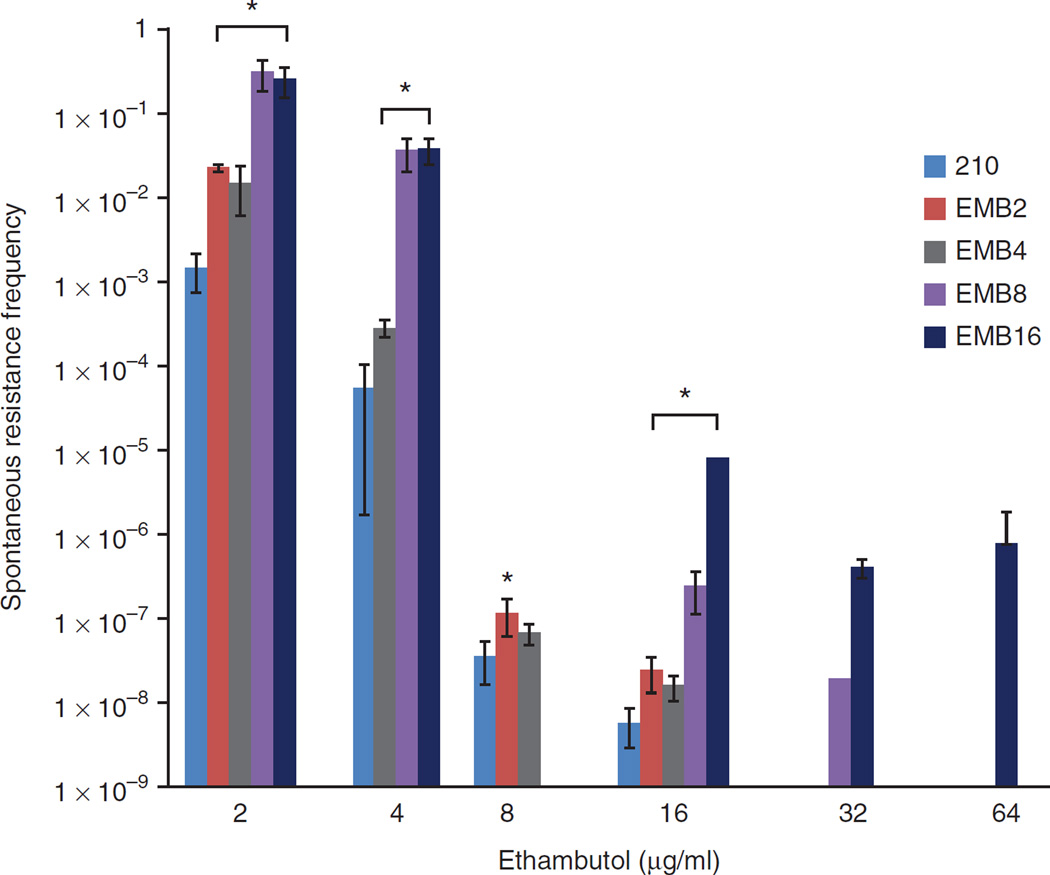
Figure 1
Figure 1
Frequencies of spontaneous resistance to ethambutol. Triplicate cultures of wild-type strain 210 and triplicate cultures of spontaneously ethambutol-resistant 210 mutants that had previously been selected with the indicated concentrations of ethambutol were replated on medium with ethambutol at the indicated concentrations. The mean frequency of colony-forming units (CFUs) recovered with each ethambutol concentration compared to in the no-drug control is shown. The number in each EMB ID indicates the ethambutol concentration (in µg/ml) under which in vitro strains were preselected. Error bars, s.d. of three independent experiments. *P < 0.05; significant differences compared to the 210 strain were determined by Student’s t test.
Figure 2
Figure 2
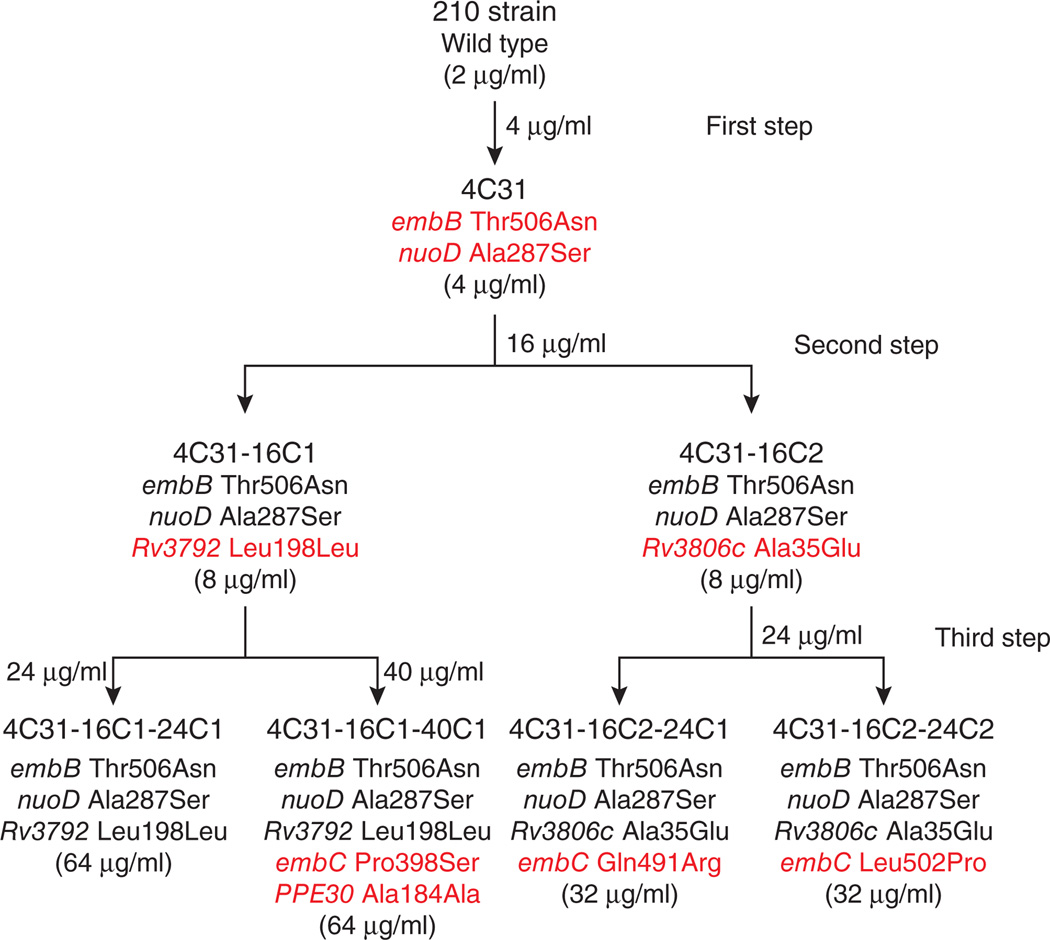
Mutant strains and MICs generated during stepwise selection for ethambutol resistance. The phylogeny of the strains selected in vitro for multistep ethambutol resistance is shown. The ethambutol concentration used for selection is shown at each step. For each colony analyzed, shown (top to bottom) is the name assigned to the strain, the encoded alterations identified by whole-genome sequencing and the ethambutol MIC (shown in parentheses). Encoded alterations are shown in red in the generation in which they appear.
Figure 3
Figure 3
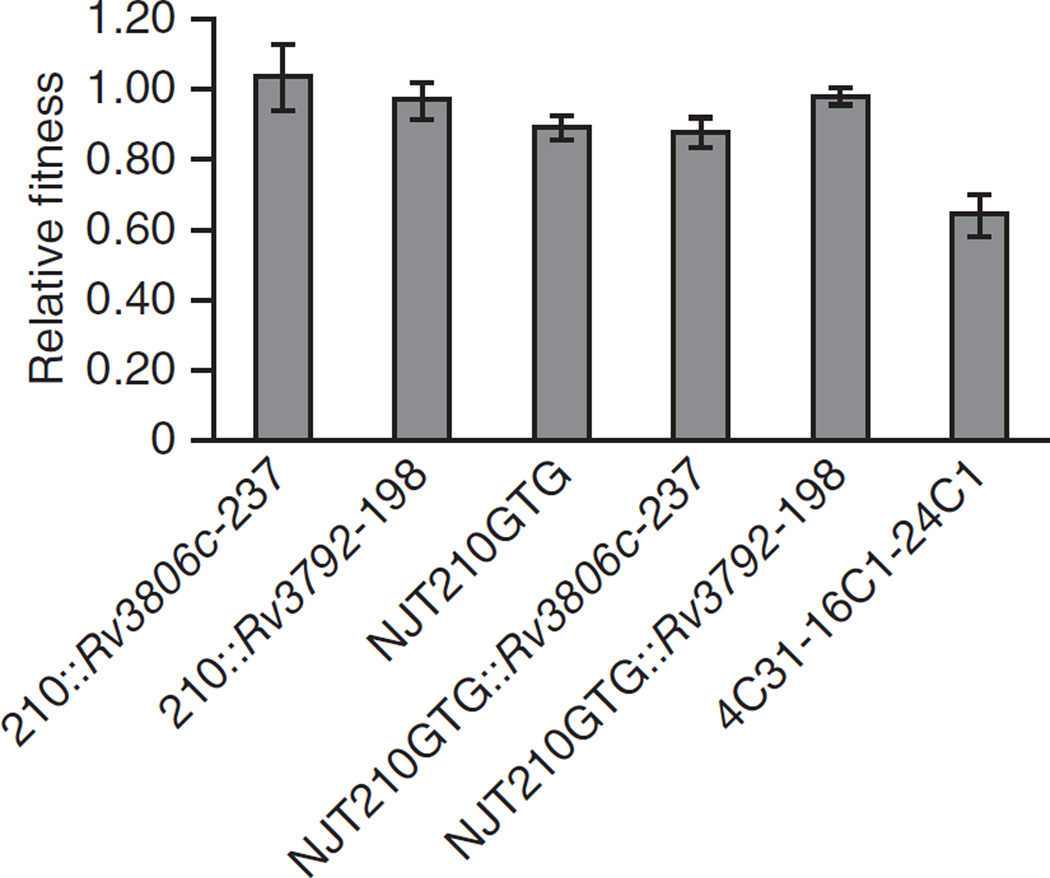
Relative competitive reductions in fitness for isogenic embB, Rv3806c and/or Rv3792 mutants and strain 4C31-16C1-24C1. Each test strain was mixed at approximately a 1:1 ratio with the parental 210 strain and then cultured in the absence of ethambutol to stationary phase. Confirmed initial (inoculation) and final CFUs were used to calculate the relative fitness of each strain compared to strain 210. The means and s.d. of three independent experiments are shown. The results show a fitness cost for the embB306 mutation but not for the other mutations introduced by allelic exchange. The multiple-step mutant strain 4C31-16C1-24C1 also has reduced fitness.
Figure 4
Figure 4
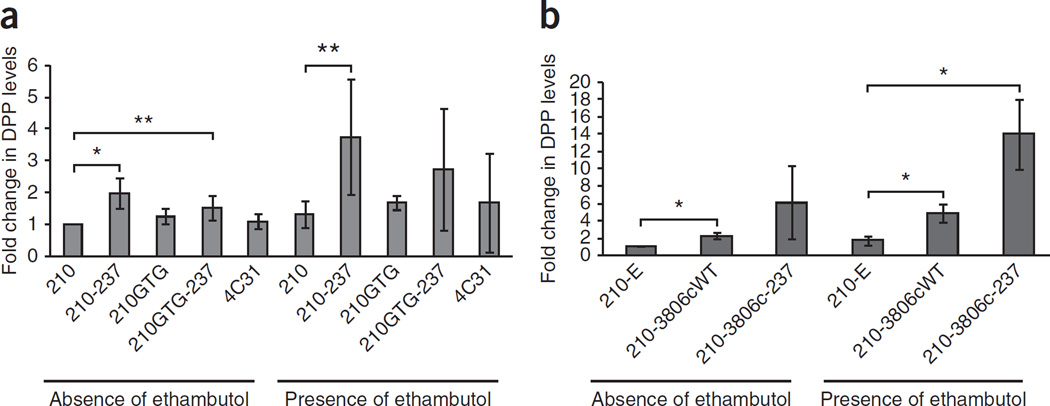
Role of Rv3806c in ethambutol resistance. (a) DPP (DPA + DPR) levels in strains with mutant Rv3806c, embB and Rv3792. Fold increases in normalized nanograms of DPP per gram of bacterial cells are shown in various strains grown in the presence and absence of ethambutol. A significant increase in DPP levels is observed in the Rv3806c-mutant strains except for in 210GTG-237 treated with ethambutol. (b) Effect of Rv3806c overexpression on DPP levels. For a,b, the strains used included the following: 210, wild-type strain 210; 210–237, strain 210::Rv3806c-237 (strain 210 containing the Rv3806c p.Ala237Val alteration); 210GTG, NJT210GTG (strain 210 containing the EmbB p.Met306Val alteration); 210GTG-237, NJT210GTG::Rv3806c-237 (strain 210 containing both EmbB p.Met306Val and Rv3806c p.Ala237Val alterations); 210-E, strain 210::pMV261 (strain 210 containing the plasmid pMV261); 210-Rv3806cWT, strain 210::pMV261-Rv3806c-WT (strain 210 overexpressing wild-type Rv3806c); 210-Rv3806c-237, strain 210::pMV261-Rv3806c-237 (strain 210 overexpressing mutant Rv3806c Ala237Val). Significant differences in DPP levels were calculated by Student’s t test: *P = 0.01, **P = 0.04. Means and s.d. of three independent experiments are shown.
Figure 5
Figure 5
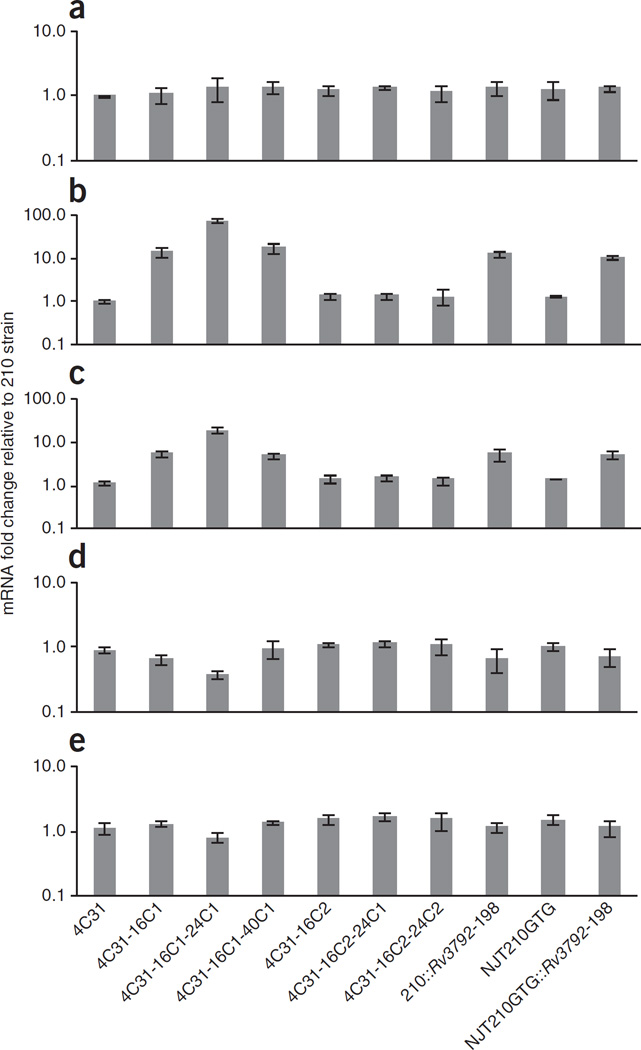
Effect of Rv3792 synonymous mutations on Rv3792 and embC mRNA levels. RNA was extracted from cultures grown to mid-log phase. Transcript levels were analyzed by qRT-PCR, and fold changes were determined by comparison to levels in the 210 strain after normalization to 16S rRNA levels. (ae) Relative mRNA levels of 5′ Rv3792 (a), 3′ Rv3792 (b), embC (c), embB (d) and Rv3806c (e). Means and s.d. are derived from three independent experiments. Large increases in the expression of 3′ Rv3792 and of embC are seen only in the Rv3792 mutants. No strain has increased Rv3806c expression; embB expression is mildly decreased in strain 4C31-16C1-24C1.

Comment in

References

    1. Zignol M, et al. Global incidence of multidrug-resistant tuberculosis. J. Infect. Dis. 2006;194:479–485. - PubMed
    1. Sharma SK, Mohan A. Multidrug-resistant tuberculosis: a menace that threatens to destabilize tuberculosis control. Chest. 2006;130:261–272. - PubMed
    1. Ramaswamy S, Musser JM. Molecular genetic basis of antimicrobial agent resistance in Mycobacterium tuberculosis: 1998 update. Tuber. Lung Dis. 1998;79:3–29. - PubMed
    1. Riska PF, Jacobs WR, Alland D. Molecular determinants of drug resistance in tuberculosis. Int. J. Tuberc. Lung Dis. 2000;4:S4–S10. - PubMed
    1. Telenti A, et al. The emb operon, a gene cluster of Mycobacterium tuberculosis involved in resistance to ethambutol. Nat. Med. 1997;3:567–570. - PubMed

Publication types

MeSH terms