. 2013 Nov;79(21):6712-8.
doi: 10.1128/AEM.01866-13. Epub 2013 Aug 30.

Dual substrate specificity of an N-acetylglucosamine phosphotransferase system in Clostridium beijerinckii

Affiliations

Dual substrate specificity of an N-acetylglucosamine phosphotransferase system in Clostridium beijerinckii

Naief H Al Makishah et al. Appl Environ Microbiol. 2013 Nov.

Abstract

The solventogenic clostridia have a considerable capacity to ferment carbohydrate substrates with the production of acetone and butanol, making them attractive organisms for the conversion of waste materials to valuable products. In common with other anaerobes, the clostridia show a marked dependence on the phosphoenolpyruvate (PEP)-dependent phosphotransferase system (PTS) to accumulate sugars and sugar derivatives. In this study, we demonstrate that extracts of Clostridium beijerinckii grown on N-acetylglucosamine (GlcNAc) exhibit PTS activity for the amino sugar. The PTS encoded by the divergent genes cbe4532 (encoding the IIC and IIB domains) and cbe4533 (encoding a IIA domain) was shown to transport and phosphorylate GlcNAc and also glucose. When the genes were recombined in series under the control of the lac promoter in pUC18 and transformed into a phosphotransferase mutant (nagE) of Escherichia coli lacking GlcNAc PTS activity, the ability to take up and ferment GlcNAc was restored, and extracts of the transformant showed PEP-dependent phosphorylation of GlcNAc. The gene products also complemented an E. coli mutant lacking glucose PTS activity but were unable to complement the same strain for PTS-dependent mannose utilization. Both GlcNAc and glucose induced the expression of cbe4532 and cbe4533 in C. beijerinckii, and consistent with this observation, extracts of cells grown on glucose exhibited PTS activity for GlcNAc, and glucose did not strongly repress utilization of GlcNAc by growing cells. On the basis of the phylogeny and function of the encoded PTS, we propose that the genes cbe4532 and cbe4533 should be designated nagE and nagF, respectively.


Figures

Fig 1
Fig 1
Phosphorylation of GlcNac by extracts of C. beijerinckii grown on (A) GlcNAc or (B) glucose. ■, phosphorylation in the presence of PEP; ▲, phosphorylation in the presence of ATP; ○, control with neither PEP nor ATP. The values shown are the average of duplicate experiments.
Fig 2
Fig 2
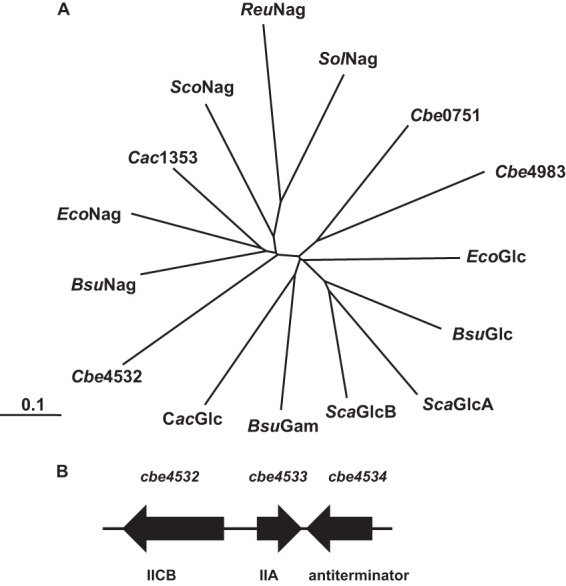
The putative N-acetylglucosamine PTS of C. beijerinckii. (A) Phylogeny of C domains of glucose-glucoside family phosphotransferase systems. The systems shown (GenBank accession numbers in parentheses) are all members of the glucose subfamily, and with the exception of numbered clostridial proteins, they have been characterized as either glucose (Glc), N-acetylglucosamine (Nag), or glucosamine (Gam) phosphotransferases: Cbe0751, Clostridium beijerinckii putative glucose PTS (YP_001307891); Cbe4983, C. beijerinckii putative glucoside PTS (YP_001312045); EcoGlc, Escherichia coli glucose (WP_000317748); BsuGlc, Bacillus subtilis glucose (NP_389272); ScaGlcA, Staphylococcus carnosus glucose (YP_002634092); ScaGlcB, S. carnosus glucose (YP_002634093); BsuGam, B. subtilis glucosamine (NP_388117); CacGlc, Clostridium acetobutylicum glucose (NP_347209); Cbe4532, C. beijerinckii putative N-acetylglucosamine PTS (YP_001311597); BsuNag, B. subtilis N-acetylglucosamine (NP_388651); EcoNag, E. coli N-acetylglucosamine (NP_415205); Cac1353, C. acetobutylicum putative N-acetylglucosamine PTS (NP_347981); ScoNag, Streptomyces coelicolor N-acetylglucosamine (NP_627133); ReuNag, Ralstonia eutrophus N-acetylglucosamine (YP_724831); SolNag, Streptomyces olivaceoviridis N-acetylglucosamine (CAD29623). (B) Chromosomal arrangement of genes cbe4532, cbe4533 and cbe4534. The genes encode the IICB domains of the PTS, IIA domain of the PTS, and BglG-like antiterminator, respectively.
Fig 3
Fig 3
Complementation of E. coli JW0665-1 (nagE) by genes cbe4532 and cbe4533. A transformant containing recombinant pUC18 carrying cbe4532 and cbe4533 was compared with the control strain transformed with pUC18 alone. (A) Fermentation of GlcNAc on MacConkey agar. (B) Utilization of GlcNAc in cultures growing on LB broth. ■, growth of control; ●, growth of transformant; □, broth GlcNAc concentration of control; ○, broth GlcNAc concentration of transformant. (C) GlcNAc PTS activity in cell extracts. ■, transformant uninhibited; □, control uninhibited; ●, transformant in the presence of 10 mM glucose. The values shown in panels B and C are the average of duplicate experiments.
Fig 4
Fig 4
Complementation of E. coli ZSC113 (Glc Man) by genes cbe4532 and cbe4533. The transformant containing recombinant pUC18 carrying cbe4532 and cbe4533 was compared with the control strain transformed with pUC18 alone. (A) Fermentation of glucose on MacConkey agar. (B) Fermentation of mannose on MacConkey agar. (C) Glucose PTS activity in cell extracts. ■, transformant in the presence of PEP; □, transformant in the absence of PEP; ●, control in the presence of PEP. The values shown are the average of duplicate experiments.
Fig 5
Fig 5
Slot blot analysis of C. beijerinckii nag gene expression. Expression of (A) cbe4532 and (B) cbe4533 was monitored following growth of C. beijerinckii in CBM containing GlcNAc, glucose, or glucitol.
Fig 6
Fig 6
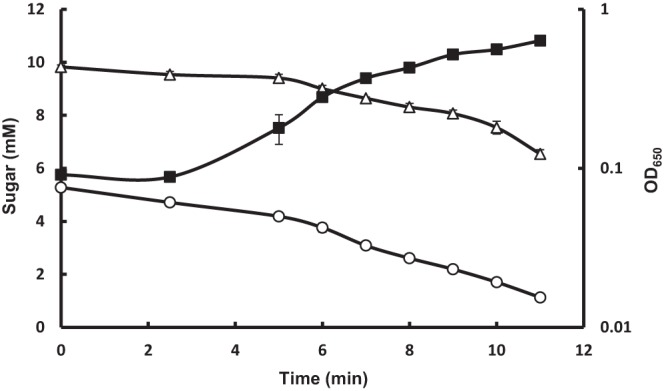
Growth and sugar utilization by C. beijerinckii in CBM containing glucose and GlcNAc. The inoculum cells were grown in CBM containing glucose and then washed and inoculated into medium containing both glucose and GlcNAc at the indicated concentrations. The values shown are means ± standard errors of the means of results from four cultures. ■, growth; ○, glucose concentration; △, GlcNAc concentration.

References

    1. Jones DT, Woods DR. 1986. Acetone-butanol fermentation revisited. Microbiol. Rev. 50:484–524 - PMC - PubMed
    1. Dürre P. 2007. Butanol: an attractive biofuel. Biotechnol. J. 2:1525–1534 - PubMed
    1. Dürre P. 2011. Fermentative production of butanol—the academic perspective. Curr. Opin. Biotechnol. 22:331–336 - PubMed
    1. Green EM. 2011. Fermentative production of butanol—the industrial perspective. Curr. Opin. Biotechnol. 22:337–343 - PubMed
    1. Mitchell WJ. 1998. Physiology of carbohydrate to solvent conversion by clostridia. Adv. Microb. Physiol. 39:31–130 - PubMed

Publication types

MeSH terms

LinkOut - more resources