. 2013:3:2544.
doi: 10.1038/srep02544.

The Herbaspirillum seropedicae SmR1 Fnr orthologs controls the cytochrome composition of the electron transport chain

Affiliations

The Herbaspirillum seropedicae SmR1 Fnr orthologs controls the cytochrome composition of the electron transport chain

Marcelo B Batista et al. Sci Rep. 2013.

Abstract

The transcriptional regulatory protein Fnr, acts as an intracellular redox sensor regulating a wide range of genes in response to changes in oxygen levels. Genome sequencing of Herbaspirillum seropedicae SmR1 revealed the presence of three fnr-like genes. In this study we have constructed single, double and triple fnr deletion mutant strains of H. seropedicae. Transcriptional profiling in combination with expression data from reporter fusions, together with spectroscopic analysis, demonstrates that the Fnr1 and Fnr3 proteins not only regulate expression of the cbb3-type respiratory oxidase, but also control the cytochrome content and other component complexes required for the cytochrome c-based electron transport pathway. Accordingly, in the absence of the three Fnr paralogs, growth is restricted at low oxygen tensions and nitrogenase activity is impaired. Our results suggest that the H. seropedicae Fnr proteins are major players in regulating the composition of the electron transport chain in response to prevailing oxygen concentrations.


Figures
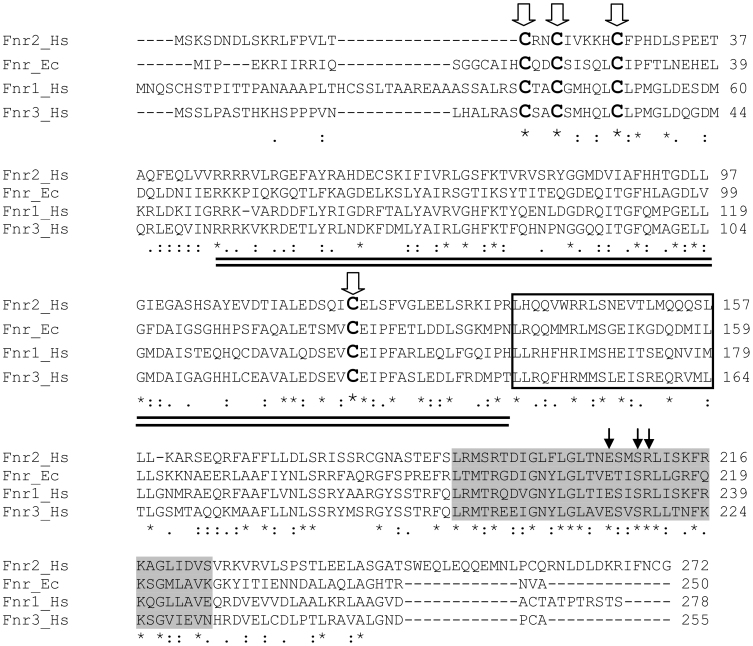
Figure 1
Figure 1. Alignment between H. seropedicae Fnr1, Fnr2 and Fnr3 proteins and E. coli Fnr.
Identical amino acids are indicated by asterisks ( * ), high similarity amino acids are indicated by colons ( : ) and low similarity amino acids by dots ( . ). Conserved cysteines required for binding of the [4Fe-4S]+ are shown in bold and indicated by thick arrows. The double underlined sequence represents the region of the N-terminal sensory domain that comprises the eight-stranded β-roll. The α-helix required for dimerization is boxed. Highlighted in light-grey is the DNA-binding domain with residues that are important for Fnr-box recognition indicated by thin arrows.
Figure 2
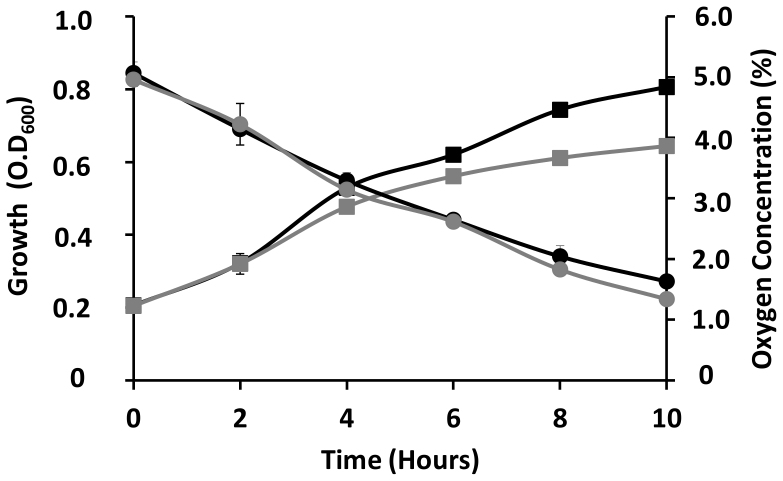
Figure 2. Influence of fnr genes on growth during oxygen limitation.
The growth of H. seropedicae SmR1 (black squares) and MB231 (grey squares) strains were assayed in NFbHP-Malate minimal media supplemented with high ammonium concentration (20 mM NH4Cl) under 5% initial oxygen concentration. The oxygen depletion in the gas phase was monitored for SmR1 (black circles) and MB231 (grey circles). Every two hours 0.5 mL samples from the flask gas phase were analysed by gas chromatography. The data represents the mean of three independent assays performed in duplicate. Error bars indicate standard deviations. In some case these are not visible as they are smaller than the graph points.
Figure 3
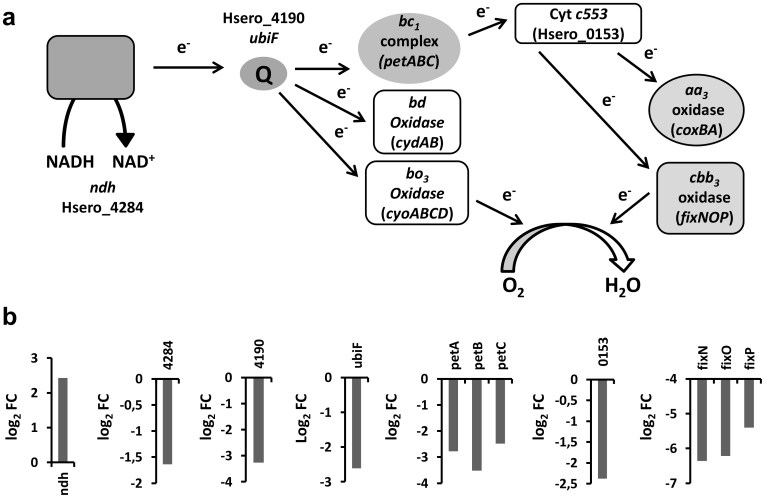
Figure 3. Fnr regulation of components of the electron transport chain (ETC) in H. seropedicae as determined by transcript profiling.
(a) Schematic representation of the probable organization of ETC branches in H. seropedicae based on the genome annotation. (b) Influence of Fnr on differential expression of genes represented in (a). FC indicates fold change.
Figure 4
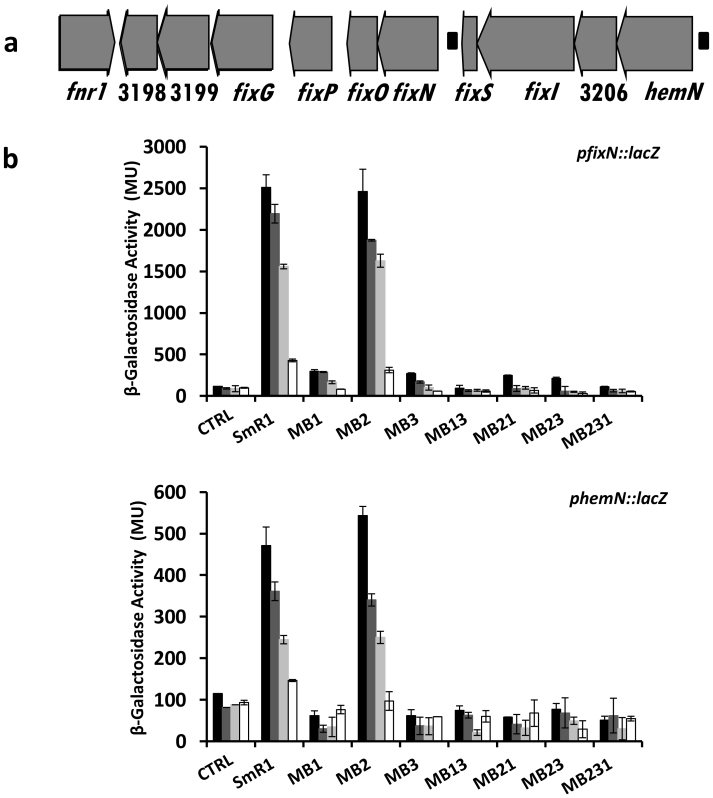
Figure 4. Effect of fnr1, fnr2 and fnr3 mutations on expression of the fixNOP and hemN-Hsero_3206-fixIS operons in H. seropedicae.
(a) Schematic representation of genomic region encoding the fixNOP and hemN-Hsero_3206-fixIS operons. The genes and predicted functions in the locus are: Hsero_3198, transmembrane protein; Hsero_3199, FixH domain containing protein; fixG, iron-sulfur 4Fe-4S ferredoxin transmembrane protein; fixP, cbb3-type cytochrome c oxidase-subunit III; fixO, cbb3-type cytochrome oxidase-subunit II; fixN,cbb3- type cytochrome c oxidase, subunit I; fixS, nitrogen fixation protein P-type ATPase protein; fixI, cation transport P-type ATPase protein; Hsero_3206, conserved hypothetical protein; hemN, oxygen-independent coproporphyrinogen III oxidase. Black rectangles represent putative FNR-boxes. Genes are not drawn to scale. (b) β-Galactosidase activities of fixN::lacZ and hemN::lacZ fusions incubated for 3 hours under the oxygen concentrations of 2.0% (black bars), 4.0% (dark grey bars), 6.0% (light grey bars) and 20.8% (white bars). CTRL indicates the SmR1 strain carrying the vector plasmid pPW452 (which contains the lacZ gene without a promoter).
Figure 5
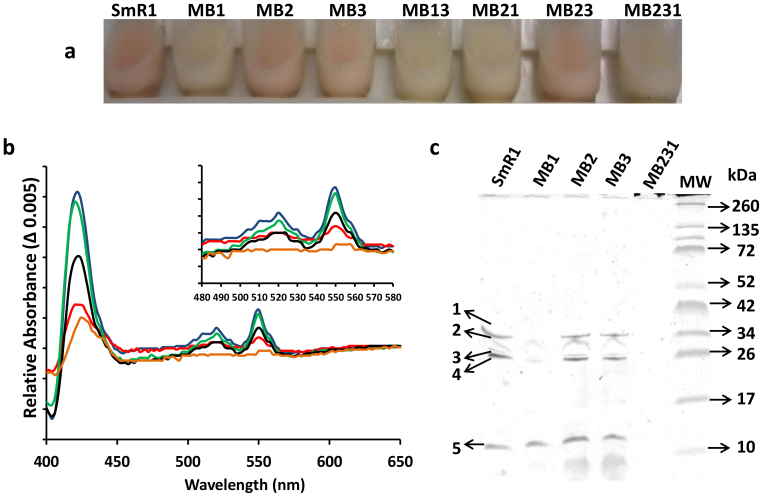
Figure 5. Fnr proteins influence the cytochrome content in H. seropedicae.
(a) Bacterial suspensions of H. seropedicae SmR1 and fnr mutant strains. Cells, from 100 mL cultures, were collected by centrifugation and resuspended in 10 mL of buffer (100 mM NaCl and 50 mM Tris.HCl pH 7.5). (b) Reduced minus oxidized visible absorption spectra of protein extracts from H. seropedicae SmR1 and fnr mutant strains. For simplification, only the data for SmR1 (blue), MB1 (red), MB2 (green), MB3 (black) and MB231 (orange) are shown. (c) Heme stained gel of H. seropedicae protein extracts. Samples (50 μg protein per lane) from H. seropedicae SmR1 and fnr mutant strains were separated by 12% Tris-Tricine SDS-PAGE and stained for covalently bound heme with o-dianisidine. On the left the heme stained bands are labeled as 1, 2, 3, 4 and 5 from the top to the bottom of the gel. The apparent molecular masses of proteins (kDa) are indicated on the right. MW: Spectra™ Multicolor Broad Range Protein Ladder (Fermentas). The strains MB13, MB21 and MB23 gave similar spectra and heme stain profiles to MB231, MB1 and MB3, respectively (Supplementary Fig. S8).
Figure 6
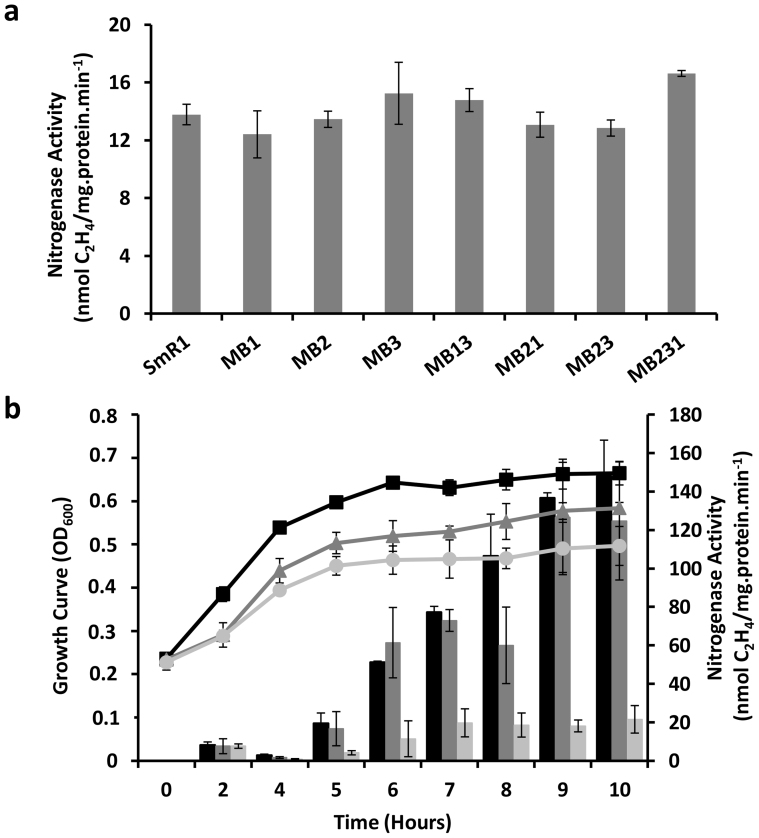
Figure 6. Influence of Fnr and FixN on nitrogenase activity.
The acetylene reduction assay was performed as described in Methods using strains grown in (a) semi-solid medium supplemented with 0.5 mM of sodium glutamate or (b) liquid medium supplemented with 0.5 mM of ammonium chloride under 5% initial oxygen in the gas phase. In (b) samples were taken from the culture to measure the growth curve (primary y axis) of SmR1 (black squares), RAM 21 (dark grey triangles) and MB231 (light grey circles). Black, dark grey and light grey bars (secondary y axis) indicate the nitrogenase activity of SmR1, RAM21 and MB231, respectively. Data represent the average of two independent experiments performed in duplicate. Error bars indicate standard deviations.

References

    1. Baldani J. I., Baldani V. L. D., Seldin L. & Dobereiner J. Characterization of Herbaspirillum seropedicae gen. nov., sp. nov., a root-associated nitrogen fixing bacterium. Int. J. Sys. Bact. 36, 86–93 (1986).
    1. Olivares F. L., Baldani V. L. D., Reis V. M., Baldani J. I. & Döbereiner J. Occurrence of the endophytic diazotrophs Herbaspirillum spp. in roots, stems and leaves predominantly of Gramineae. Biol. Fertil. Soils. 21, 197–200 (1996).
    1. James E. K. & Olivares F. L. Infection and colonization of sugar cane and other graminaceous plants by endophytic diazotrophs. Crit. Rev. Plan. Sci. 17, 77–119 (1998).
    1. Pedrosa F. O. et al. Genome of Herbaspirillum seropedicae strain SmR1, a specialized diazotrophic endophyte of tropical grasses. PLoS Genet. 7, http://dx.doi.org/10.1371/journal.pgen.1002064 (2011). - DOI - PMC - PubMed
    1. Körner H., Sofia H. J. & Zumft W. G. Phylogeny of the bacterial superfamily of Crp-Fnr transcripitional regulators, exploiting the metabolic spectrum by controlling alternative gene programs. FEMS Microbiol. Rev. 27, 559–592 (2003). - PubMed

Publication types

MeSH terms

LinkOut - more resources