


Elevated C-reactive protein associated with late- and very-late-onset schizophrenia in the general population: a prospective study
- PMID: 23996346
- PMCID: PMC4133657
- DOI: 10.1093/schbul/sbt120
Elevated C-reactive protein associated with late- and very-late-onset schizophrenia in the general population: a prospective study
Abstract
Background: Individuals with autoimmune diseases and severe infections have persistent or acutely elevated inflammatory biomarkers and increased risk of schizophrenia. We tested the hypothesis that baseline elevated plasma levels of the inflammatory biomarker, C-reactive protein (CRP), associate with increased risk of late- and very-late-onset schizophrenia in the general population, and if such an association possibly is causal.
Method: We analyzed data from 78 810 men and women, aged 20-100 years, from 2 large population studies. Endpoints were hospitalization with schizophrenia and schizophrenia and schizophrenia-like psychosis combined. We performed prospective and cross-sectional analyses adjusted for potential confounders with up to 20 years of follow-up. Furthermore, we used genetic variants influencing plasma CRP levels to perform a Mendelian randomization study.
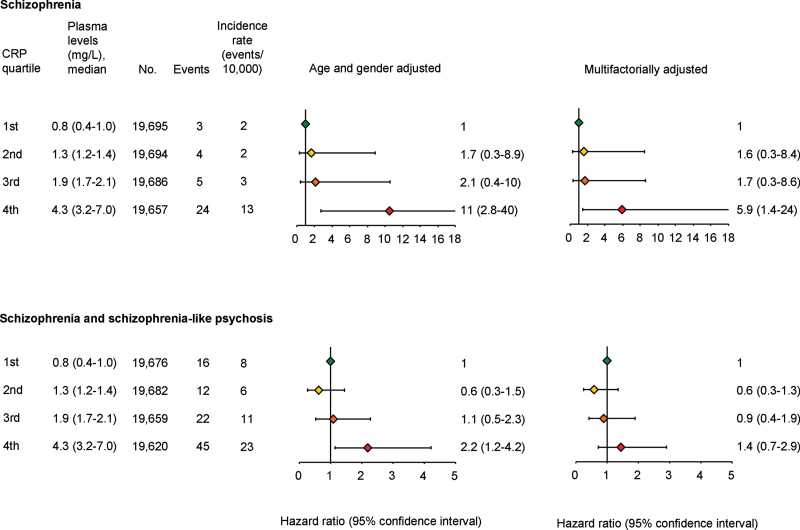
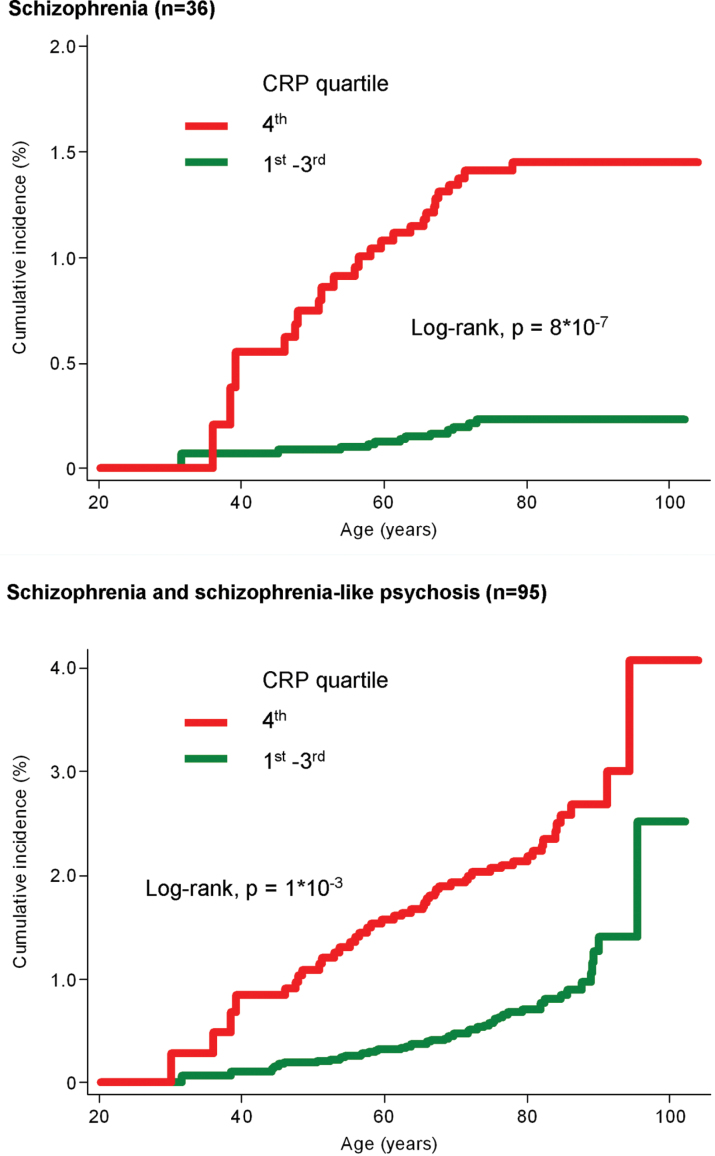
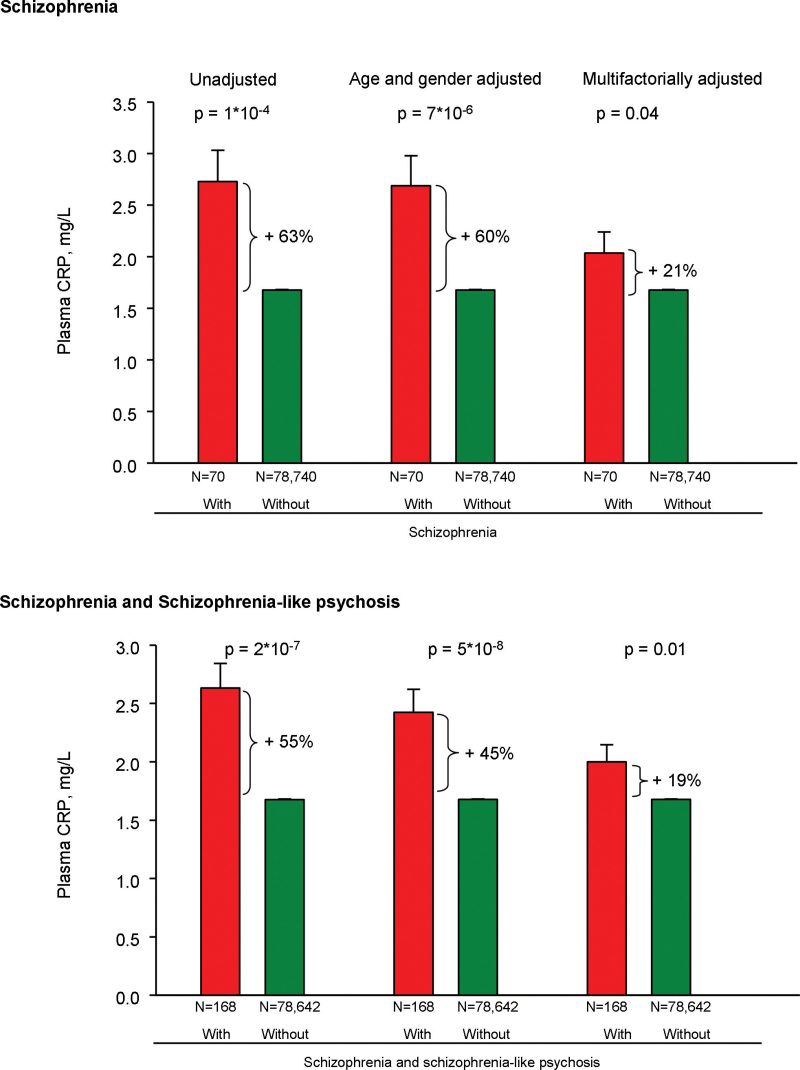
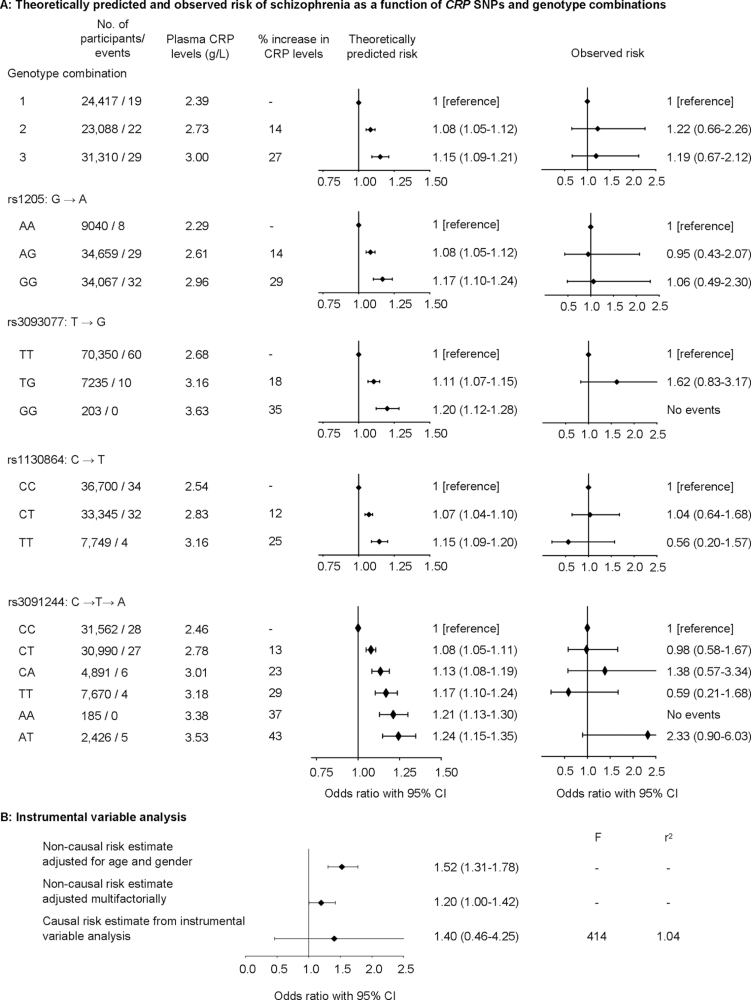
Results: Age- and gender-adjusted hazard ratios vs individuals in the first quartile of CRP were 1.7 (95% CI: 0.3-8.9) for second quartile, 2.1 (0.4-10) for third quartile, and 11 (2.8-40) for fourth quartile individuals. The corresponding hazard ratio for fourth quartile individuals after multifactorial adjustment was 5.9 (1.4-24). Furthermore, individuals with vs without schizophrenia had 63% increased plasma levels of CRP (P = 1 × 10(-4)). Finally, when CRP was on a continuous scale, a doubling in CRP yielded an age- and gender-adjusted observational OR of 1.5 (1.3-1.8) and a corresponding causal OR of 1.4 (0.5-4.3) (observed vs causal: P = .89).
Conclusion: Baseline elevated plasma CRP is associated with a 6- to 11-fold increased risk of late- and very-late-onset schizophrenia in the general population. We cannot exclude that this is a causal association. These are novel findings.
Keywords: epidemiology; genetics; inflammation; schizophrenia.
© The Author 2013. Published by Oxford University Press on behalf of the Maryland Psychiatric Research Center. All rights reserved. For permissions, please email: journals.permissions@oup.com.
Figures
Comment in
-
Elevated C reactive protein in adults predicts the later development of late-onset or very-late-onset schizophrenia.Evid Based Ment Health. 2015 May;18(2):e2. doi: 10.1136/eb-2014-101996. Epub 2015 Mar 18. Evid Based Ment Health. 2015. PMID: 25787013 Free PMC article. No abstract available.
References
-
- Gabay C, Kushner I. Acute-phase proteins and other systemic responses to inflammation. N Engl J Med. 1999;340:448–454 - PubMed
-
- Benros ME, Nielsen PR, Nordentoft M, Eaton WW, Dalton SO, Mortensen PB. Autoimmune diseases and severe infections as risk factors for schizophrenia: a 30-year population-based register study. Am J Psychiatry. 2011;168:1303–1310 - PubMed
-
- Potvin S, Stip E, Sepehry AA, Gendron A, Bah R, Kouassi E. Inflammatory cytokine alterations in schizophrenia: a systematic quantitative review. Biol Psychiatry. 2008;63:801–808 - PubMed
Publication types
MeSH terms
Substances
LinkOut - more resources
Full Text Sources
Other Literature Sources
Medical
Research Materials
Miscellaneous
