


Executive dysfunction in OSA before and after treatment: a meta-analysis
- PMID: 23997362
- PMCID: PMC3738038
- DOI: 10.5665/sleep.2950
Executive dysfunction in OSA before and after treatment: a meta-analysis
Abstract
Study objectives: Obstructive sleep apnea (OSA) is a frequent and often underdiagnosed condition that is associated with upper airway collapse, oxygen desaturation, and sleep fragmentation leading to cognitive dysfunction. There is meta-analytic evidence that subdomains of attention and memory are affected by OSA. However, a thorough investigation of the impact of OSA on different subdomains of executive function is yet to be conducted. This report investigates the impact of OSA and its treatment, in adult patients, on 5 theorized subdomains of executive function.
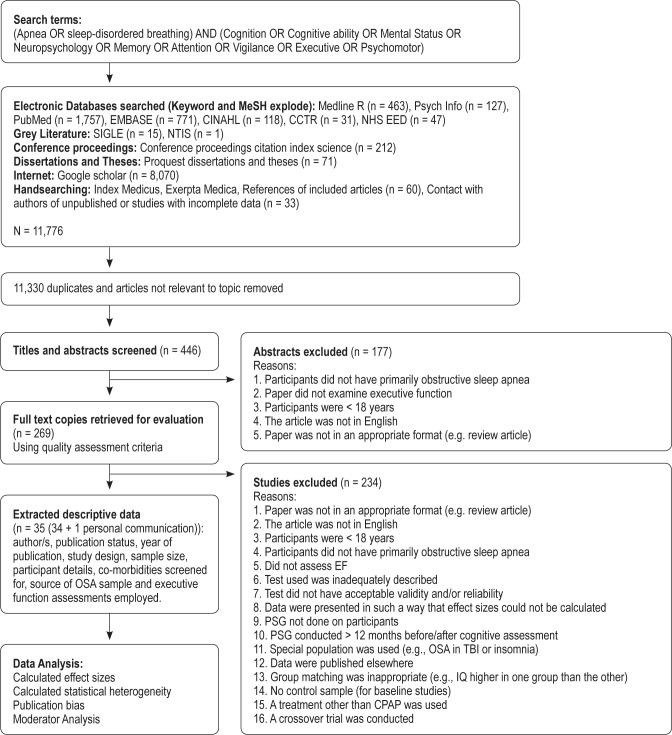
Design: An extensive literature search was conducted of published and unpublished materials, returning 35 studies that matched selection criteria. Meta-analysis was used to synthesize the results from studies examining the impact of OSA on executive functioning compared to controls (21 studies), and before and after treatment (19 studies); 5 studies met inclusion in both categories.
Measurements: Research papers were selected which assessed 5 subdomains of executive function: Shifting, Updating, Inhibition, Generativity, and Fluid Reasoning.
Results: All 5 domains of executive function demonstrated medium to very large impairments in OSA independent of age and disease severity. Furthermore, all subdomains of executive function demonstrated small to medium improvements with CPAP treatment.
Discussion: Executive function is impaired across all five domains in OSA; these difficulties improved with CPAP treatment. Age and disease severity did not moderate the effects found; however, further studies are needed to explore the extent of primary and secondary effects, and the impact of age and premorbid intellectual ability (cognitive reserve).
Keywords: Obstructive sleep apnea; cognition; executive function; neuropsychology; review.
Figures
References
-
- Al-Lawati NM, Patel SR, Ayas NT. Epidemiology, risk factors, and consequences of obstructive sleep apnoea and short sleep duration. Prog Cardiovasc Dis. 2009;51:285–93. - PubMed
-
- Butkov N, Lee-Chiong T. Fundamentals of sleep technology. Philadelphia: Lippincott Williams & Wilkins; 2007.
-
- Young T, Palta N, Dempsey J. The occurrence of sleep disordered breathing among middle-aged adults. N Eng J Med. 1993;32:1230–5. - PubMed
-
- Al-Ghanim N, Comondore VR, Fleetham J, et al. The economic impact of obstructive sleep apnoea. Lung. 2008;186:7–12. - PubMed
-
- Hillman DR, Murphy AS, Pezzullo L. The economic cost of sleep disorders. Sleep. 2006;29:299–305. - PubMed
SUPPLEMENTAL REFERENCES
-
- Bailey GL. Neuropsychological functioning, sleep and vigilance in men with obstructive sleep apnea syndrome treated with continuous positive airway pressure. The Florida State University. 1993
-
- Barbé F, Mayoralas LR, Duran J, et al. Treatment with continuous positive airway pressure is not effective in patients with sleep apnea but no daytime sleepiness. Ann Intern Med. 2001;134:1015–23. - PubMed
Publication types
MeSH terms
LinkOut - more resources
Full Text Sources
Other Literature Sources
Miscellaneous
