


Childbirth education and obstetric interventions among low-risk canadian women: is there a connection?
- PMID: 23997551
- PMCID: PMC3489119
- DOI: 10.1891/1058-1243.21.4.229
Childbirth education and obstetric interventions among low-risk canadian women: is there a connection?
Abstract
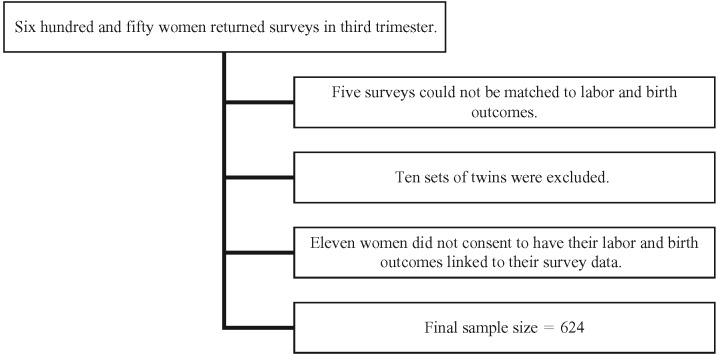
The objective of this study was to examine the associations between attendance at childbirth education classes and maternal characteristics (age, income, educational level, single parent status), maternal psychological states (fear of birth, anxiety), rates of obstetric interventions, and breastfeeding initiation. Between women's 35th and 39th weeks of gestation, we collected survey data about their childbirth fear, anxiety, attendance at childbirth education classes, choice of health-care provider, and expectations for interventions; we then linked women's responses (n = 624) to their intrapartum records obtained through Perinatal Services British Columbia. Older, more educated, and nulliparous women were more likely to attend childbirth education classes than younger, less educated, and multiparous women. Attending prenatal education classes was associated with higher rates of vaginal births among women in the study sample. Rates of labor induction and augmentation and use of epidural anesthesia were not significantly associated with attendance at childbirth education classes. Future studies might explore the effect of specialized education programs on rates of interventions during labor and mode of birth.
Keywords: childbirth education; low-risk pregnant women; obstetric interventions; prenatal classes.
References
-
- Armstrong E. M. (2000). Lessons in control: Prenatal education in the hospital. Social Problems, 47(4), 583–605
-
- BC Women’s Hospital (2011). Welcome to the BC women’s prenatal classes online registration. Retrieved from https://edreg.cw.bc.ca/Prenatal/Default.aspx
-
- Bennett A., Hewson D., Booker E., Holliday S. (1985). Antenatal preparation and labor support in relation to birth outcomes. Birth, 12(l), 9–16 10.1111/j.1523-536X.1985.tb00924.x - PubMed
-
- British Columbia Perinatal Health Program (2010). Perinatal health report 2008. Retrieved from http://www.perinatalservicesbc.ca/NR/rdonlyres/3DEC78D6-BDC3-4602-B09B-F...
-
- Canadian Institute of Health Information (2010). Highlights of 2008–2009 selected indicators describing the birthing process in Canada. Retrieved from https://secure.cihi.ca/estore/productSeries.htm?locale=en&pc=PCC226
LinkOut - more resources
Full Text Sources