


Clinically meaningful change estimates for the six-minute walk test and daily activity in individuals with chronic heart failure
- PMID: 23997688
- PMCID: PMC3751711
Clinically meaningful change estimates for the six-minute walk test and daily activity in individuals with chronic heart failure
Abstract
Purpose: The purpose of the present pilot study was to provide a preliminary estimate of the minimum detectable difference (MDD) and minimum clinically important difference (MCID) of the six-minute walk test (6MWT) and daily activity in outpatients with chronic heart failure (CHF).
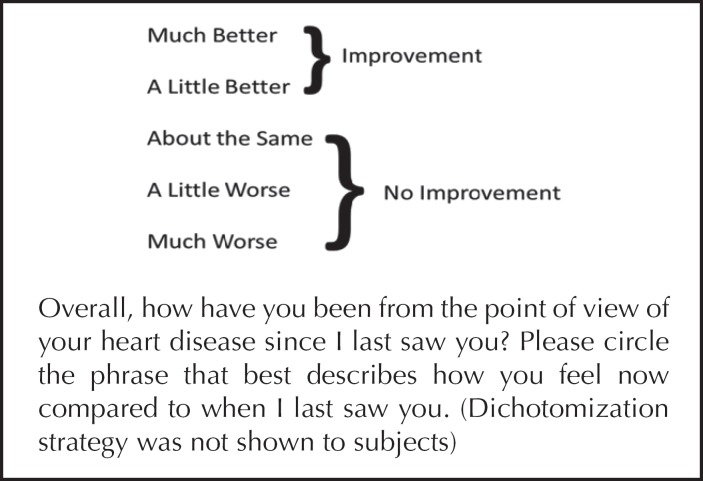
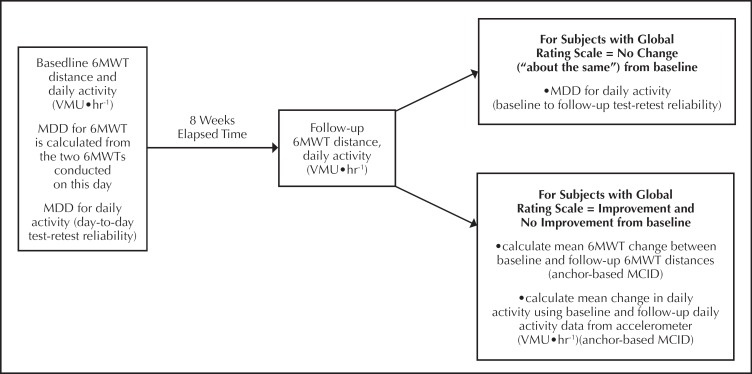
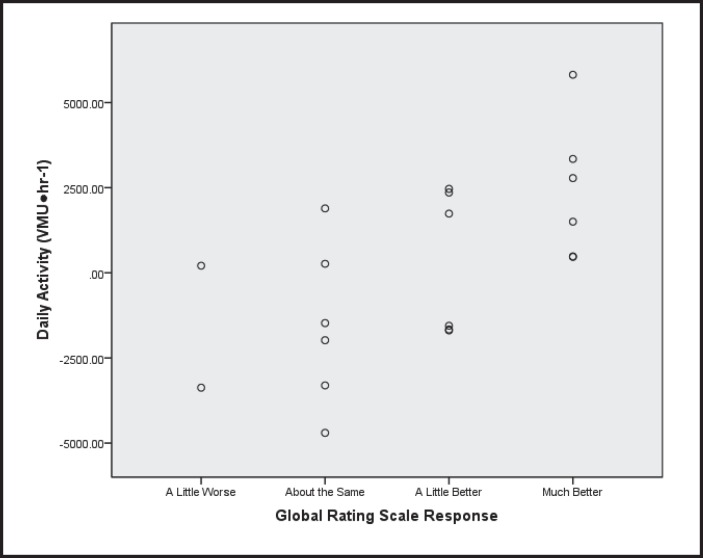
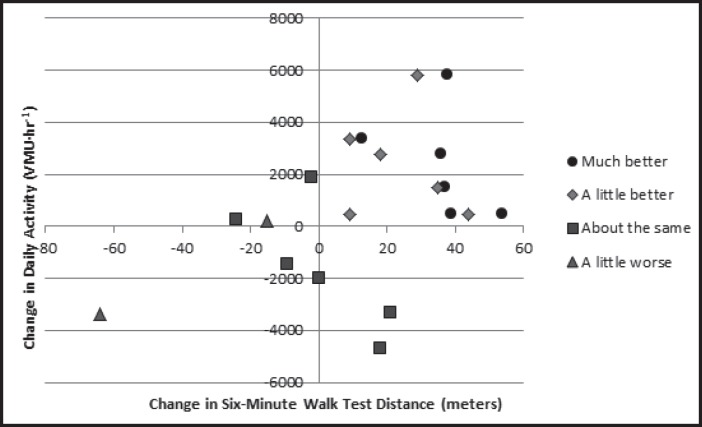
Methods: A convenience sample of 22 adults with stable New York Heart Association Functional Class II and III CHF performed two baseline 6MWTs separated by 30 minutes of rest. Subjects then wore a triaxial accelerometer for 7 days to monitor daily activity. After 7 weeks of usual care, subjects again wore the accelerometer for 7 days and then returned to the clinic to complete the Global Rating of Change Scale (GRS) with regard to their heart disease and perform another set of 6MWTs. For the 6MWT, the MDD was calculated using the two baseline 6MWT distances. For daily activity, the MDD was calculated using two methods: (1) day-to-day test-retest reliability during baseline monitoring, and (2) baseline to follow-up test-retest reliability in those who reported no change on the GRS. The MCID for the 6MWT and daily activity was calculated using the mean and 95% confidence interval (CI95%) for those subjects who reported 'improvement' on the GRS.
Results: The MDD at the CI95% for the 6MWT was 32.4 meters. The MCID for the 6MWT was 30.1 (CI95% 20.8, 39.4) meters. The MDD for daily activity was 5,909 vector magnitude units (VMU·hr.(-1)) The MCID for daily activity was 1,337 VMU·hr.(-1) There was good alignment of the MDD and MCID for the 6MWT, suggesting that clinically meaningful change is approximately 32 meters. However, the calculated MCID was substantially less than measurement error as represented by the MDD, indicating that the MCID was underestimated in this sample or that daily activity may be robust to change in overall disease status.
Keywords: clinically meaningful change; daily activity; heart failure; six-minute walk test.
Figures
References
-
- Gordan A, Tyni-Lenne R, Persson H, Kauser L, Hultman E, Sylven C. Markedly improved skeletal muscle function with local muscle training in patients with chronic heart failure. Clin. Cardiol. 1996;19:568–574. - PubMed
-
- Wasserman K, Hansen JE, Sue DY, Stringer WW, Whipp BJ. Principles of Exercise Testing and Interpretation. Philadelphia, PA: Lippincott Williams & Wilkins; 2005.
-
- Oka RK, Gortner SR, Stotts NA, Haskell WL. Predictors of physical activity with chronic heart failure secondary to either ischemic or idiopathic dilated cardiomyopathy. Am J Cardiol. 1996;77:159–163. - PubMed
-
- van den Berg-Emons H, Bussmann J, Balk A, et al. Level of activities associated with mobility during everyday life in patients with chronic congestive heart failure as measured with an “Activity Monitor.”. Phys Ther. 2001;81:1502–1511. - PubMed
-
- Davies SW, Jordan SL, Lipkin DP. Use of limb movement sensors as indicators of the level of everyday physical activity in chronic congestive heart failure. Am J Cardiol. 1992;69:1581–1586. - PubMed
LinkOut - more resources
Full Text Sources
Other Literature Sources
Medical