


Co-culture of Mouse Embryonic Stem Cells with Sertoli Cells Promote in vitro Generation of Germ Cells
- PMID: 23997904
- PMCID: PMC3758033
Co-culture of Mouse Embryonic Stem Cells with Sertoli Cells Promote in vitro Generation of Germ Cells
Abstract
Objective(s): Sertoli cells support in vivo germ cell production; but, its exact mechanism has not been well understood. The present study was designed to analyze the effect of Sertoli cells in differentiation of mouse embryonic stem cells (mESCs) to germ cells.
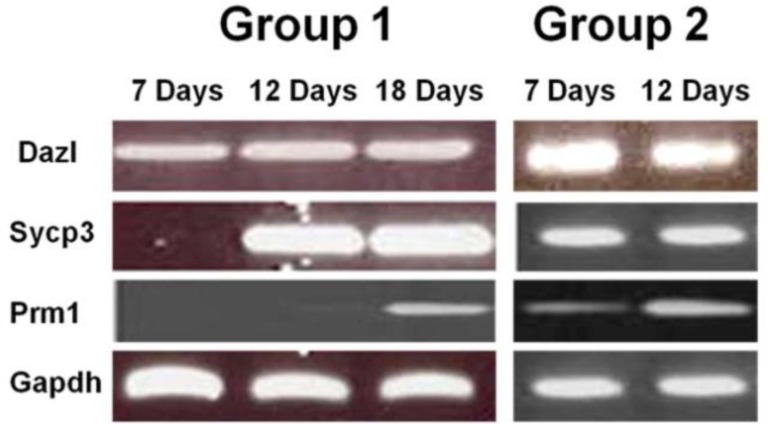
Materials and methods: A fusion construct composed of a Stra8 gene promoter and the coding region of enhanced green fluorescence protein was produced to select differentiated mESCs. To analyze sertoli cells' effect in differentiation process, mESCs were separated into two groups: the first group was cultured on gelatin with retinoic acid treatment and the second group was co-cultured with sertoli cell feeder without retinoic acid induction. Expressions of pre-meiotic (Stra8), meiotic (Dazl and Sycp3) and post-meiotic (Prm1) genes were evaluated at different differentiation stages (+7, +12 and +18 days of culture).
Results: In the first group, expressions of meiotic and post-meiotic genes started 12 and 18 days after induction with retinoic acid, respectively. In the second group, 7 days after co-culturing with Sertoli cells, expression of meiotic and post-meiotic genes was observed.
Conclusion: These results show that differentiation process to germ cells is supported by Sertoli cells. Our findings provide a novel effective approach for generation of germ cell in vitro and studying the interaction of germ cells with their niche.
Keywords: Co-culture; Differentiation; Embryonic stem cell; In vitro derived germ cells; Sertoli cell.
Figures
References
-
- Anniballo R, Brehm R, and Steger K. Recognising the Sertoli-cell-only (SCO) syndrome: a case study. Andrologia. 2011;43:78–83. - PubMed
-
- Zhou GB, Meng QG, Li N. In vitro derivation of germ cells from embryonic stem cells in mammals. Mol Reprod Dev. 2010;77:586–594. - PubMed
-
- Kerr CL, Cheng L. The dazzle in germ cell differentiation. J Mol Cell Biol. 2010;2:26–29. - PubMed
LinkOut - more resources
Full Text Sources