


Review
doi: 10.1186/alzrt204.
eCollection 2013.
Apolipoprotein E as a β-amyloid-independent factor in Alzheimer's disease
Affiliations
- PMID: 23998393
- PMCID: PMC3979087
- DOI: 10.1186/alzrt204
Item in Clipboard
Review
Apolipoprotein E as a β-amyloid-independent factor in Alzheimer's disease
Alzheimers Res Ther.
.
Abstract
APOE, which encodes apolipoprotein E, is the most prevalent and best established genetic risk factor for late-onset Alzheimer's disease. Current understanding of Alzheimer's disease pathophysiology posits an important role for apolipoprotein E in the disease cascade via its interplay with β-amyloid. However, evidence is also emerging for roles of apolipoprotein E in the disease process that are independent of β-amyloid. Particular areas of interest are lipid metabolism, tau pathology, neuroenergetics, neurodevelopment, synaptic plasticity, the neurovasculature, and neuroinflammation. The intent of this article is to review the literature in each of these areas.
Figures
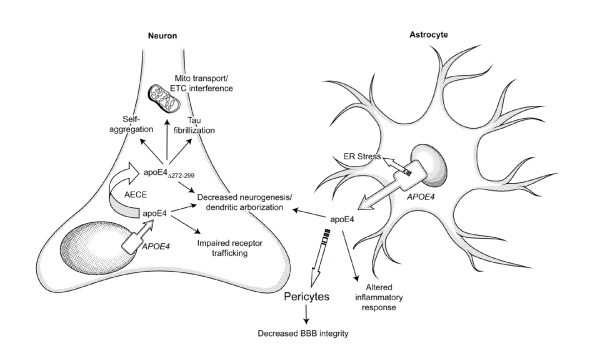
Effects of cell-type specific expression and aberrant processing of apolipoprotein E4 in the brain. Astrocyte-secreted apolipoprotein E (apoE) is internalized by neurons, but apoE4 expression in astrocytes has been associated with endoplasmic reticulum (ER) stress that may impair astrocyte function. Astrocyte-secreted apoE4 has also been associated with decreased blood–brain barrier (BBB) integrity via signaling in pericytes, decreased synapse development, and alterations in inflammatory response. A smaller proportion of brain apoE expression is attributed to neurons: apoE4 expressed in neurons (but not that internalized from astrocytes) is highly susceptible to cleavage by apoE cleaving enzyme (AECE) in the secretory pathway, becoming AECE-cleaved apoE4 missing C-terminus residues 272 to 299 (apoEΔ272–299). This cleavage product is capable of escaping the secretory pathway, self-aggregating in the cytosol, increasing tau fibrillization, interfering with mitochondrial function and motility, and impairing neurogenesis. In neurons, full-length apoE4 has been associated with decreased dendritic arborization and impairment of receptor trafficking. ETC, electron transport chain.
References
Publication types
Grants and funding
LinkOut - more resources
Full Text Sources
Other Literature Sources
Miscellaneous
