


Academic proficiency in children after early congenital heart disease surgery
- PMID: 24000004
- PMCID: PMC3946912
- DOI: 10.1007/s00246-013-0781-6
Academic proficiency in children after early congenital heart disease surgery
Abstract
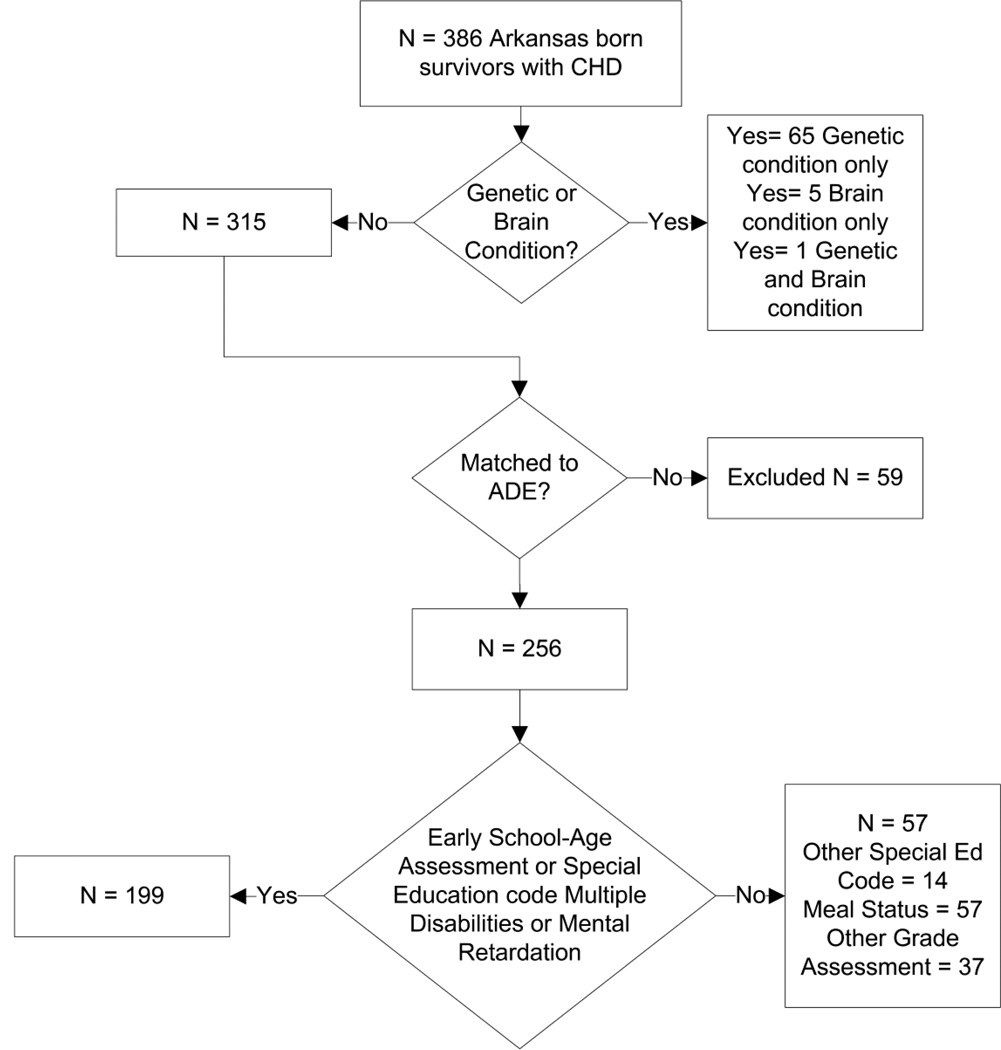
Children with early surgery for congenital heart disease (CHD) are known to have impaired neurodevelopment; their performance on school-age achievement tests and their need for special education remains largely unexplored. The study aimed to determine predictors of academic achievement at school age and placement in special education services among early CHD surgery survivors. Children with CHD surgery at <1 year of age from January 1, 1998 to December 31, 2003, at the Arkansas Children's Hospital were identified. Out-of-state births and infants with known genetic and/or neurologic conditions were excluded. Infants were matched to an Arkansas Department of Education database containing standardized assessments at early school age and special-education codes. Predictors for achieving proficiency in literacy and mathematics and the receipt of special education were determined. Two hundred fifty-six children who attended Arkansas public schools and who had surgery as infants were included; 77.7 % had either school-age achievement-test scores or special-education codes of mental retardation or multiple disabilities. Scores on achievement tests for these children were 7-13 % lower than those of Arkansas students (p < 0.01). They had an eightfold increase in receipt of special education due to multiple disabilities [odds ratio (OR) 10.66, 95 % confidence interval (CI) 4.23-22.35] or mental retardation (OR 4.96, 95 % CI 2.6-8.64). Surgery after the neonatal period was associated with decreased literacy proficiency, and cardiopulmonary bypass during the first surgery was associated with decreased mathematics proficiency. Children who had early CHD surgery were less proficient on standardized school assessments, and many received special education. This is concerning because achievement-test scores at school age are "real-world" predictors of long-term outcomes.
Conflict of interest statement
Dr. Mulkey receives funding from the University of Arkansas for Medical Sciences Center for Translational Neuroscience, the Arkansas Children’s Hospital Research Institute, and the Arkansas Biosciences Institute. The other authors have no conflicts of interest to disclose.
Figures
References
-
- Hoffman JI. Congenital heart disease: incidence and inheritance. Pediatr Clin North Am. 1990;37:25–43. - PubMed
-
- Samanek M. Congenital heart malformations: prevalence, severity, survival, and quality of life. Cardiol Young. 2000;10:179–185. - PubMed
-
- Donofrio MT, Massaro AN. Impact of congenital heart disease on brain development and neurodevelopmental outcome. [Accessed May 15, 2013];Int J Pediatr. 2010 http://www.ncbinlmnih.gov/pmc/articles/PMC2938447/ - PMC - PubMed
-
- Hsia TY, Gruber PJ. Factors influencing neurologic outcome after neonatal cardiopulmonary bypass: what we can and cannot control. Ann Thorac Surg. 2006;81:S2381–S2388. - PubMed
Publication types
MeSH terms
Grants and funding
LinkOut - more resources
Full Text Sources
Other Literature Sources
Medical
