Wounded embryonic corneas exhibit nonfibrotic regeneration and complete innervation
- PMID: 24003085
- PMCID: PMC3783042
- DOI: 10.1167/iovs.13-12504
Wounded embryonic corneas exhibit nonfibrotic regeneration and complete innervation
Abstract
Purpose: Wound healing in adult corneas is characterized by activation of keratocytes and extracellular matrix (ECM) synthesis that results in fibrotic scar formation and loss of transparency. Since most fetal wounds heal without scaring, we investigated the regenerative potential of wounded embryonic corneas.
Methods: On embryonic day (E) 7 chick corneas were wounded by making a linear incision traversing the epithelium and anterior stroma. Wounded corneas were collected between E7 and E18, and analyzed for apoptosis, cell proliferation, staining of ECM components, and corneal innervation.
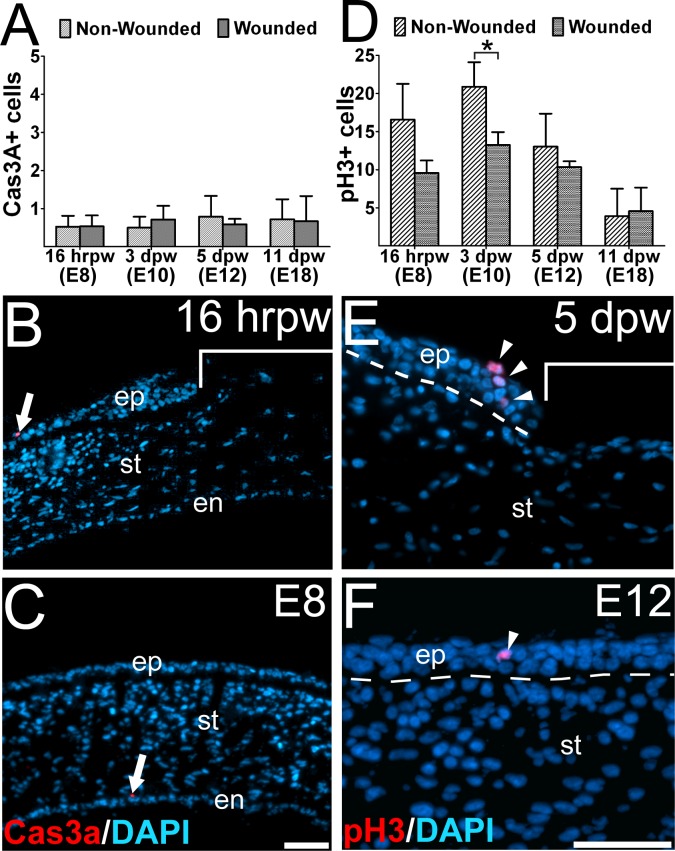
Results: Substantial wound retraction was observed within 16-hours postwounding (hpw) and partial re-epithelialized by 5-days postwounding (dpw). Corneal wounds were fully re-epithelialized by 11 dpw with no visible scars. There was no difference in the number of cells undergoing apoptosis between wounded and control corneas. Cell proliferation was reduced in the wounded corneas, albeit mitotic cells in the regenerating epithelium. Staining for alpha-smooth muscle actin (α-SMA), tenascin, and fibronectin was vivid but transient at the wound site. Staining for procollagen I, perlecan, and keratan sulfate proteoglycan was reduced at the wound site. Wounded corneas were fully regenerated by 11 dpw and showed similar patterns of staining for ECM components, albeit an increase in perlecan staining. Corneal innervation was inhibited during wound healing, but regenerated corneas were innervated similar to controls.
Conclusions: These data show that minimal keratocyte activation, rapid ECM reconstruction, and proper innervation occur during nonfibrotic regeneration of the embryonic cornea.
Keywords: corneal development; corneal wound healing; extracellular matrix; innervation.
Figures



References
-
- Ghiasi H, Cai S, Perng GC, Nesburn AB, Wechsler SL. The role of natural killer cells in protection of mice against death and corneal scarring following ocular HSV-1 infection. Antiviral Res. 2000; 45: 33–45 - PubMed
-
- Hassell JR, Cintron C, Kublin C, Newsome DA. Proteoglycan changes during restoration of transparency in corneal scars. Arch Biochem Biophys. 1983; 222: 362–369 - PubMed
-
- Wilson SE, Mohan RR, Mohan RR, Ambrósio R Jr, Hong JW, Lee JS. The corneal wound healing response: cytokine-mediated interaction of the epithelium, stroma, and inflammatory cells. Prog Retin Eye Res. 2001; 20: 625–637 - PubMed
-
- Jester JV, Petroll WM, Barry PA, Cavanagh HD. Expression of alpha-smooth muscle (alpha-SM) actin during corneal stromal wound healing. Invest Ophthalmol Vis Sci. 1995; 36: 809–819 - PubMed
-
- Matsubara M, Girard MT, Kublin CL, Clinton C, Fini ME. Differential roles for two gelatinolytic enzymes of the matrix metalloproteinase family in the remodeling cornea. Dev Biol. 1991; 147: 425–439 - PubMed
Publication types
MeSH terms
Grants and funding
LinkOut - more resources
Full Text Sources
Other Literature Sources
Medical