Review
. 2013 Sep 1;5(9):a009159.
doi: 10.1101/cshperspect.a009159.

Eph receptor signaling and ephrins

Affiliations
Review

Eph receptor signaling and ephrins

Erika M Lisabeth et al. Cold Spring Harb Perspect Biol. .

Abstract

The Eph receptors are the largest of the RTK families. Like other RTKs, they transduce signals from the cell exterior to the interior through ligand-induced activation of their kinase domain. However, the Eph receptors also have distinctive features. Instead of binding soluble ligands, they generally mediate contact-dependent cell-cell communication by interacting with surface-associated ligands-the ephrins-on neighboring cells. Eph receptor-ephrin complexes emanate bidirectional signals that affect both receptor- and ephrin-expressing cells. Intriguingly, ephrins can also attenuate signaling by Eph receptors coexpressed in the same cell. Additionally, Eph receptors can modulate cell behavior independently of ephrin binding and kinase activity. The Eph/ephrin system regulates many developmental processes and adult tissue homeostasis. Its abnormal function has been implicated in various diseases, including cancer. Thus, Eph receptors represent promising therapeutic targets. However, more research is needed to better understand the many aspects of their complex biology that remain mysterious.


Figures
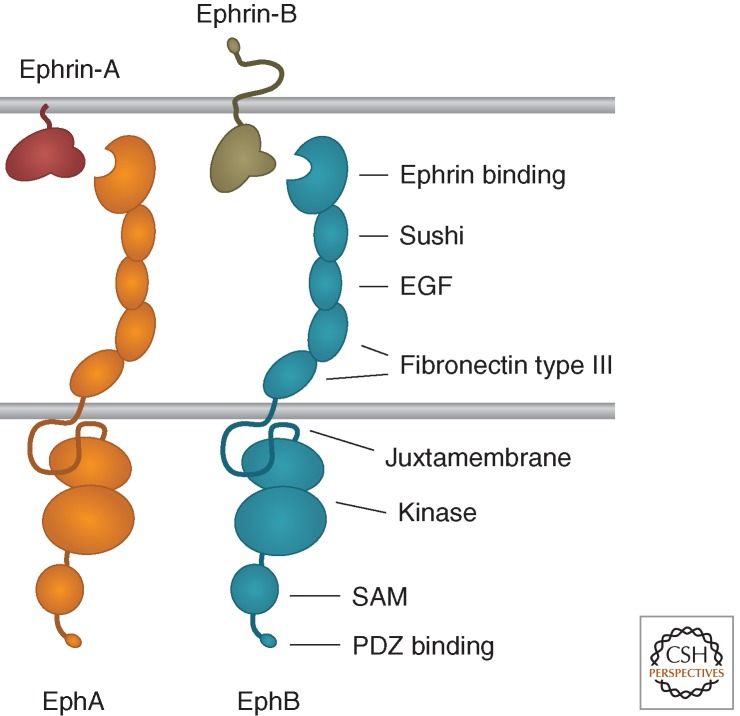
Figure 1.
Figure 1.
Domain structure of Eph receptors and ephrins.
Figure 2.
Figure 2.
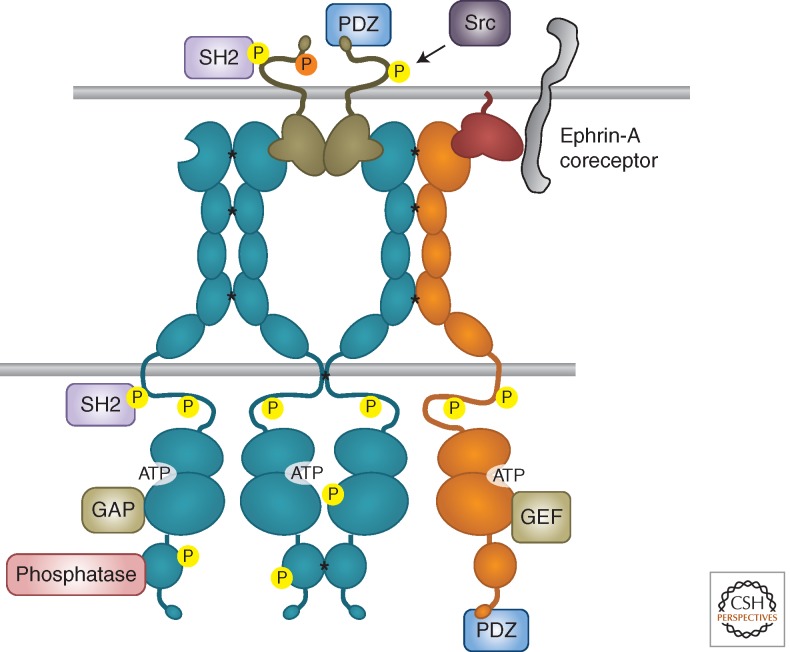
Eph receptor clustering and bidirectional signaling. SH2 and PDZ indicate proteins containing these domains. All types of signaling proteins shown can associate with both EphA and EphB receptors. Asterisks indicate receptor–receptor interactions favoring clustering; yellow circles indicate tyrosine phosphorylation and the orange circle indicates serine phosphorylation.
Figure 3.
Figure 3.
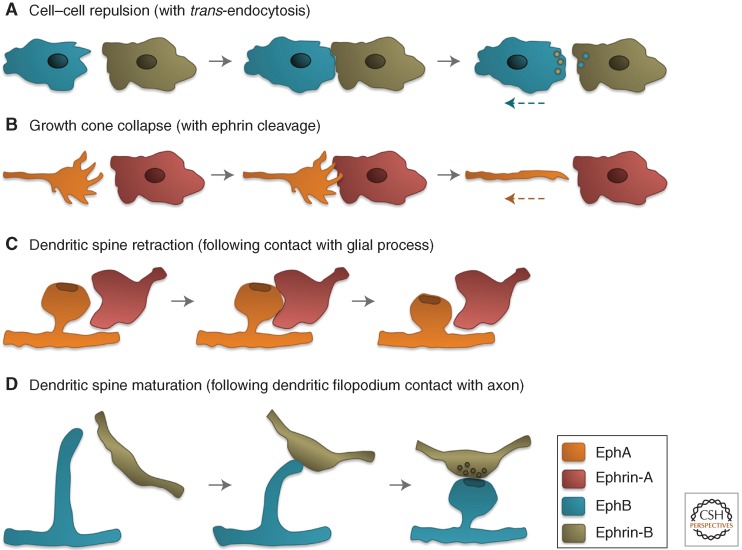
Eph receptor–ephrin repulsive effects and dendritic spine maturation. (A) An EphB-expressing cell encounters an ephrin-B-expressing cell and retracts after the internalization of EphB–ephrin-B complexes enables cell separation. (B) An EphA-expressing growth cone at the leading edge of an axon encounters an ephrin-A-expressing cell, collapses, and begins to retract after the cleavage of ephrin-A molecules enables cell separation. (C) An EphA-expressing spine on a dendrite (bearing an excitatory postsynaptic terminal represented as a darker oval) comes in contact with an ephrin-A-expressing glial process and retracts becoming shorter. (D) An EphB-expressing filopodial protrusion on a dendrite acquires an enlarged “head” and shortens following contact with an ephrin-B-expressing axon. The presynaptic terminal also matures following contact.
Figure 4.
Figure 4.
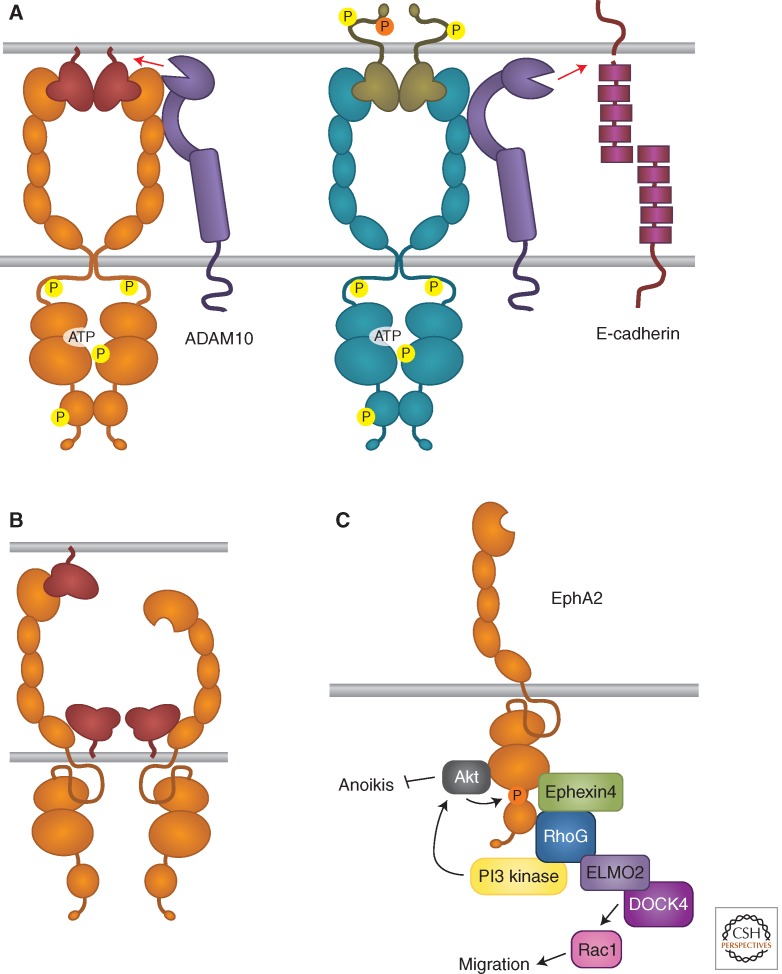
Eph receptor/ephrin signaling activities beyond bidirectional signaling. (A) Roles of the ADAM10 metalloprotease in Eph receptor/ephrin signaling. (B) Inhibition of Eph receptor forward signaling by cis interaction with ephrins. (C) Ephrin-independent Eph receptor signaling.
Figure 5.
Figure 5.
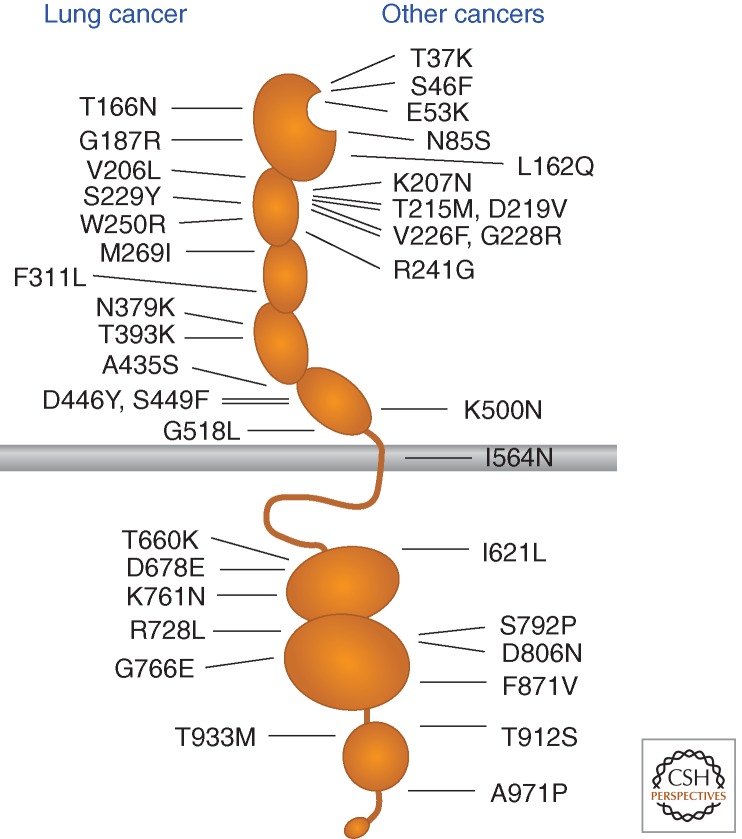
EphA3 receptor somatic mutations in cancer.

References

    1. Afshari FT, Kwok JC, Fawcett JW 2010. Astrocyte-produced ephrins inhibit Schwann cell migration via VAV2 signaling. J Neurosci 30: 4246–4255 - PMC - PubMed
    1. Antion MD, Christie LA, Bond AM, Dalva MB, Contractor A 2010. Ephrin-B3 regulates glutamate receptor signaling at hippocampal synapses. Mol Cell Neurosci 45: 378–388 - PMC - PubMed
    1. Argenzio E, Bange T, Oldrini B, Bianchi F, Peesari R, Mari S, Di Fiore PP, Mann M, Polo S 2011. Proteomic snapshot of the EGF-induced ubiquitin network. Mol Syst Biol 7: 462. - PMC - PubMed
    1. Arvanitis D, Davy A 2008. Eph/ephrin signaling: Networks. Genes Dev 22: 416–429 - PMC - PubMed
    1. Arvanitis DN, Jungas T, Behar A, Davy A 2010. Ephrin-B1 reverse signaling controls a posttranscriptional feedback mechanism via miR-124. Mol Cell Biol 30: 2508–2517 - PMC - PubMed

Publication types

MeSH terms