


Cheetahs, Acinonyx jubatus, balance turn capacity with pace when chasing prey
- PMID: 24004493
- PMCID: PMC3971710
- DOI: 10.1098/rsbl.2013.0620
Cheetahs, Acinonyx jubatus, balance turn capacity with pace when chasing prey
Abstract
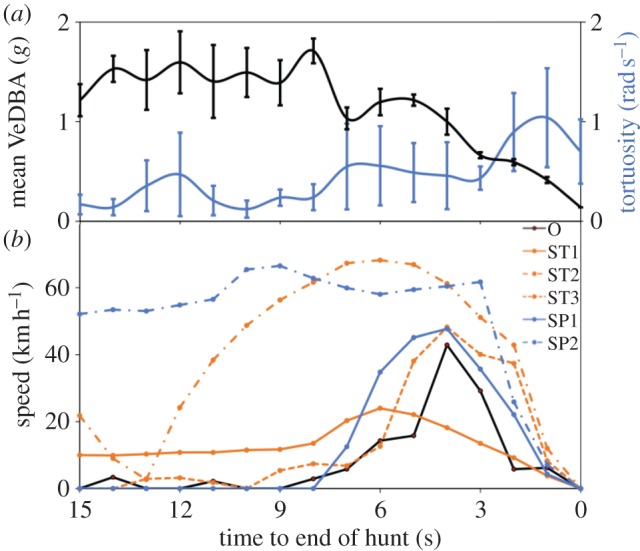
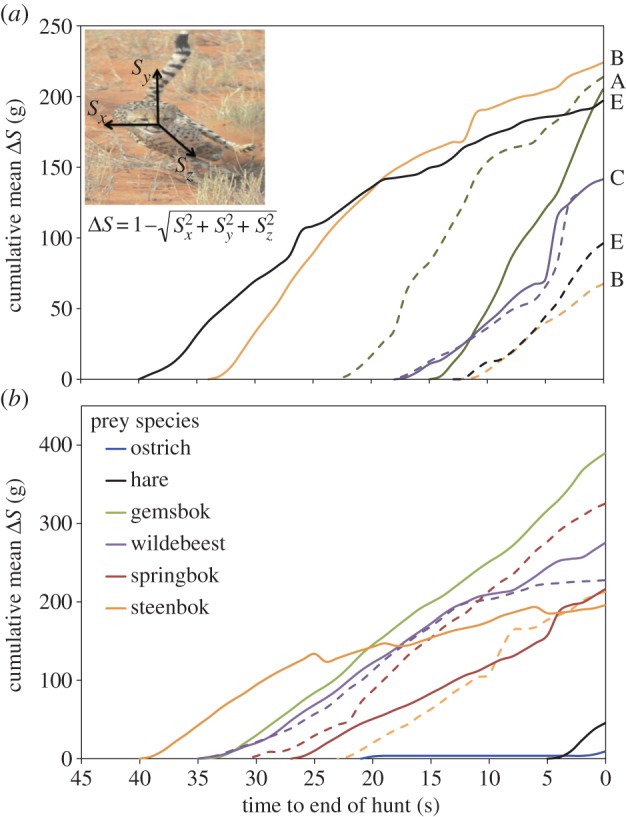
Predator-prey interactions are fundamental in the evolution and structure of ecological communities. Our understanding, however, of the strategies used in pursuit and evasion remains limited. Here, we report on the hunting dynamics of the world's fastest land animal, the cheetah, Acinonyx jubatus. Using miniaturized data loggers, we recorded fine-scale movement, speed and acceleration of free-ranging cheetahs to measure how hunting dynamics relate to chasing different sized prey. Cheetahs attained hunting speeds of up to 18.94 m s(-1) and accelerated up to 7.5 m s(-2) with greatest angular velocities achieved during the terminal phase of the hunt. The interplay between forward and lateral acceleration during chases showed that the total forces involved in speed changes and turning were approximately constant over time but varied with prey type. Thus, rather than a simple maximum speed chase, cheetahs first accelerate to decrease the distance to their prey, before reducing speed 5-8 s from the end of the hunt, so as to facilitate rapid turns to match prey escape tactics, varying the precise strategy according to prey species. Predator and prey thus pit a fine balance of speed against manoeuvring capability in a race for survival.
Keywords: acceleration; energy; movement; predator; speed; turning.
Figures
Comment in
-
Do animals exercise to keep fit?J Anim Ecol. 2016 May;85(3):614-20. doi: 10.1111/1365-2656.12488. Epub 2016 Jan 21. J Anim Ecol. 2016. PMID: 26791834
References
-
- Hilborn A, Pettorelli N, Orme CDL, Durant SM. 2012. Stalk and chase: how hunt stages affect hunting success in Serengeti cheetah. Anim. Behav. 84, 701–707 (doi:10.1016/j.anbehav.2012.06.027) - DOI
-
- Wilson AM, Lowe JC, Roskilly K, Hudson PE, Golabek KA, McNutt JW. 2013. Locomotion dynamics of hunting in wild cheetahs. Nature 498, 185–189 (doi:10.1038/nature12295) - DOI - PubMed
-
- Fish FE, Hurley J, Costa DP. 2003. Maneuverability by the sea lion Zalophus californianus: turning performance of an unstable body design. J. Exp. Biol. 206, 667–674 (doi:10.1242/jeb.00144) - DOI - PubMed
-
- Hudson PE, Corr SA, Payne-Davis RC, Clancy SN, Lane E, Wilson AM. 2011. Functional anatomy of the cheetah (Acinonyx jubatus) hindlimb. J. Anat. 218, 363–374 (doi:10.1111/j.1469-7580.2010.01310.x) - DOI - PMC - PubMed
-
- Goto M, Kawai M, Nakata M, Itamoto K, Miyata H, Ikebe Y, Tajima T, Wada N. 2013. Distribution of muscle fibers in skeletal muscles of the cheetah (Acinonyx jubatus). Mamm. Biol. 78, 127–133 (doi:10.1016/j.mambio.2012.07.001) - DOI
Publication types
MeSH terms
LinkOut - more resources
Full Text Sources
Other Literature Sources
