


Adult consequences of growth failure in early childhood
- PMID: 24004889
- PMCID: PMC3798075
- DOI: 10.3945/ajcn.113.064584
Adult consequences of growth failure in early childhood
Abstract
Background: Growth failure is associated with adverse consequences, but studies need to control adequately for confounding.
Objective: We related height-for-age z scores (HAZs) and stunting at age 24 mo to adult human capital, marriage, fertility, health, and economic outcomes.
Design: In 2002-2004, we collected data from 1338 Guatemalan adults (aged 25-42 y) who were studied as children in 1969-1977. We used instrumental variable regression to correct for estimation bias and adjusted for potentially confounding factors.
Results: A 1-SD increase in HAZ was associated with more schooling (0.78 grades) and higher test scores for reading and nonverbal cognitive skills (0.28 and 0.25 SDs, respectively), characteristics of marriage partners (1.39 y older, 1.02 grade more schooling, and 1.01 cm taller) and, for women, a higher age at first birth (0.77 y) and fewer number of pregnancies and children (0.63 and 0.43, respectively). A 1-SD increase in HAZ was associated with increased household per capita expenditure (21%) and a lower probability of living in poverty (10 percentage points). Conversely, being stunted at 2 y was associated with less schooling, a lower test performance, a lower household per capita expenditure, and an increased probability of living in poverty. For women, stunting was associated with a lower age at first birth and higher number of pregnancies and children. There was little relation between either HAZ or stunting and adult health.
Conclusion: Growth failure in early life has profound adverse consequences over the life course on human, social, and economic capital.
Figures
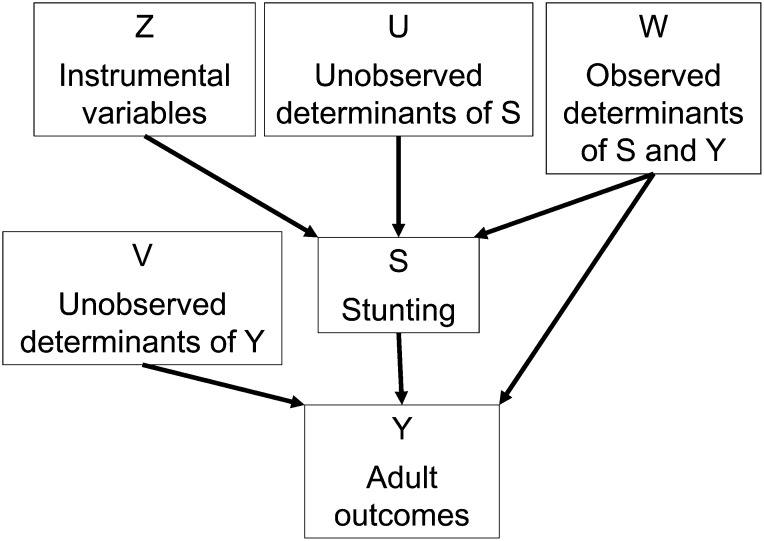

 where W is a vector of observed determinants that affect both S and Y directly, Z is a vector of instrumental variables, and U and V represent all remaining unobserved determinants that directly affect S and Y, respectively. If U is correlated with V, the ordinary least-squares estimate of β2 from Equation 2 on its own will be biased because S would be correlated with V. In addition to the true effect of S on Y, the estimate of β2 would include the correlated effect of the unobserved determinants, or confounders, in V. The correlation between U and V would be present, eg, if unobserved parental preferences or community services that affected S in early life also directly affected Y in later life. In instrumental variable estimates, S in Equation 2 is replaced by the predicted value of S from Equation 1. Under the following 2 assumptions, the instrumental variable estimate of β2 will be asymptotically unbiased: 1) Z is sufficiently strongly associated with S, and 2) Z affects Y only through S (ie, Z is independent of V). The first assumption is verifiable in the data. Tests for the second assumption are available when there are multiple instruments in Z (called overidentification tests).
References
-
- Black ER, Victoria C, Walker S, Bhutta Z, Christian P, De Onis M, Ezzati M, Grantham-McGregor S, Katz J, Martorell R, et al. Maternal and child undernutrition and overweight in low-income and middle-income countries. Lancet 2013;382:427–51. - PubMed
-
- Victora CG, de Onis M, Hallal PC, Blössner M, Shrimpton R. Worldwide timing of growth faltering: revisiting implications for interventions. Pediatrics 2010;125:e473–80. - PubMed
-
- Adair LS, Fall CH, Osmond C, Stein AD, Martorell R, Ramirez-Zea M, Sachdev HS, Dahly DL, Bas I, Norris SA, et al. Associations of linear growth and relative weight gain during early life with adult health and human capital in countries of low and middle income countries: findings from five birth cohort studies. Lancet 2013;382:525ndash34. - PMC - PubMed
Publication types
MeSH terms
Grants and funding
LinkOut - more resources
Full Text Sources
Other Literature Sources
Medical
