


CDC's Emergency Management Program activities - worldwide, 2003-2012
- PMID: 24005225
- PMCID: PMC4585622
CDC's Emergency Management Program activities - worldwide, 2003-2012
Abstract
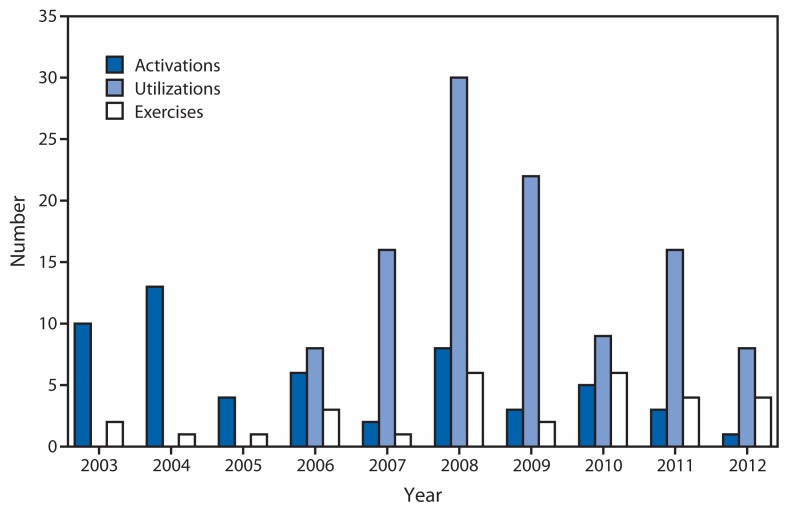
In 2003, recognizing the increasing frequency and complexity of disease outbreaks and disasters and a greater risk for terrorism, CDC established the Emergency Operations Center (EOC), bringing together CDC staff members who respond to public health emergencies to enhance communication and coordination. To complement the physical EOC environment, CDC implemented the Incident Management System (IMS), a staffing structure and set of standard operational protocols and services to support and monitor CDC program-led responses to complex public health emergencies. The EOC and IMS are key components of CDC's Emergency Management Program (EMP), which applies emergency management principles to public health practice. To enumerate activities conducted by the EMP during 2003-2012, CDC analyzed data from daily reports and activity logs. The results of this analysis determined that, during 2003-2012, the EMP fully activated the EOC and IMS on 55 occasions to support responses to infectious disease outbreaks, natural disasters, national security events (e.g., conventions, presidential addresses, and international summits), mass gatherings (e.g., large sports and social events), and man-made disasters. On 109 other occasions, the EMP was used to support emergency responses that did not require full EOC activation, and the EMP also conducted 30 exercises and drills. This report provides an overview of those 194 EMP activities.
Figures

References
-
- CDC. Office of Public Health Preparedness and Response: Division of Emergency Operations. Atlanta, GA: US Department of Health and Human Services, CDC; 2013. Available at http://ophpr.cdc.gov/deo/default.asp.
-
- CDC. Emergency preparedness and response Office of Public Health Preparedness and Response: CDC Emergency Operations Center. Atlanta, GA: US Department of Health and Human Services, CDC; 2013. Available at http://www.cdc.gov/phpr/eoc.htm.
-
- CDC. Emergency management program framework document. Atlanta, GA: US Department of Health and Human Services, CDC; 2013.
Publication types
MeSH terms
LinkOut - more resources
Full Text Sources
Medical
