


Interventions for the management of dry mouth: non-pharmacological interventions
- PMID: 24006231
- PMCID: PMC7100870
- DOI: 10.1002/14651858.CD009603.pub3
Interventions for the management of dry mouth: non-pharmacological interventions
Abstract
Background: Xerostomia is the subjective sensation of dry mouth. Common causes of xerostomia include adverse effects of many commonly prescribed medications, disease (e.g. Sjogren's Syndrome) and radiotherapy treatment for head and neck cancers. Non-pharmacological techniques such as acupuncture or mild electrostimulation may be used to improve symptoms.
Objectives: To assess the effects of non-pharmacological interventions administered to stimulate saliva production for the relief of dry mouth.
Search methods: We searched the Cochrane Oral Health Group's Trials Register (to 16th April 2013), the Cochrane Central Register of Controlled Trials (CENTRAL) (The Cochrane Library 2013, Issue 3), MEDLINE via OVID (1948 to 16th April 2013), EMBASE via OVID (1980 to 16th April 2013), AMED via OVID (1985 to 16th April 2013), CINAHL via EBSCO (1981 to 16th April 2013), and CANCERLIT via PubMed (1950 to 16th April 2013). The metaRegister of Controlled Clinical Trials (www.controlled-trials.com) and ClinicalTrials.gov (www.clinicaltrials.gov) were also searched to identify ongoing and completed trials. References lists of included studies and relevant reviews were also searched. There were no restrictions on the language of publication or publication status.
Selection criteria: We included parallel group randomised controlled trials of non-pharmacological interventions to treat dry mouth, where participants had dry mouth symptoms at baseline.
Data collection and analysis: At least two review authors assessed each of the included studies to confirm eligibility, assess risk of bias and extract data using a piloted data extraction form. We calculated mean difference (MD) and 95% confidence intervals (CI) for continuous outcomes or where different scales were used to assess an outcome, we calculated standardised mean differences (SMD) together with 95% CIs. We attempted to extract data on adverse effects of interventions. Where data were missing or unclear we attempted to contact study authors to obtain further information.
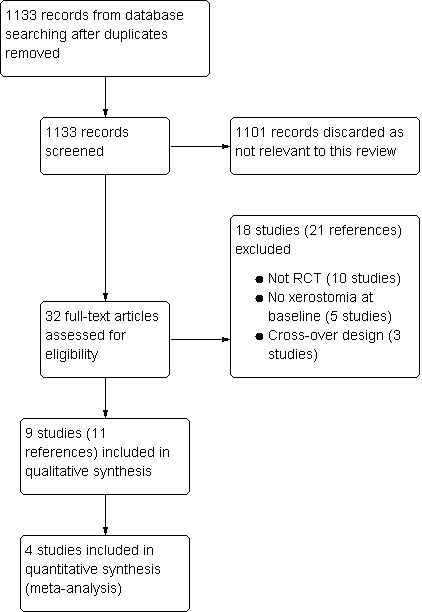
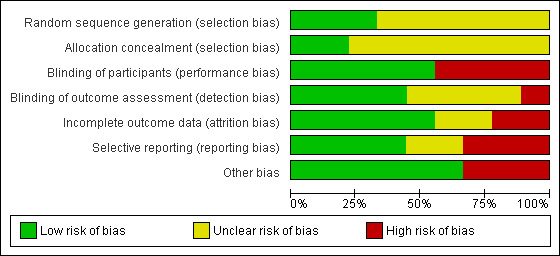
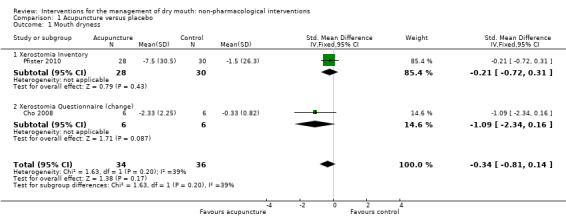
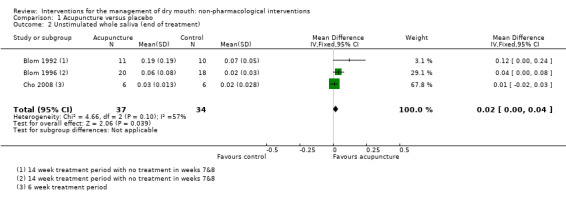
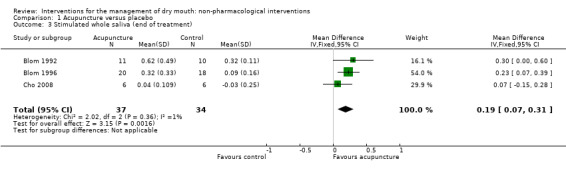
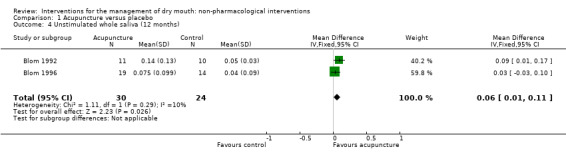
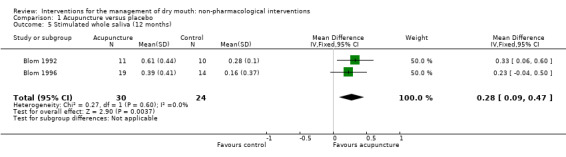
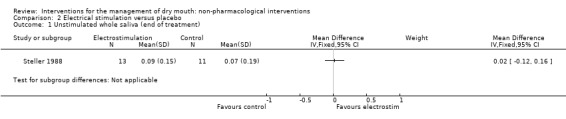
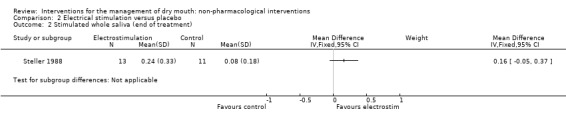
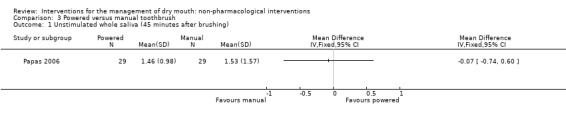
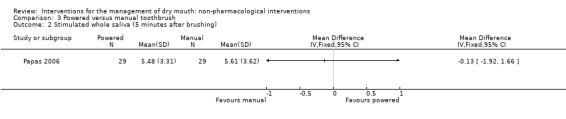
Main results: There were nine studies (total 366 participants randomised) included in this review of non-pharmacological interventions for dry mouth which were divided into three comparisons. Eight studies were assessed at high risk of bias in at least one domain and the remaining study was at unclear risk of bias.Five small studies (total 153 participants, with dry mouth following radiotherapy treatment) compared acupuncture with placebo. Four were assessed at high risk and one at unclear risk of bias. Two trials reported outcome data for dry mouth in a form suitable for meta-analysis. The pooled estimate of these two trials (70 participants, low quality evidence) showed no difference between acupuncture and control in dry mouth symptoms (SMD -0.34, 95% CI -0.81 to 0.14, P value 0.17, I(2) = 39%) with the confidence intervals including both a possible reduction or a possible increase in dry mouth symptoms. Acupuncture was associated with more adverse effects (tiny bruises and tiredness which were mild and temporary). There was a very small increase in unstimulated whole saliva (UWS) at the end of 4 to 6 weeks of treatment (three trials, 71 participants, low quality evidence) (MD 0.02 ml/minute, 95% CI 0 to 0.04, P value 0.04, I(2) = 57%), and this benefit persisted at the 12-month follow-up evaluation (two trials, 54 participants, low quality evidence) (UWS, MD 0.06 ml/minute, 95% CI 0.01 to 0.11, P value 0.03, I(2) = 10%). For the outcome of stimulated whole saliva (SWS, three trials, 71 participants, low quality evidence) there was a benefit favouring acupuncture (MD 0.19 ml/minute, 95% CI 0.07 to 0.31, P value 0.002, I(2) = 1%) an effect which also persisted at the 12-month follow-up evaluation (SWS MD 0.28 ml/minute, 95% CI 0.09 to 0.47, P value 0.004, I(2) = 0%) (two trials, 54 participants, low quality evidence).Two small studies, both at high risk of bias, compared the use of an electrostimulation device with a placebo device in participants with Sjögren's Syndrome (total 101 participants). A further study, also at high risk of bias, compared acupuncture-like electrostimulation of different sets of points in participants who had previously been treated with radiotherapy. None of these studies reported the outcome of dry mouth. There was no difference between electrostimulation and placebo in the outcomes of UWS or SWS at the end of the 4-week treatment period in the one study (very low that provided data for these outcomes. No adverse effects were reported.A single study at high risk of bias, compared the stimulatory effect of powered versus manual toothbrushing and found no difference for the outcomes of UWS or SWS.
Authors' conclusions: There is low quality evidence that acupuncture is no different from placebo acupuncture with regard to dry mouth symptoms, which is the most important outcome. This may be because there were insufficient participants included in the two trials to show a possible effect or it may be that there was some benefit due to 'placebo' acupuncture which could have biased the effect to the null. There is insufficient evidence to determine the effects of electrostimulation devices on dry mouth symptoms. It is well known that dry mouth symptoms may be problematic even when saliva production is increased, yet only two of the trials that evaluated acupuncture reported dry mouth symptoms, a worrying reporting bias. There is some low quality evidence that acupuncture results in a small increase in saliva production in patients with dry mouth following radiotherapy.There is insufficient evidence to determine the effects of electrostimulation devices on dry mouth symptoms or saliva production in patients with Sjögren's Syndrome. Reported adverse effects of acupuncture are mild and of short duration, and there were no reported adverse effects from electrostimulation.
Conflict of interest statement
Gemma Bryan: no interests to declare. Sue Furness: no interests to declare. Helen Worthington: no interests to declare. Roddy McMillan: no interests to declare. Sarah Birchenough: no interests to declare.
Figures

Update of
-
Interventions for the management of dry mouth: non-pharmacological interventions.Cochrane Database Syst Rev. 2013 Aug 30;(8):CD009603. doi: 10.1002/14651858.CD009603.pub2. Cochrane Database Syst Rev. 2013. Update in: Cochrane Database Syst Rev. 2013 Sep 05;(9):CD009603. doi: 10.1002/14651858.CD009603.pub3. PMID: 23996155 Updated.
References
References to studies included in this review
Blom 1992 {published data only}
-
- Blom M, Dawidson I, Angmar‐Månsson B. The effect of acupuncture on salivary flow rates in patients with xerostomia. Oral Surgery, Oral Medicine, and Oral Pathology 1992;73(3):293‐8. - PubMed
Blom 1996 {published data only}
-
- Blom M, Dawidson I, Angmar‐Månsson B, Johnson G. Effect of acupuncture on salivary flow in subjects with radiation‐induced xerostomia. Caries Research 1993;27:225.
-
- Blom M, Dawidson I, Fernberg JO, Johnson G, Angmar‐Månsson B. Acupuncture treatment of patients with radiation‐induced xerostomia. Oral Oncology, European Journal of Cancer 1996;32B(3):182‐90. - PubMed
Cho 2008 {published data only}
-
- Cho JH, Chung WK, Kang W, Choi SM, Cho CK, Son CG. Manual acupuncture improved quality of life in cancer patients with radiation‐induced xerostomia. The Journal of Alternative and Complementary Medicine 2008;14(5):523‐6. - PubMed
List 1998 {published data only}
-
- List T, Lundeberg T, Lundström I, Lindström F, Ravald N. The effect of acupuncture in the treatment of patients with primary Sjögren's syndrome. Acta Odontologica Scandinavica 1998;56:95‐9. - PubMed
Papas 2006 {published data only}
-
- Papas A, Singh M, Harrington D, Rodriguez S, Ortblad K, Jager M, et al. Stimulation of salivary flow with powered toothbrush in a xerostomic population. Special Care Dentistry 2006;26(6):241‐6. - PubMed
Pfister 2010 {published data only}
Steller 1988 {published data only}
-
- Steller M, Chou L, Daniels TE. Electrical stimulation of salivary flow in patients with Sjögren's Syndrome. Journal of Dental Research 1988;67:1334‐7. - PubMed
Talal 1992 {published data only}
-
- Talal N, Quinn JH, Daniels TE. The clinical effects of electrostimulation on salivary function of Sjögren's syndrome patients: a placebo controlled trial. Rheumatology International 1992;12:43‐5. - PubMed
Wong 2003 {published data only}
-
- Wong R, Sagar S, Whelan T, Foster G, Farges‐Babjak A, Willan A, et al. The use of acupuncture‐like transcutaneous nerve stimulation (CODETRON) in the treatment of radiation‐induced xerostomia in head and neck cancer patients treated with radical radiotherapy. International Journal of Radiation, Oncology, Biology, and Physics 2011;51:2351. - PubMed
-
- Wong RKW, Jones GW, Sagar SM, Babjak A‐F, Whelan T. A phase I‐II study in the use of acupuncture‐like transcutaneous nerve stimulation in the treatment of radiation‐induced xerostomia in head‐and‐neck cancer patients treated with radical radiotherapy. International Journal of Radiation, Oncology, Biology and Physics 2003;57(2):472‐80. - PubMed
References to studies excluded from this review
Blom 2000 {published data only}
-
- Blom M, Lundeberg T. Long‐term follow‐up of patients treated with acupuncture for xerostomia and the influence of additional treatment. Oral Diseases 2000;6(1):15‐24. [PUBMED: 10673783] - PubMed
Braga 2011 {published data only}
-
- Braga FP, Lemos Junior CA, Alves FA, Migliari DA. Acupuncture for the prevention of radiation‐induced xerostomia in patients with head and neck cancer. Brazilian Oral Research 2011;25(2):180‐5. [PUBMED: 21537645] - PubMed
-
- Braga FPF, Migliari DA. Acupuncture for prevention of radiation‐induced xerostomia. Oral Diseases 2010;16(6):539 (Abs No 104).
Cheville 2006 {published data only}
-
- Cheville AM, Basford JR. Home based acupuncture: a study in xerostomia. Focus on Alternative and Complementary Therapies 2006;11(Suppl 1):10‐1.
Deng 2008 {published data only}
Fontanesi 1991 {published data only}
-
- Fontanesi J, Golden EB, Ciani P. Hyperbaric oxygen therapy can reverse radiation‐Induced xerostomia. Journal of Hyperbaric Medicine 1991;6(3):215‐21.
Garcia 2009 {published data only}
-
- Garcia MK, Chiang JS, Cohen L, Liu M, Palmer JL, Rosenthal DI, et al. Acupuncture for radiation‐induced xerostomia in patients with cancer: a pilot study. Head & Neck 2009;31(10):1360‐8. [PUBMED: 19378325] - PubMed
Loncar 2011 {published data only}
-
- Loncar B, Stipetic MM, Baricevic M, Risovic D. The effect of low‐level laser therapy on salivary glands in patients with xerostomia. Photomedicine and Laser Surgery 2011;29(3):171‐5. [PUBMED: 21054200] - PubMed
Meng 2012 {published data only}
Niemtzow 2007 {published data only}
-
- Niemtzow vonR. Rapid acupuncture treatment for severe dry mouth secondary to radiotherapy, chemotherapy and surgery for head and neck cancer patients [Schnell wirksame akupunktur bei schwerer mundtrockenheit nach bestrahlung, chemotherapie und operation bei kopf und hals carcinomen]. Schmerz und Akupunktur 2007;3:118‐22.
Schiff 2009 {published data only}
-
- Schiff E, Mogilner JG, Sella E, Doweck I, Hershko O, Ben‐Arye E, et al. Hypnosis for postradiation xerostomia in head and neck cancer patients: a pilot study. Journal of Pain and Symptom Management 2009;37(6):1086‐92.e1. [PUBMED: 19186028] - PubMed
Simcock 2009 {published data only}
-
- Simcock R, Fallowfield L, Jenkins V. Group acupuncture to relieve radiation induced xerostomia: a feasibility study. Acupuncture in Medicine: Journal of the British Medical Acupuncture Society 2009;27(3):109‐13. [PUBMED: 19734380] - PubMed
Simcock 2013 {published data only}
-
- Simcock R, Fallowfield L, Monson K, Ivonne ST, Parlour L, Langridge CI, et al. ARIX: A randomized trial of acupuncture versus oral care sessions in patients with chronic radiation‐induced xerostomia following treatment for head and neck cancer. Journal of Clinical Oncology 2012;30(Suppl):Abstract No 5527.
-
- Simcock R, Fallowfield L, Monson K, Solis‐Trapala I, Parlour L, Langridge C, et al. ARIX: a randomised trial of acupuncture v oral care sessions in patients with chronic xerostomia following treatment of head and neck cancer. Annals of Oncology 2013;24(3):776‐83. - PubMed
Simoes 2010 {published data only}
-
- Simoes A, Campos L, Souza DN, Matos JA, Freitas PM, Nicolau J. Laser phototherapy as topical prophylaxis against radiation induced xerostomia. Photomedicine and Laser Surgery 2010;28(3):357‐63. - PubMed
Strietzel 2007 {published data only}
-
- Strietzel FP, Martin‐Granizo R, Fedele S, Lo Russo L, Mignogna M, Reichart PA, et al. Electrostimulating device in the management of xerostomia. Oral Diseases 2007;13(2):206‐13. [PUBMED: 17305624] - PubMed
Strietzel 2011 {published data only}
-
- Alajbeg I, Falcao DP, Tran SD, Martin‐Granizo R, Lafaurie GI, Matranga D, et al. Intraoral electrostimulator for xerostomia relief: a long‐term, multicenter, open‐label, uncontrolled, clinical trial. Oral Surgery, Oral Medicine, Oral Pathology and Oral Radiology 2012;113(6):773‐81. [PUBMED: 22668705] - PubMed
-
- Strietzel FP, Lafaurie GI, Bautista Mendoza GR, Alajbeg I, Pejda S, Vuletić Mantilla R, et al. Efficacy and safety of an intraoral electrostimulation device for xerostomia relief: a multicenter, randomized trial. Arthritis and Rheumatism 2011;63(1):180‐90. - PubMed
Weiss 1986 {published data only}
-
- Weiss WW Jr, Brenman HS, Katz P, Bennett JA. Use of an electronic stimulator for the treatment of dry mouth. Journal of Oral and Maxillofacial Surgery 1986;44(11):845‐50. [PUBMED: 3490558] - PubMed
Wong 2010 {published data only}
-
- Wong RK, Sagar SM, Chen BJ, Yi GY, Cook R. Phase II randomized trial of acupuncture‐like transcutaneous electrical nerve stimulation to prevent radiation‐induced xerostomia in head and neck cancer patients. Journal of the Society for Integrative Oncology 2010;8(2):35‐42. [PUBMED: 20388444] - PubMed
Wong 2012 {published data only}
-
- Wong RK, James JL, Sagar S, Wyatt G, Nguyen‐Tan PF, Singh AK, et al. Phase 2 results from Radiation Therapy Oncology Group Study 0537: a phase 2/3 study comparing acupuncture‐like transcutaneous electrical nerve stimulation versus pilocarpine in treating early radiation‐induced xerostomia. Cancer 2012;118(17):4244‐52. - PMC - PubMed
References to ongoing studies
NCT01141231 {published data only}
-
- MD Anderson Cancer Center. Acupuncture in treating dry mouth caused by radiation therapy in patients with head and neck cancer. Available from ClinicalTrials.gov.
Additional references
Cohen 1988
-
- Cohen J. Statistical Power Analysis for the Behavioural Sciences. 2nd Edition. Hillsdale, New Jersey: Lawrence Erlbaum Associates, 1988.
CONSORT 2010
Davies 2007
Egger 1997
Enger 2011
-
- Enger TB, Palm Ø, Garen T, Sandvik L, Jensen JL. Oral distress in primary Sjögren's syndrome: implications for health‐related quality of life. European Journal of Oral Sciences 2011;119(6):474‐80. - PubMed
Fedele 2008
-
- Fedele S, Wolff A, Strietzel F, Lopez RM, Porter SR, Konttinen YT. Neuroelectrostimulation in treatment of hyposalivation and xerostomia in Sjogren's syndrome: a salivary pacemaker. Journal of Rheumatology 2008;35(8):1489‐94. - PubMed
Femiano 2008
-
- Femiano F, Lanza A, Buonaiuto C, Gombos F, Rullo R, Festa V, et al. Oral manifestations of adverse drug reactions: guidelines. Journal of the European Academy of Dermatology and Venereology 2008;22:681‐91. - PubMed
Furness 2011
Garcia 2013
Hackett 2012
-
- Hackett KL, Newton JL, Frith J, Elliott C, Lendrem D, Foggo H, et al. Impaired functional status in primary Sjögren's syndrome. Arthritis Care & Research 2012;64(11):1760‐4. - PubMed
Higgins 2011
-
- Higgins JPT, Green S (editors). Cochrane Handbook for Systematic Reviews of Interventions version 5.1.0 (updated March 2011). The Cochrane Collaboration, 2011. Available from www.cochrane‐handbook.org.
Hopcraft 2010
-
- Hopcraft MS, Tan C. Xerostomia: an update for clinicians. Australian Dental Journal 2010;55(3):238‐44. - PubMed
Lončar 2011
-
- Lončar B, Stipetić MM, Baričević M, Risović D. The effect of low‐level laser therapy on salivary glands in patients with xerostomia. Photomedicine and Laser Surgery 2011;29(3):171‐5. - PubMed
Ma 2009
Mese 2007
-
- Mese H, Matsuo R. Salivary secretion, taste and hyposalivation. Journal of Oral Rehabilitation 2007;34(10):711‐23. - PubMed
Napenas 2009
-
- Napenas JJ, Brennan MT, Fox PC. Diagnosis and treatment of xerostomia (dry mouth). Odontology 2009;97(2):76‐83. - PubMed
O'Sullivan 2010
-
- O'Sullivan EM, Higginson IJ. Clincial effectiveness and safety of acupuncture in the treatment of irradiation‐induced xerostomia in patients with head and neck cancer: a systematic review. Acupuncture in Medicine 2010;28(4):191‐9. - PubMed
Porter 2004
-
- Porter SR, Scully C, Hegarty AM. An update of the etiology and management of xerostomia. Oral Surgery, Oral Medicine, Oral Pathology, Oral Radiology, and Endodontics 2004;97(1):28‐46. - PubMed
Porter 2010
-
- Porter SR, Fedele S, Habbab KM. Xerostomia in head and neck malignancy. Oral Oncology 2010;46(6):460‐3. - PubMed
Proctor 2007
-
- Proctor GB, Carpenter GH. Regulation of salivary gland function by autonomic nerves. Autonomic Neuroscience: Basic and Clinical 2007;133:3‐18. - PubMed
Scully 2004
-
- Scully C, Bagan JV. Adverse drug reactions in the orofacial region. Critical Reviews in Oral Biology and Medicine 2004;15(4):221‐39. - PubMed
Shiboski 2007
-
- Shiboski CH, Hodgson TA, Ship JA, Schiødt M. Management of salivary hypofunction during and after radiotherapy. Oral Surgery, Oral Medicine, Oral Pathology, Oral Radiology, and Endodontology 2007;103(Supp 66):e1‐19. - PubMed
SPIRIT 2013
Tavender 2004
Thomson 2005
-
- Thomson WM. Issues in the epidemiological investigation of dry mouth. Gerodontology 2005;22(2):65‐76. - PubMed
Thomson 2007
-
- Thomson WM. Measuring change in dry‐mouth symptoms over time using the Xerostomia Inventory. Gerodontology 2007;24(1):30‐5. - PubMed
Tobón 2012
Visvanathan 2010
-
- Visvanathan V, Nix P. Managing the patient presenting with xerostomia: a review. International Journal of Clinical Practice 2010;64(3):404‐7. - PubMed
Wolff 2012
-
- Wolff A, Fox PC, Porter S, Konttinen YT. Established and novel approaches for the management of hyposalivation and xerostomia. Current Pharmaceutical Design 2012;18(34):5515‐21. [PUBMED: 22632391] - PubMed
Zhuang 2013
-
- Zhuang L, Yang Z, Zeng X, Zhua X, Chen Z, Liu L, et al. The preventive and therapeutic effect of acupuncture for radiation‐induced xerostomia in patients with head and neck cancer: a systematic review. Integrative Cancer Therapies 2013;12(3):197‐205. - PubMed
Publication types
MeSH terms
LinkOut - more resources
Full Text Sources
Other Literature Sources
Medical
Miscellaneous
