Review
. 2013 Sep 4;5(9):2106-15.
doi: 10.3390/v5092106.

Varicella zoster virus (VZV)-human neuron interaction

Affiliations
Review

Varicella zoster virus (VZV)-human neuron interaction

Nicholas L Baird et al. Viruses. .

Abstract

Varicella zoster virus (VZV) is a highly neurotropic, exclusively human herpesvirus. Primary infection causes varicella (chickenpox), wherein VZV replicates in multiple organs, particularly the skin. Widespread infection in vivo is confirmed by the ability of VZV to kill tissue culture cells in vitro derived from any organ. After varicella, VZV becomes latent in ganglionic neurons along the entire neuraxis. During latency, virus DNA replication stops, transcription is restricted, and no progeny virions are produced, indicating a unique virus-cell (neuron) relationship. VZV reactivation produces zoster (shingles), often complicated by serious neurological and ocular disorders. The molecular trigger(s) for reactivation, and thus the identity of a potential target to prevent it, remains unknown due to an incomplete understanding of the VZV-neuron interaction. While no in vitro system has yet recapitulated the findings in latently infected ganglia, recent studies show that VZV infection of human neurons in SCID mice and of human stem cells, including induced human pluripotent stem cells and normal human neural progenitor tissue-like assemblies, can be established in the absence of a cytopathic effect. Usefulness of these systems in discovering the mechanisms underlying reactivation awaits analyses of VZV-infected, highly pure (>90%), terminally differentiated human neurons capable of prolonged survival in vitro.


Figures
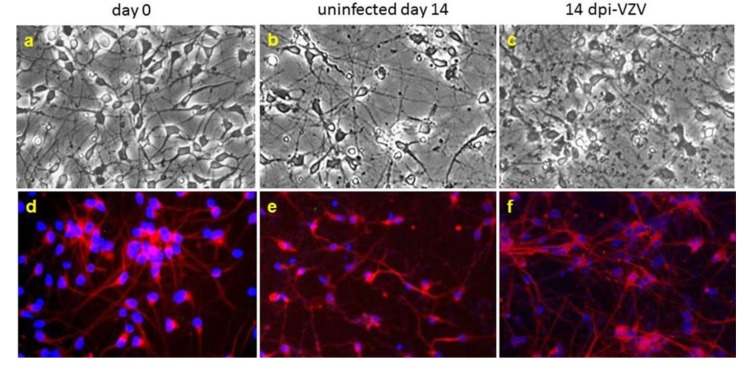
Figure 1
Figure 1
Varicella zoster virus (VZV) infection of highly pure human neurons does not produce a cytopathic effect (CPE). Phase-contrast microscopy of terminally differentiated neurons maintained in tissue culture for up to 21 days showed healthy-appearing neurons on day 0 (a) and day 14 in culture (b) as well as 14 days after VZV infection (c). Immunofluorescence staining (df) with anti-βIII-tubulin antibody revealed positive staining for the neuronal marker (red). Nuclei stained blue with DAPI. Copied and modified with permission from J. Neurovirol [33].
Figure 2
Figure 2
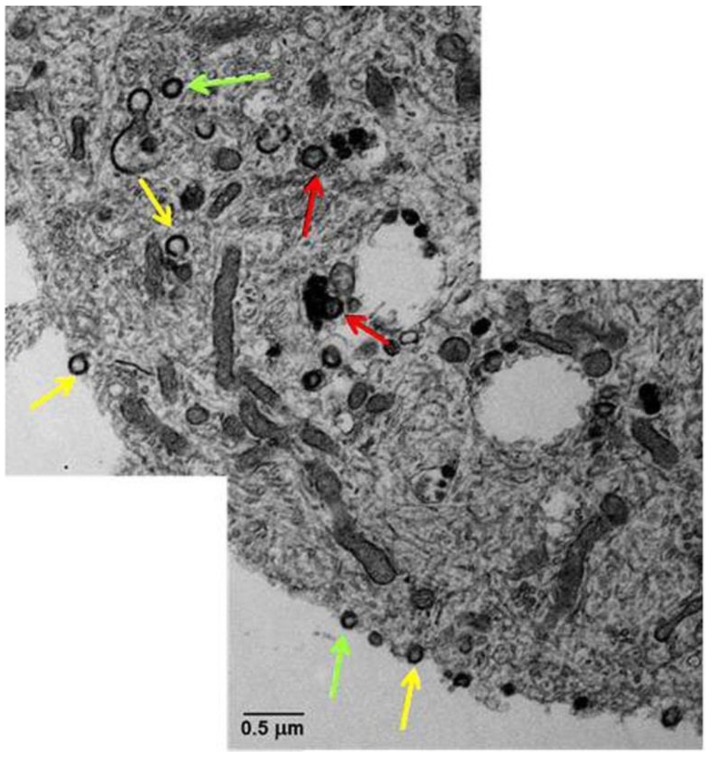
Transmission electron microscopy of VZV-infected human neurons derived from induced pluripotent stem cells. A montage of the cytoplasm and cell surface of a VZV-infected neuron showed viral particles without capsids and viral DNA (yellow arrows), viral particles with capsids but not viral DNA (green arrows), and complete viral particles with capsid and DNA (red arrows). Copied and modified with permission from J. Virol [34].
Figure 3
Figure 3
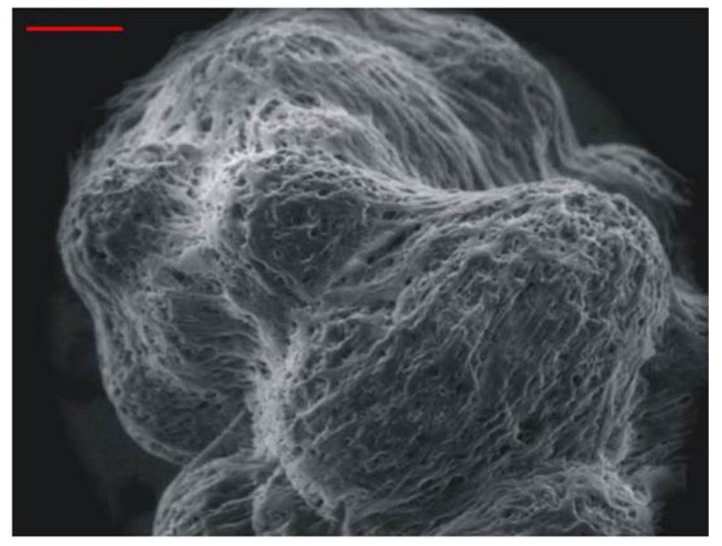
Scanning electron microscopy of 3-dimensional tissue-like assemblies of normal human neuronal progenitor cells maintained for 6 months in suspension. Note the indistinguishable nature of individual cells. Cells assemble around the spherical support matrix, and multiple cell-coated matrixes fuse to form tissue-like assemblies. Bar = 100 mm. Image copied with permission from PLoS Pathogens [35].

References

    1. Gilden D.H., Cohrs R.J., Mahalingam R. Clinical and molecular pathogenesis of varicella virus infection. Viral Immunol. 2003;16:243–258. doi: 10.1089/088282403322396073. - DOI - PubMed
    1. Gilden D.H., Gesser R., Smith J., Wellish M., Laguardia J.J., Cohrs R.J., Mahalingam R. Presence of VZV and HSV-1 DNA in human nodose and celiac ganglia. Virus Genes. 2001;23:145–147. doi: 10.1023/A:1011883919058. - DOI - PubMed
    1. Gilden D.H., Vafai A., Shtram Y., Becker Y., Devlin M., Wellish M. Varicella-zoster virus DNA in human sensory ganglia. Nature. 1983;306:478–480. doi: 10.1038/306478a0. - DOI - PubMed
    1. Hyman R.W., Ecker J.R., Tenser R.B. Varicella-zoster virus RNA in human trigeminal ganglia. Lancet. 1983;2:814–816. doi: 10.1016/S0140-6736(83)90736-5. - DOI - PubMed
    1. Azarkh Y., Gilden D., Cohrs R.J. Molecular characterization of varicella zoster virus in latently infected human ganglia: Physical state and abundance of VZV DNA, quantitation of viral transcripts and detection of VZV-specific proteins. Curr. Top. Microbiol. Immunol. 2010;342:229–241. doi: 10.1007/82_2009_2. - DOI - PMC - PubMed

Publication types

LinkOut - more resources