. 2013 Oct 15;109(8):2217-27.
doi: 10.1038/bjc.2013.536. Epub 2013 Sep 5.

Members of the EpCAM signalling pathway are expressed in gastric cancer tissue and are correlated with patient prognosis

Affiliations

Members of the EpCAM signalling pathway are expressed in gastric cancer tissue and are correlated with patient prognosis

V S Warneke et al. Br J Cancer. .

Abstract

Background: We investigated the expression of members of the epithelial cell adhesion molecule (EpCAM) signalling pathway in gastric cancer (GC) testing the following hypotheses: are these molecules expressed in GC and are they putatively involved in GC biology.

Methods: The study cohort consisted of 482 patients. The following members of the EpCAM signalling pathway were analysed by immunohistochemistry and were correlated with various clinico-pathological patient characteristics: extracellular domain of EpCAM (EpEX), intracellular domain of EpCAM (EpICD), E-cadherin, β-catenin, presenilin-2 (PSEN2), and ADAM17.

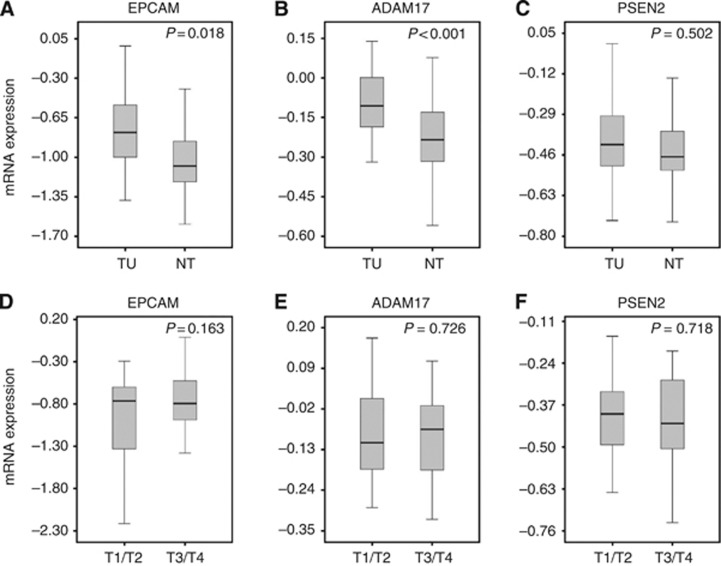
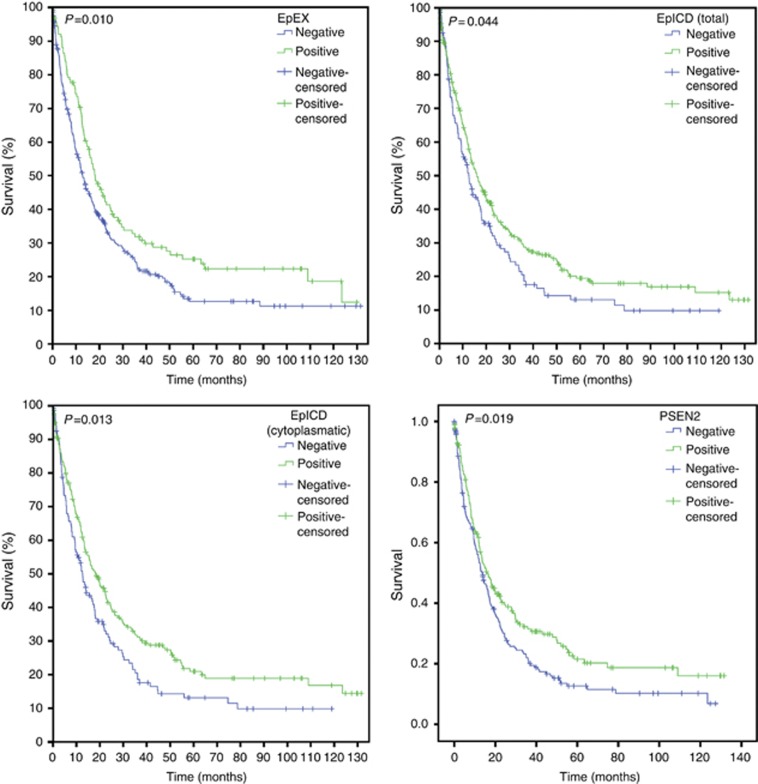
Results: All members of the EpCAM signalling pathway were differentially expressed in GC. The expression correlated significantly with tumour type (EpEX, EpICD, E-cadherin, β-catenin, and PSEN2), mucin phenotype (EpEX, EpICD, β-catenin, and ADAM17), T-category (EpEX, E-cadherin, and β-catenin), N-category (EpEX and β-catenin), UICC tumour stage (EpEX, EpICD, β-catenin, and PSEN2), tumour grade (EpEX, EpICD, E-cadherin, β-catenin, and PSEN2), and patients' survival (EpEX, EpICD, and PSEN2). A significant coincidental expression in GC was found for EpEX, EpICD, E-cadherin, β-catenin, PSEN2, and ADAM17. Decreased immunodetection of EpEX in locally advanced GC was not associated with decreased EpCAM mRNA levels.

Conclusion: All members of the EpCAM signalling pathway are expressed in GC. The expression correlated significantly with each other and with various clinico-pathological patient characteristics, including patients' survival. Thus, the EpCAM signalling pathway is a highly interesting putative therapeutic target in GC.


Figures

Figure 1
Figure 1
EpCAM and WNT signalling pathways. A regulated intramembrane proteolysis (RIP) involves shedding of the ectodomain EpEX and nuclear translocation of the intracellular domain EpICD. Cleavage of EpCAM is sequentially catalysed by ADAM17 and PSEN2. Released EpICD associates with FHL2, β-catenin, and Lef-1 to form a nuclear protein complex, leading to gene transcription (modified from Maetzel et al (2009)).
Figure 2
Figure 2
EPCAM, ADAM17, and PSEN2 expression in gastric tissue measured by real-time RT-PCR. Boxplots depicting mRNA levels of EPCAM (A and D; in 42 patients), ADAM17 (B and E; in 53 patients), and PSEN2 (C and F; in 54 patients). The upper panel depicts mRNA expression of EPCAM (A), ADAM17 (B), and PSEN2 (C) comparing malignant (TU) versus adjacent non-malignant (NT) gastric tissue. P-values were calculated with a paired two-sided Student's t-test. The lower panel shows mRNA expression of EPCAM (D), ADAM17 (E), and PSEN2 (F) comparing grouped T-categories. P-values were calculated with an unpaired two-sided Student's t-test.
Figure 3
Figure 3
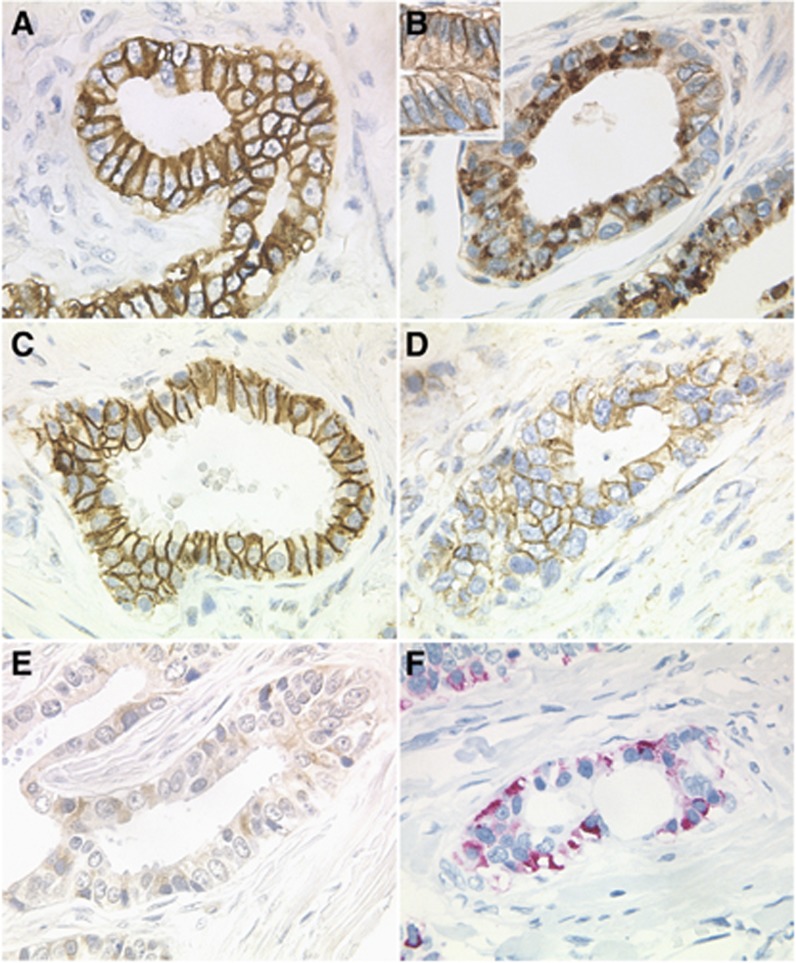
Detection of members of the EpCAM signalling pathway in GC tissue by immunohistochemistry. The expression of members of the EpCAM signalling pathway were explored by immunostaining using antibodies directed against EpEX (A), EpICD (B), β-catenin, (C) E-cadherin (D), PSEN2 (E), and ADAM17 (F). Note the membranous immunoreactions of EpEX (A), β-catenin (C), and E-cadherin (D), and the cytoplasmic immunoreactions of EpICD (B), PSEN2 (E), and ADAM17 (F). All pictures were taken from the same intestinal-type GC of a 47-year-old male patient. The insert in B illustrates membranous immunolabelling of EpICD in an intestinal-type GC of a different patient. Original magnifications, 600-fold.
Figure 4
Figure 4
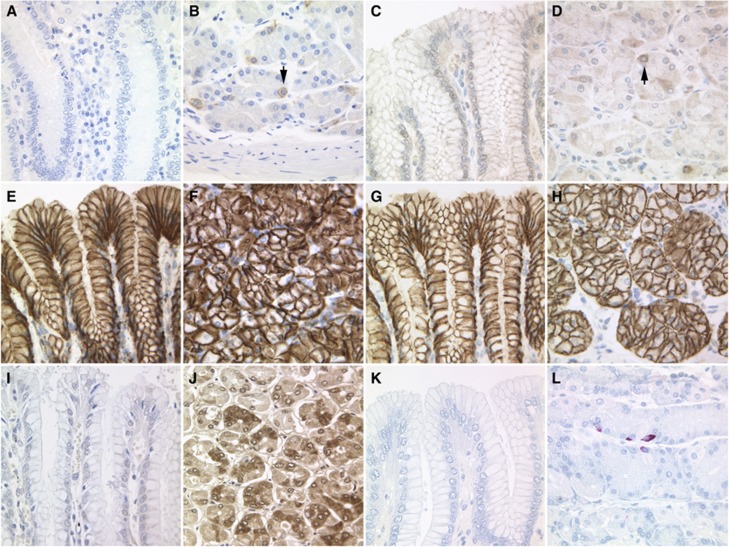
Detection of members of the EpCAM signalling pathway in non-neoplastic gastric mucosa by immunohistochemistry. The expression of members of the EpCAM signalling pathway were explored by immunostaining using antibodies directed against EpEX (A and B), EpICD (C and D), β-catenin (E and F), E-cadherin (G and H), PSEN2 (I and J), and ADAM17 (K and L). Note that EpEX, EpICD and ADAM17 were expressed only in few scattered cells of the gastric glands (B, D, and L; arrows) and absent in the foveolar epithelium (A, C, and K). β-catenin (E and F), and E-cadherin (G and H) were ubiquitously expressed. Interestingly, strong immunostaining was found for PSEN2 in gastric glands (J) and was completely absent in the gastric foveolar epithelium (I). Original magnifications, 400-fold.
Figure 5
Figure 5
Patients' survival. Kaplan–Meier curves depicting patients' survival according to immunodetection of EpEX (all cases, P=0.010), EpICD-total (all cases; P=0.044), EpICD cytoplasmic (all cases, P=0.013), and PSEN2 (all cases, P=0.019).

References

    1. Alberts SR, Cervantes A, van de Velde CJ. Gastric cancer: epidemiology, pathology and treatment. Ann Oncol. 2003;14 (Suppl 2:ii31–ii36. - PubMed
    1. Baeuerle PA, Gires O. EpCAM (CD326) finding its role in cancer. Br J Cancer. 2007;96 (3:417–423. - PMC - PubMed
    1. Brunkan AL, Goate AM. Presenilin function and gamma-secretase activity. J Neurochem. 2005;93 (4:769–792. - PubMed
    1. Buhard O, Cattaneo F, Wong YF, Yim SF, Friedman E, Flejou JF, Duval A, Hamelin R. Multipopulation analysis of polymorphisms in five mononucleotide repeats used to determine the microsatellite instability status of human tumors. J Clin Oncol. 2006;24 (2:241–251. - PubMed
    1. Campbell WA, Iskandar MK, Reed ML, Xia W. Endoproteolysis of presenilin in vitro: inhibition by gamma-secretase inhibitors. Biochemistry. 2002;41 (10:3372–3379. - PubMed

Publication types

MeSH terms