. 2013 Dec;135(12):121006.
doi: 10.1115/1.4025324.

A numerical and experimental investigation of the effect of false vocal fold geometry on glottal flow

A numerical and experimental investigation of the effect of false vocal fold geometry on glottal flow

Mehrdad H Farahani et al. J Biomech Eng. 2013 Dec.

Abstract

The false vocal folds are hypothesized to affect the laryngeal flow during phonation. This hypothesis is tested both computationally and experimentally using rigid models of the human larynges. The computations are performed using an incompressible Navier-Stokes solver with a second order, sharp, immersed-boundary formulation, while the experiments are carried out in a wind tunnel with physiologic speeds and dimensions. The computational flow structures are compared with available glottal flow visualizations and are employed to study the vortex dynamics of the glottal flow. Furthermore, pressure data are collected on the surface of the laryngeal models experimentally and computationally. The investigation focuses on three geometric features: the size of the false vocal fold gap; the height between the true and false vocal folds; and the width of the laryngeal ventricle. It is shown that the false vocal fold gap has a significant effect on glottal flow aerodynamics, whereas the second and the third geometric parameters are of lesser importance. The link between pressure distribution on the surface of the larynx and false vocal fold geometry is discussed in the context of vortex evolution in the supraglottal region. It was found that the formation of the starting vortex considerably affects the pressure distribution on the surface of the larynx. The interaction of this vortex structure with false vocal folds creates rebound vortices in the laryngeal ventricle. In the cases of small false vocal fold gap, these rebound vortices are able to reach the true vocal folds during a time period comparable with one cycle of the phonation. Moreover, they can create complex vorticity patterns, which result in significant pressure fluctuations on the surface of the larynx.


Figures
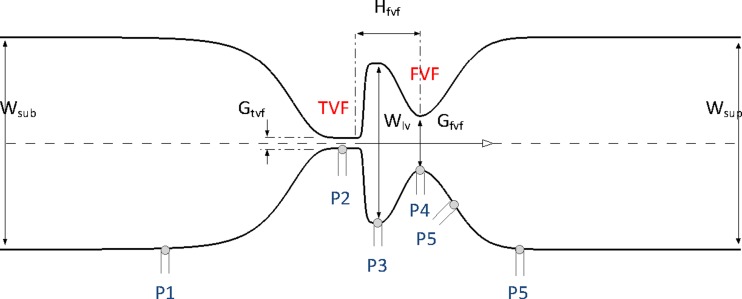
Fig. 1
Fig. 1
Schematic view of the laryngeal models, W sub = width of subglottal region, W sup = width of supraglottal region, WVL = width of ventricle of the larynx, Hfvf = height between FVFs and TVFs, Gtvf = TVF gap, Gfvf = FVF gap. Gtvf = 1 mm and W sub = W sup = 20 mm are constant for all models. The location of the pressure taps on the surface of the experimental models is shown in the lower side of the larynx.
Fig. 2
Fig. 2
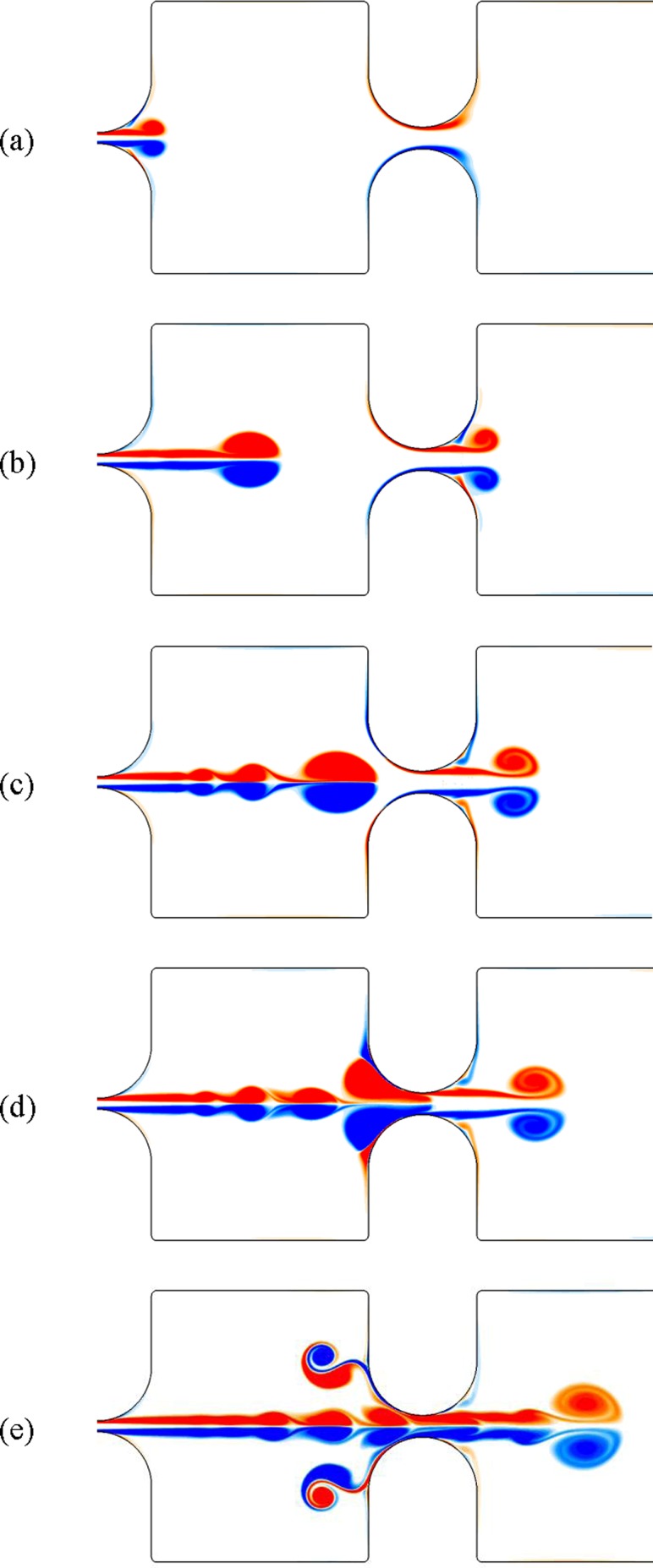
Vorticity contour of the air flow in a semilaryngeal structure at dimensional times of (a) 3.5 ms, (b) 5.8 ms, (c) 7.2 ms, (d) 7.8 ms, and (e) 9.5 ms. The size of first and second constriction gap was 0.04 and 0.08 cm, respectively.
Fig. 3
Fig. 3
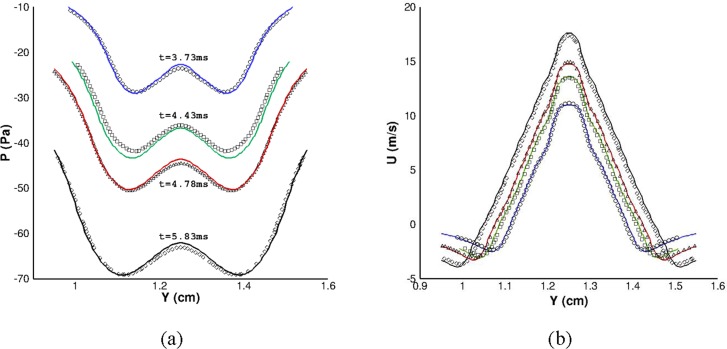
A comparison between the current computational solver (solid lines) with the result of Chisari et al. [16] (scattered symbols). (a) Pressure and (b) streamwise velocity profiles along the line that connect the starting vortex centroids at times of 3.73 ms (circles), 4.43 ms (squares), 4.78 ms (diamonds), and 5.83 ms (deltas).
Fig. 4
Fig. 4
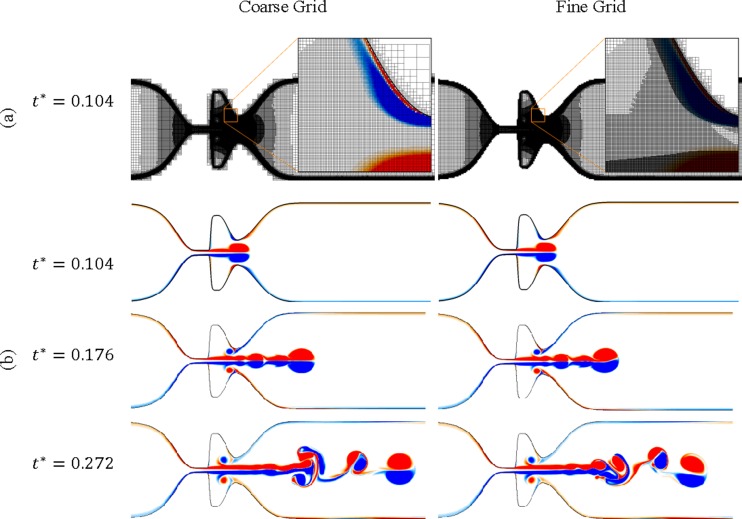
Grid refinement study: (a) comparison between the coarse and fine mesh. The Cartesian mesh interior to the solid that is not required for the ghost fluid treatment is pruned during the simulation for improved memory performance. (b) Comparison between the vorticity contours of the coarse and fine grid at t * = 0.104, 0.176, and 0.272, respectively.
Fig. 5
Fig. 5
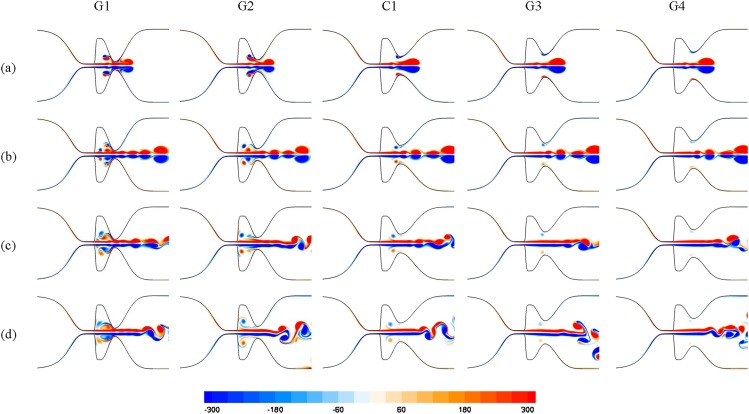
Nondimensional vorticity contours for the laryngeal models with different sizes of the Gfvf at nondimensional time (t *) of (a) 0.128, (b) 0.176, (c) 0.24, and (d) 0.304. The interaction between the starting vortex and the FVFs increases as the Gfvf decreases; hence, rebound vortices in the laryngeal ventricle of the models with narrow Gfvf are stronger.
Fig. 6
Fig. 6
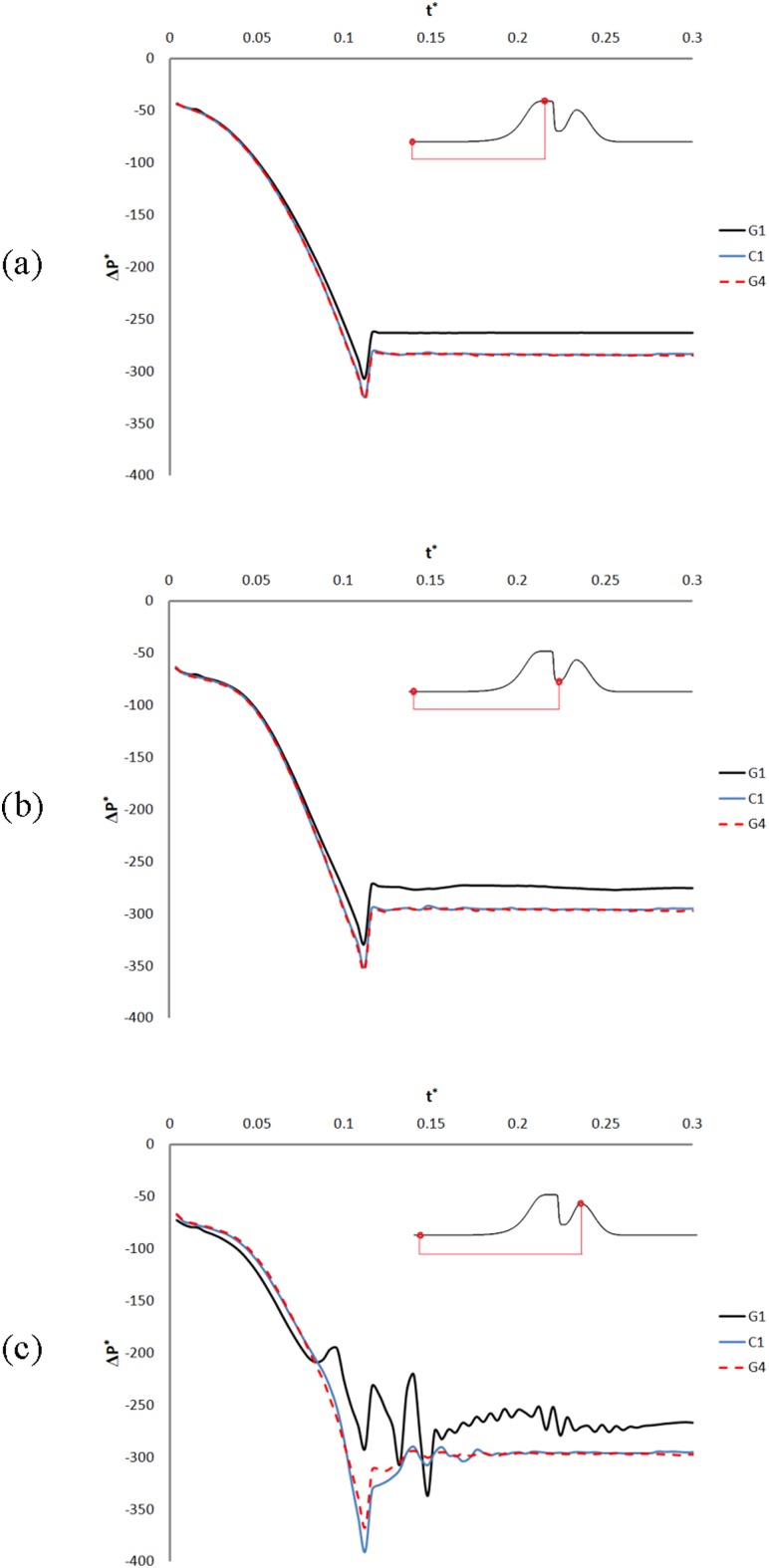
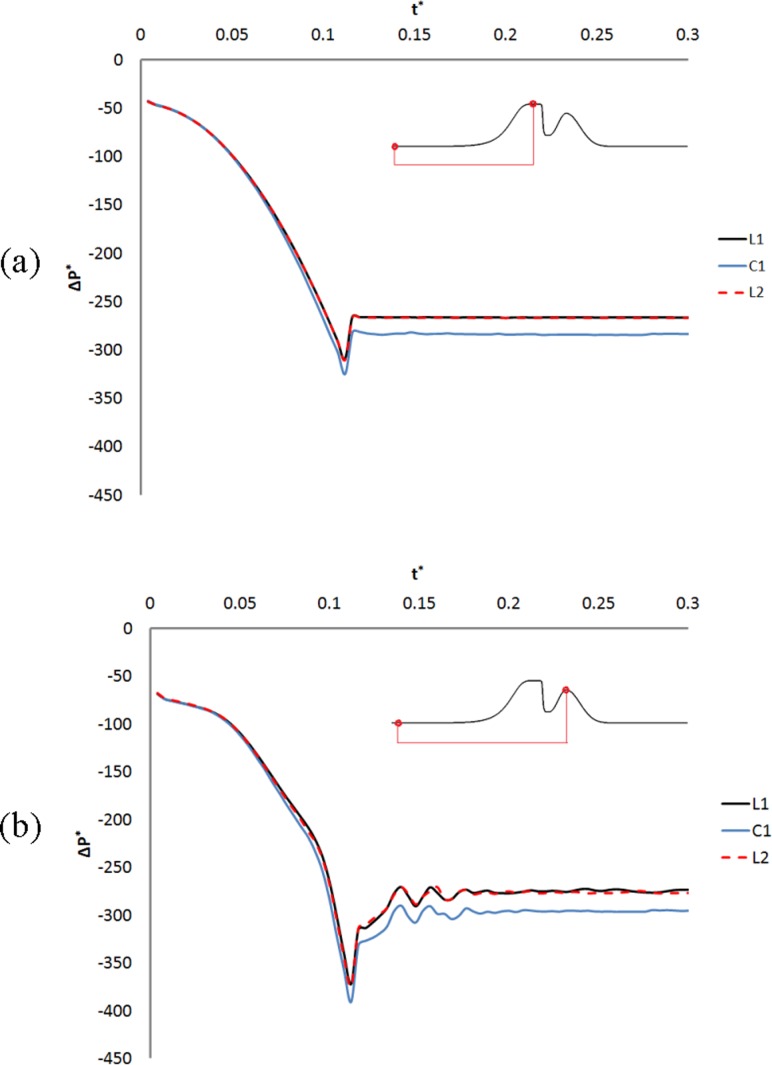
Nondimensional differential pressure (ΔP *) history on the surface of the TVFs (a), laryngeal ventricle (b), and FVFs (c) for models with different sizes of FVF gap. t * is the nondimensional time. The pressure initially drops as the starting vortex is created and convected in the laryngeal ventricle and then recovers partially for the rest of the simulation. Moreover, pressure data on the surface of the FVF fluctuate for the models with narrow Gfvf.
Fig. 7
Fig. 7
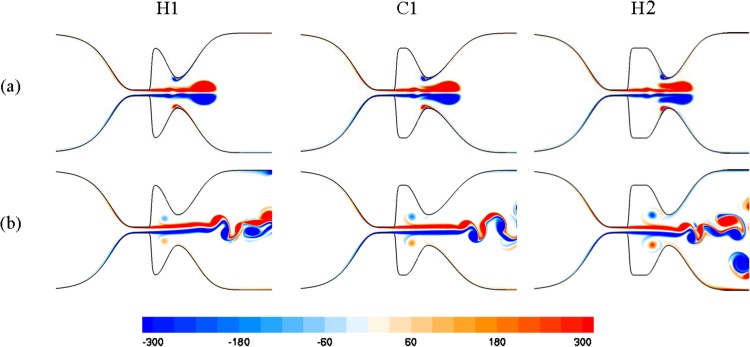
Nondimensional vorticity contours for the laryngeal models with different size of Hfvf at nondimensional time (t *) of (a) 0.128 and (b) 0.304, respectively
Fig. 8
Fig. 8
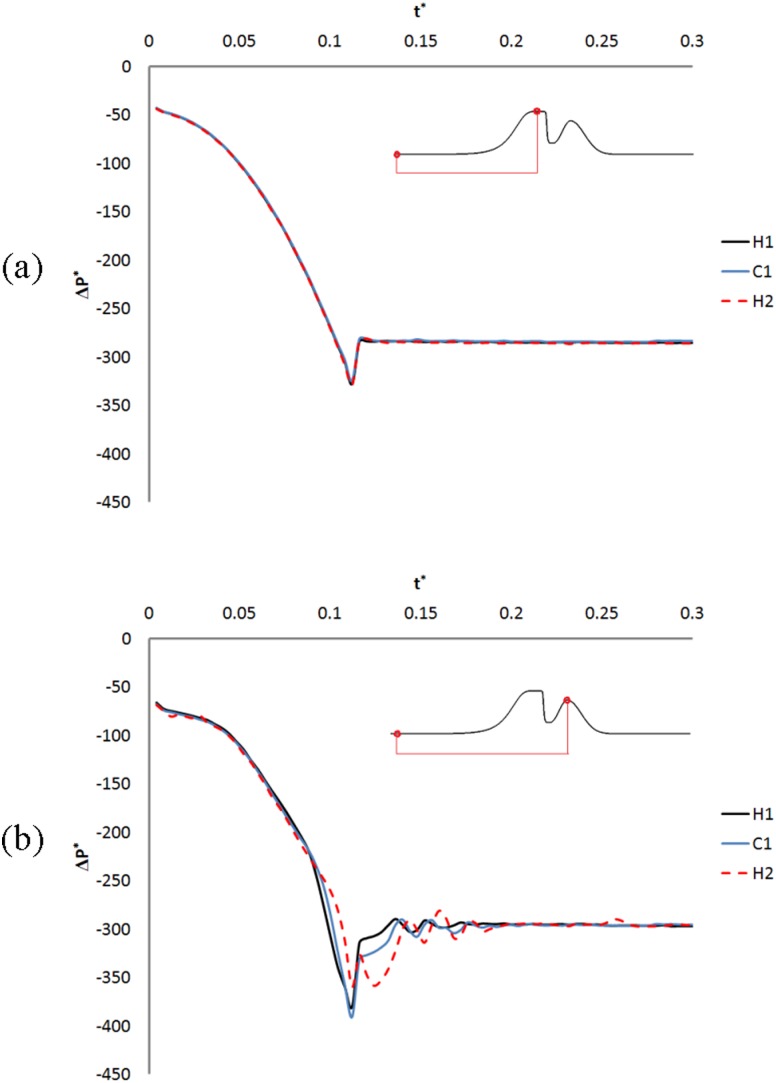
Nondimensional differential pressure (ΔP *) history on the surface of (a) TVFs and (b) FVFs for models with different sizes of Hfvf. t* is the nondimensional time. The plot of ΔP * on the surface of the laryngeal ventricle (plot omitted) is similar to ΔP * on the surface of the TVFs; however, its values after pressure recovery are close to the ΔP * on the surface of the FVFs.
Fig. 9
Fig. 9
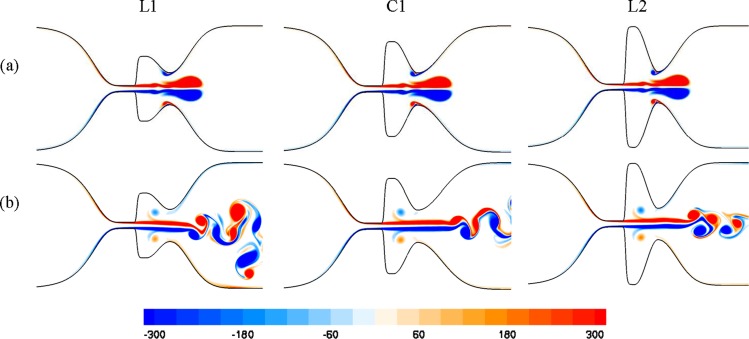
Nondimensional vorticity contours for the laryngeal models with different sizes of Wlv at nondimensional time (t *) of (a) 0.128 and (b) 0.304
Fig. 10
Fig. 10
Nondimensional differential pressure history on the surface of TVFs and FVFs for models with different sizes of Wlv

References

    1. Stager, S. , 2011, “The Role of the Supraglottic Area in Voice Production,” Otolaryngol., 2(S), pp. 1–7.
    1. Agarwal, M. , Scherer, R. C. , and Hollien, H. , 2003, “The False Vocal Folds: Shape and Size in Frontal View During Phonation Based on Laminagraphic Tracings,” J. Voice, 17(2), pp. 97–113.10.1016/S0892-1997(03)00012-2 - DOI - PubMed
    1. Chan, R. W. , Fu, M. , and Tirunagari, N. , 2006, “Elasticity of the Human False Vocal Fold,” Ann. Otol. Rhinol. Laryngol., 115(5), pp. 370–381. - PubMed
    1. Haji, T. , Mori, K. , Omori, K. , and Isshiki, N. , 1992, “Mechanical-Properties of the Vocal Fold -Stress-Strain Studies,” Acta Oto-Laryngol., 112(3), pp. 559–565.10.3109/00016489209137440 - DOI - PubMed
    1. Fuks, L. , Hammarberg, B. , and Sundberg, J. , 1998, “A Self-Sustained Vocal-Ventricular Phonation Mode: Acoustical, Aerodynamic and Glottographic Evidences,” KTH TMH-QPSR, 3, pp. 49–59.